
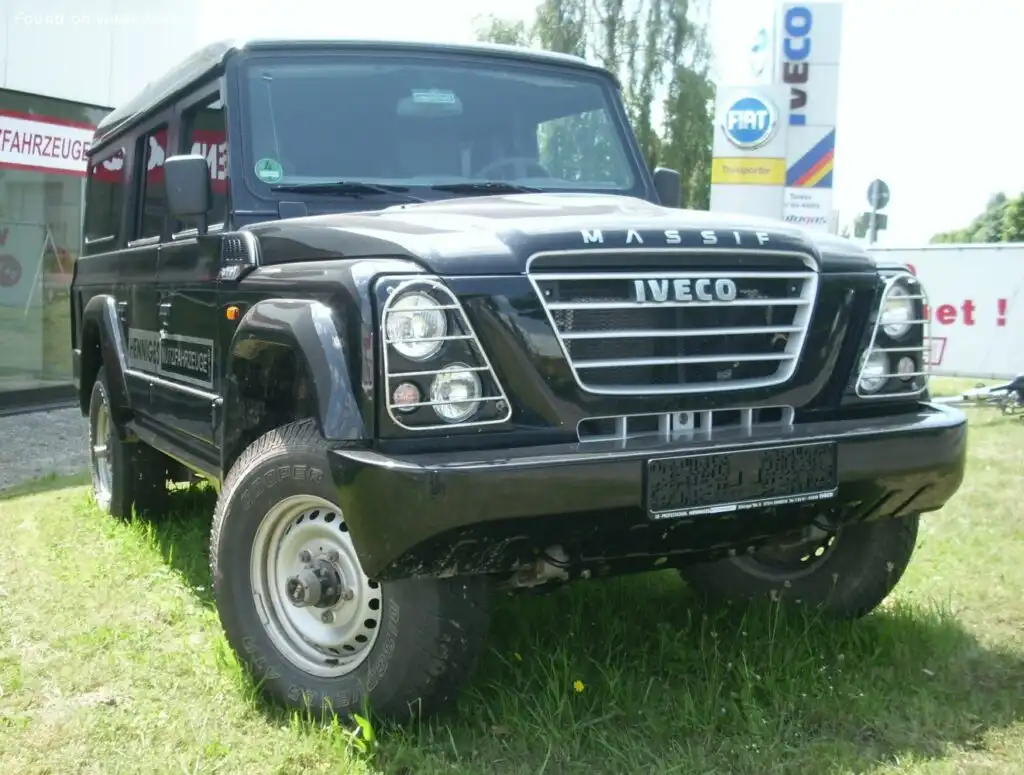
The Iveco Massif 4×4 3.0 HPT, produced from 2008 to 2011, represents a unique entry in the off-road vehicle segment. Developed by Iveco, a commercial vehicle manufacturer, the Massif was intended to fill a niche between traditional pickup trucks and more utilitarian 4x4s. It was primarily marketed in Europe and other international markets, offering a blend of commercial robustness and limited passenger comfort. The 3.0 HPT variant, equipped with a 3.0-liter turbocharged diesel engine producing 146 horsepower, was a key offering within the Massif lineup, positioned as a balance between capability and fuel efficiency.
Technical Specifications
| Brand | Iveco |
| Model | Massif 4×4 |
| Generation | Massif 4×4 |
| Type (Engine) | 3.0 HPT (146 Hp) |
| Start of production | 2008 |
| End of production | 2011 |
| Powertrain Architecture | Internal Combustion engine |
| Body type | Off-road vehicle |
| Seats | 5 |
| Doors | 5 |
| Fuel consumption (urban) | 11.4 l/100 km (20.6 US mpg) |
| Fuel consumption (extra urban) | 9.9 l/100 km (23.8 US mpg) |
| Fuel consumption (combined) | 10.4 l/100 km (22.6 US mpg) |
| Fuel Type | Diesel |
| Maximum speed | 140 km/h (86.99 mph) |
| Weight-to-power ratio | 14.7 kg/Hp (68.2 Hp/tonne) |
| Weight-to-torque ratio | 6.1 kg/Nm (163.6 Nm/tonne) |
| Power | 146 Hp @ 3000 rpm |
| Torque | 350 Nm @ 2000 rpm (258.15 lb.-ft. @ 2000 rpm) |
| Engine layout | Front, Longitudinal |
| Engine Model/Code | F1C HPI |
| Fuel injection system | Diesel Commonrail |
| Engine aspiration | Turbocharger, Intercooler |
| Engine oil capacity | 7.6 l (8.03 US qt | 6.69 UK qt) |
| Coolant capacity | 9 l (9.51 US qt | 7.92 UK qt) |
| Kerb Weight | 2140 kg (4717.89 lbs) |
| Max. weight | 3050 kg (6724.1 lbs) |
| Max load | 910 kg (2006.21 lbs) |
| Fuel tank capacity | 100 l (26.42 US gal | 22 UK gal) |
| Length | 4720 mm (185.83 in) |
| Width | 1750 mm (68.9 in) |
| Height | 2050 mm (80.71 in) |
| Wheelbase | 2768 mm (108.98 in) |
| Drive wheel | All wheel drive (4×4) |
| Number of gears and type of gearbox | 6 gears, manual transmission |
| Front suspension | Leaf spring |
| Rear suspension | Leaf spring |
| Front brakes | Disc |
| Rear brakes | Disc |
| Tires size | 235/85 R16 |
Powertrain & Engine Architecture
The heart of the Massif 3.0 HPT is the F1C HPI 3.0-liter diesel engine. This engine is a four-cylinder, longitudinal configuration, utilizing a common rail direct injection system. The turbocharger with intercooler significantly boosts power output, allowing for 146 horsepower at 3000 rpm and a substantial 350 Nm (258 lb-ft) of torque at 2000 rpm. This torque figure is particularly important for off-road applications, providing strong low-end pulling power. The engine’s architecture is relatively simple, favoring durability and ease of maintenance over outright refinement. The Massif 3.0 HPT was exclusively offered with a six-speed manual transmission, chosen for its robustness and driver control in challenging terrain. The transmission’s gear ratios are geared towards maximizing torque delivery, rather than achieving high-speed acceleration.
Driving Characteristics
The Iveco Massif 3.0 HPT delivers a driving experience focused on capability rather than comfort. The leaf spring suspension, while contributing to a robust chassis, results in a firm ride, especially when unladen. The 3.0-liter engine provides adequate power for most situations, but it’s not a particularly quick vehicle. Acceleration is moderate, and the engine’s peak power is relatively high in the rev range for a diesel. The six-speed manual transmission allows the driver to keep the engine in its optimal power band, but requires frequent shifting. Compared to potential higher-output versions (which were not widely available), the 146 hp variant prioritized fuel economy and longevity. The 4×4 system, with selectable four-wheel drive and low range, provides excellent traction in off-road conditions.
Equipment & Trim Levels
The Iveco Massif 4×4 was not offered with a wide range of trim levels. It was largely conceived as a utilitarian vehicle, and as such, the standard equipment reflected this. Basic features included air conditioning, power windows, and central locking. Interior upholstery was typically durable, hard-wearing cloth. Optional extras were limited, often including items like a winch, upgraded tires, and a basic audio system. The dashboard layout is functional but spartan, prioritizing practicality over aesthetics. The focus was on providing a durable and reliable vehicle capable of handling demanding tasks, rather than offering luxury features.
Chassis & Braking
The Massif’s chassis is a ladder-frame construction, providing exceptional strength and rigidity. This is essential for off-road durability and load-carrying capacity. The front and rear suspension both utilize leaf springs, contributing to the vehicle’s robust nature but also its firm ride. Braking is provided by disc brakes on all four wheels, offering adequate stopping power for the vehicle’s weight. However, the braking system is not particularly sophisticated, lacking features like ABS in some markets. The 235/85 R16 tires are designed for off-road use, providing good traction on various surfaces. The vehicle’s relatively high ground clearance further enhances its off-road capability.
Market Reception & Comparison
The Iveco Massif 4×4 received mixed reviews. Critics generally praised its robust construction, off-road capability, and durable powertrain. However, it was often criticized for its harsh ride, basic interior, and lack of refinement. Compared to other vehicles in its class, such as the Land Rover Defender or Toyota Land Cruiser, the Massif offered a more affordable entry point but lacked the same level of sophistication and brand prestige. Its fuel economy, around 22.6 US mpg combined, was reasonable for a vehicle of its size and capability. Reliability was generally good, owing to the simplicity of the engine and drivetrain, but parts availability could be an issue in some regions.
Legacy
The Iveco Massif 4×4, while not a commercial success in the mainstream market, has gained a following among enthusiasts who appreciate its ruggedness and simplicity. The 3.0 HPT engine, while not known for being particularly high-tech, has proven to be relatively reliable over the long term. On the used car market, Massifs are typically priced affordably, making them an attractive option for those seeking a capable and durable off-road vehicle. However, potential buyers should be aware of the vehicle’s limited refinement and potential challenges with parts availability. The Massif represents a unique chapter in automotive history, showcasing Iveco’s foray into the consumer 4×4 market with a vehicle built for work and adventure.
