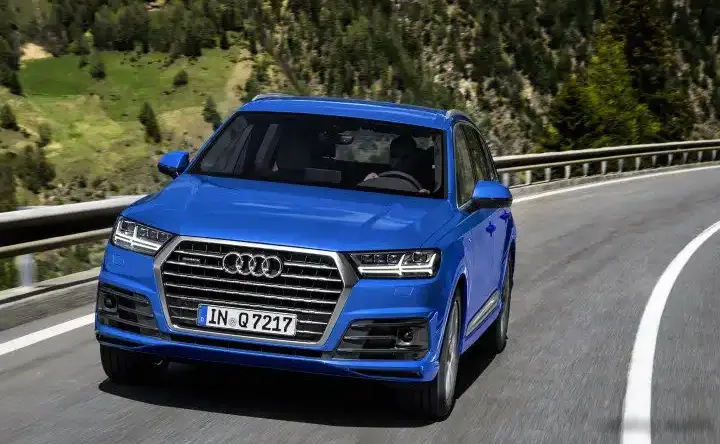
The Audi Q7 (Typ 4M) 3.0 TFSI V6 quattro tiptronic represents a significant iteration of Audi’s popular luxury SUV, produced from January 2015 through 2019. This variant, powered by a supercharged 3.0-liter V6 engine paired with an eight-speed automatic transmission and Audi’s quattro all-wheel-drive system, occupied a key position in the Q7 lineup, offering a balance of performance, luxury, and technology. It was positioned as a mid-to-upper range offering, slotting above the base 2.0 TFSI models and below the performance-oriented SQ7. The Typ 4M generation marked a substantial shift for the Q7, moving to the MLB Evo platform, resulting in significant weight reduction and improved efficiency compared to its predecessor.
Technical Specifications
| Brand | Audi |
| Model | Q7 |
| Generation | Q7 (Typ 4M) |
| Type (Engine) | 3.0 TFSI V6 (333 Hp) quattro tiptronic |
| Start of production | January, 2015 |
| End of production | 2019 |
| Powertrain Architecture | Internal Combustion engine |
| Body type | SUV |
| Seats | 5 |
| Doors | 5 |
| Fuel consumption (urban) | 9.4-10 l/100 km (25 – 23.5 US mpg) |
| Fuel consumption (extra urban) | 6.8-7.3 l/100 km (34.6 – 32.2 US mpg) |
| Fuel consumption (combined) | 7.7-8.3 l/100 km (30.5 – 28.3 US mpg) |
| CO2 emissions | 179-193 g/km |
| Fuel Type | Petrol (Gasoline) |
| Acceleration 0 – 100 km/h | 6.1 sec |
| Acceleration 0 – 62 mph | 6.1 sec |
| Acceleration 0 – 60 mph | 5.8 sec |
| Maximum speed | 250 km/h (155.34 mph) |
| Emission standard | Euro 6 |
| Weight-to-power ratio | 5.9 kg/Hp, 169 Hp/tonne |
| Weight-to-torque ratio | 4.5 kg/Nm, 223.4 Nm/tonne |
| Power | 333 Hp @ 5500-6500 rpm |
| Power per litre | 111.2 Hp/l |
| Torque | 440 Nm @ 2900-5300 rpm (324.53 lb.-ft. @ 2900-5300 rpm) |
| Engine layout | Front, Longitudinal |
| Engine Model/Code | EA837 evo / CREC |
| Engine displacement | 2995 cm3 (182.77 cu. in.) |
| Number of cylinders | 6 |
| Engine configuration | V-engine |
| Cylinder Bore | 84.5 mm (3.33 in.) |
| Piston Stroke | 89 mm (3.5 in.) |
| Compression ratio | 10.8:1 |
| Number of valves per cylinder | 4 |
| Fuel injection system | Direct injection and Multi-port manifold injection |
| Engine aspiration | Supercharger, Intercooler |
| Valvetrain | DOHC |
| Engine oil capacity | 6.8 l (7.19 US qt | 5.98 UK qt) |
| Coolant | 13.2 l (13.95 US qt | 11.61 UK qt) |
| Kerb Weight | 1970 kg (4343.11 lbs.) |
| Max. weight | 2740 kg (6040.67 lbs.) |
| Max load | 770 kg (1697.56 lbs.) |
| Trunk (boot) space – minimum | 890 l (31.43 cu. ft.) |
| Trunk (boot) space – maximum | 2075 l (73.28 cu. ft.) |
| Fuel tank capacity | 85 l (22.45 US gal | 18.7 UK gal) |
| Max. roof load | 100 kg (220.46 lbs.) |
| Permitted trailer load with brakes (8%) | 2700 kg (5952.48 lbs.) |
| Permitted trailer load with brakes (12%) | 2700 kg (5952.48 lbs.) |
| Permitted trailer load without brakes | 750 kg (1653.47 lbs.) |
| Permitted towbar download | 115 kg (253.53 lbs.) |
| Length | 5052 mm (198.9 in.) |
| Width | 1968 mm (77.48 in.) |
| Width including mirrors | 2212 mm (87.09 in.) |
| Height | 1741 mm (68.54 in.) |
| Wheelbase | 2994 mm (117.87 in.) |
| Front track | 1679 mm (66.1 in.) |
| Rear (Back) track | 1691 mm (66.57 in.) |
| Front overhang | 978 mm (38.5 in.) |
| Rear overhang | 1080 mm (42.52 in.) |
| Drag coefficient (Cd) | 0.32 |
| Minimum turning circle (turning diameter) | 12.4 m (40.68 ft.) |
| Drivetrain Architecture | The Internal combustion engine (ICE) drives permanently the four wheels of the vehicle. |
| Drive wheel | All wheel drive (4×4) |
| Number of gears and type of gearbox | 8 gears, automatic transmission tiptronic |
| Front suspension | Independent multi-link suspension, Transverse stabilizer, Air Suspension – Optional |
| Rear suspension | Independent multi-link suspension, Transverse stabilizer, Air Suspension – Optional |
| Front brakes | Ventilated discs |
| Rear brakes | Ventilated discs |
| Assisting systems | ABS (Anti-lock braking system) |
| Steering type | Steering rack and pinion |
| Power steering | Electric Steering |
| Tires size | 255/60 R18; 255/55 R19; 255/50 R20 |
| Wheel rims size | 8J x 18; 8J x 19; 8J x 20 |
Powertrain & Engine Architecture
At the heart of the Q7 3.0 TFSI lies the EA837 evo engine, a 2,995 cc (182.77 cu. in.) naturally aspirated V6. This engine utilizes a fourth-generation Roots-type supercharger, providing instant boost and eliminating turbo lag. Direct injection and multi-point fuel injection work in concert to optimize combustion efficiency and power delivery. The engine produces 333 horsepower at 5,500-6,500 rpm and 440 Nm (324.53 lb-ft) of torque between 2,900 and 5,300 rpm. The eight-speed tiptronic automatic transmission, a staple of Audi’s quattro models, provides smooth and responsive gear changes. It features a torque converter for smooth low-speed operation and manual shift capability for driver control. The quattro all-wheel-drive system employs a self-locking center differential, distributing torque between the front and rear axles as needed, enhancing traction and stability.
Driving Characteristics
The 3.0 TFSI powertrain delivers a refined and capable driving experience. The supercharger provides immediate throttle response, making the Q7 feel surprisingly agile for its size. Acceleration from 0 to 60 mph takes approximately 5.8 seconds. The eight-speed transmission is well-tuned, offering seamless shifts and keeping the engine in its optimal power band. Compared to the base 2.0 TFSI, the 3.0 TFSI offers significantly more power and a more relaxed cruising experience. While not as overtly sporty as the SQ7, the 3.0 TFSI provides ample power for everyday driving and confident highway passing. The quattro system inspires confidence in all weather conditions, providing excellent grip and stability.
Equipment & Trim Levels
The Q7 3.0 TFSI typically came well-equipped, featuring standard amenities such as leather upholstery, tri-zone automatic climate control, a panoramic sunroof, and Audi’s MMI infotainment system with a 7-inch display. Optional extras included a Bang & Olufsen sound system, adaptive cruise control, a head-up display, and a rear-seat entertainment system. Trim levels varied by market, but generally included Premium, Premium Plus, and Prestige. Higher trims added features like ventilated front seats, a power-adjustable steering wheel, and advanced driver-assistance systems.
Chassis & Braking
The Typ 4M Q7 utilizes a lightweight MLB Evo platform, contributing to its improved handling and efficiency. The suspension consists of independent multi-link setups at both the front and rear. Air suspension was available as an option, providing adjustable ride height and enhanced comfort. Braking duties are handled by ventilated discs on all four wheels, providing ample stopping power. The electronic stability control (ESC) system integrates with the ABS and traction control systems to maintain vehicle stability in challenging conditions.
Market Reception & Comparison
The Audi Q7 3.0 TFSI was generally well-received by automotive critics. It was praised for its refined powertrain, comfortable ride, and spacious interior. Fuel economy was considered reasonable for a vehicle of its size and performance, averaging around 28-30 mpg combined. Compared to rivals like the BMW X5 and Mercedes-Benz GLE, the Q7 offered a compelling blend of luxury, technology, and driving dynamics. The 3.0 TFSI offered a significant performance upgrade over the base 2.0 TFSI, justifying the price premium for many buyers. However, some critics noted that the Q7’s size could make it challenging to maneuver in tight urban environments.
Legacy
The Audi Q7 (Typ 4M) 3.0 TFSI has proven to be a reliable and durable vehicle. The EA837 evo engine is known for its longevity, and the eight-speed tiptronic transmission is generally robust. Common maintenance items include oil changes, brake pad replacements, and occasional sensor replacements. On the used car market, these Q7s hold their value relatively well, reflecting their reputation for quality and refinement. They remain a popular choice for buyers seeking a luxurious and capable SUV with a proven track record.