
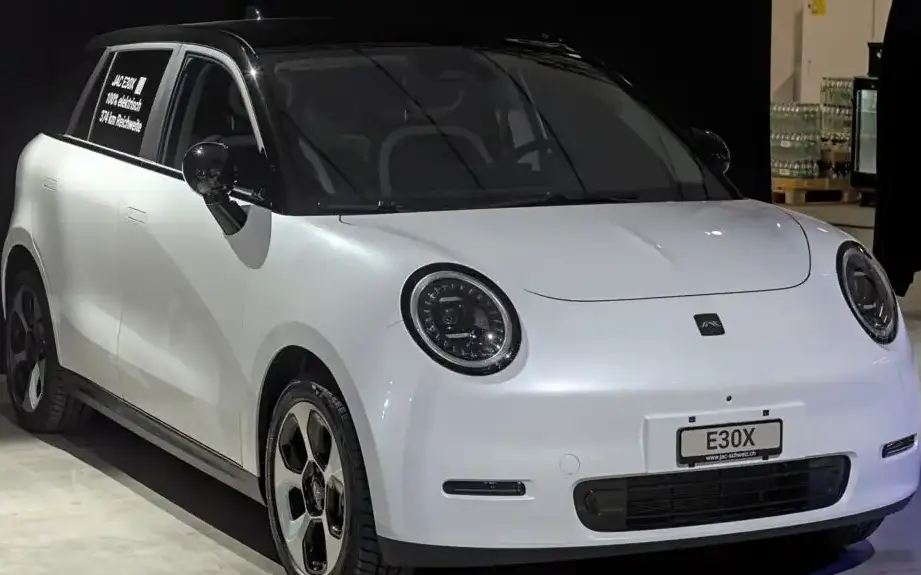
The JAC E30X 51.5 kWh is a battery electric vehicle (BEV) hatchback produced by the Anhui Jianghuai Automobile Group Co., Ltd. (JAC Motors) starting in 2023. Positioned as an entry-level electric vehicle, the E30X aims to provide affordable and practical transportation in the rapidly growing EV market, primarily targeting urban commuters. It represents JAC’s commitment to expanding its electric vehicle offerings and competing with other compact EVs available globally. The E30X is built on a dedicated electric vehicle platform, prioritizing space efficiency and battery integration.
Technical Specifications
| Brand | JAC |
| Model | E30X |
| Generation | E30X |
| Type (Engine) | 51.5 kWh (136 Hp) |
| Start of production | 2023 |
| Powertrain Architecture | BEV (Electric Vehicle) |
| Body type | Hatchback |
| Seats | 5 |
| Doors | 5 |
| Fuel Type | Electricity |
| Acceleration 0 – 100 km/h | 7.8 sec |
| Acceleration 0 – 62 mph | 7.8 sec |
| Acceleration 0 – 60 mph | 7.4 sec |
| Maximum speed | 150 km/h (93.21 mph) |
| 100 km/h – 0 | 37 m |
| Weight-to-power ratio | 10.6 kg/Hp, 94.1 Hp/tonne |
| Weight-to-torque ratio | 8.3 kg/Nm, 121.1 Nm/tonne |
| Gross battery capacity | 51.5 kWh |
| Battery technology | Lithium iron phosphate (LiFePO4) |
| Battery location | Below the floor |
| All-electric range (WLTP) | 374-400 km (232.39 – 248.55 mi) |
| All-electric range (CLTC) | 505 km (313.79 mi) |
| Average Energy consumption (WLTP) | 14.7-15.6 kWh/100 km (23.66 – 25.11 kWh/100 mi) |
| Average Energy consumption (CLTC) | 10 kWh/100 km (16.09 kWh/100 mi) |
| Electric motor power | 136 Hp |
| Electric motor Torque | 175 Nm (129.07 lb.-ft.) |
| Electric motor location | Front axle, Transverse |
| Electric motor type | Synchronous |
| System power | 136 Hp |
| System torque | 175 Nm (129.07 lb.-ft.) |
| Kerb Weight | 1445 kg (3185.68 lbs.) |
| Max. weight | 1820 kg (4012.41 lbs.) |
| Max load | 375 kg (826.73 lbs.) |
| Trunk (boot) space – minimum | 310 l (10.95 cu. ft.) |
| Length | 4025 mm (158.46 in.) |
| Width | 1770 mm (69.69 in.) |
| Height | 1560 mm (61.42 in.) |
| Wheelbase | 2620 mm (103.15 in.) |
| Minimum turning circle | 9.9 m (32.48 ft.) |
| Drivetrain Architecture | One electric motor drives the front wheels. |
| Drive wheel | Front wheel drive |
| Number of gears | 1 |
| Gearbox type | Automatic transmission |
| Front suspension | Independent, type McPherson with coil spring and anti-roll bar |
| Rear suspension | Torsion |
| Front brakes | Ventilated discs |
| Rear brakes | Disc |
| Assisting systems | ABS (Anti-lock braking system) |
| Steering type | Steering rack and pinion |
| Power steering | Electric Steering |
| Tires size | 205/55 R16; 205/50 R17; 205/55 R17 |
| Wheel rims size | 16; 17 |
Powertrain & Engine Architecture
The JAC E30X utilizes a single synchronous electric motor driving the front wheels. This motor produces 136 horsepower and 175 Nm (129.07 lb.-ft.) of torque. The powertrain is powered by a 51.5 kWh Lithium Iron Phosphate (LiFePO4) battery pack located under the vehicle floor, contributing to a lower center of gravity and improved stability. LiFePO4 batteries are known for their thermal stability and longer lifespan compared to other lithium-ion chemistries, although they generally have a lower energy density. The vehicle employs a single-speed automatic transmission, typical for electric vehicles, providing seamless acceleration. The battery supports charging via standard charging ports, though specific charging times vary depending on the charging infrastructure used.
Driving Characteristics
The E30X offers brisk acceleration for its class, achieving 0-60 mph in approximately 7.4 seconds. The instant torque delivery characteristic of electric motors provides responsive acceleration in urban driving conditions. The single-speed transmission ensures smooth power delivery without gear changes. While not designed for high-performance driving, the E30X provides adequate power for everyday commuting and city driving. The relatively low weight of the vehicle, at around 3186 lbs, contributes to its agility. Compared to potential future higher-performance variants, this 136 hp version prioritizes efficiency and affordability over outright speed.
Equipment & Trim Levels
The JAC E30X is generally offered with a standard equipment level focused on practicality and convenience. Standard features typically include air conditioning, power windows, a basic infotainment system with Bluetooth connectivity, and ABS. Interior upholstery is typically cloth, and the dashboard design is functional and straightforward. Available optional extras may include a larger touchscreen infotainment system, a rearview camera, and parking sensors. The trim level is generally a single, well-equipped configuration, reflecting its positioning as an entry-level EV.
Chassis & Braking
The E30X features a McPherson strut independent suspension in the front and a torsion beam suspension in the rear. This setup provides a balance between ride comfort and handling. The front brakes are ventilated discs, while the rear brakes are solid discs, providing adequate stopping power for the vehicle’s weight and performance. The electric power steering system offers light and precise steering feel. The vehicle is equipped with an Anti-lock Braking System (ABS) as a standard safety feature.
Market Reception & Comparison
The JAC E30X has been generally well-received as an affordable and practical electric vehicle option. Critics have praised its competitive pricing, decent range, and comfortable ride. However, some reviews have noted the relatively basic interior and limited availability of advanced features compared to some competitors. In terms of fuel economy, the E30X achieves an estimated 14.7-15.6 kWh/100 km (23.66 – 25.11 kWh/100 mi) on the WLTP cycle, translating to approximately 142-134 MPGe. Compared to other entry-level EVs, the E30X offers a competitive range and efficiency profile.
Legacy
The JAC E30X represents a significant step for JAC Motors in the electric vehicle market. The LiFePO4 battery technology used in the E30X is expected to provide good long-term reliability and durability. As the EV market continues to evolve, the E30X is likely to be remembered as an early and affordable option that helped to accelerate the adoption of electric vehicles. Its success in the used car market will depend on factors such as battery health and overall maintenance, but the inherent reliability of the LiFePO4 chemistry suggests it will hold its value reasonably well.
