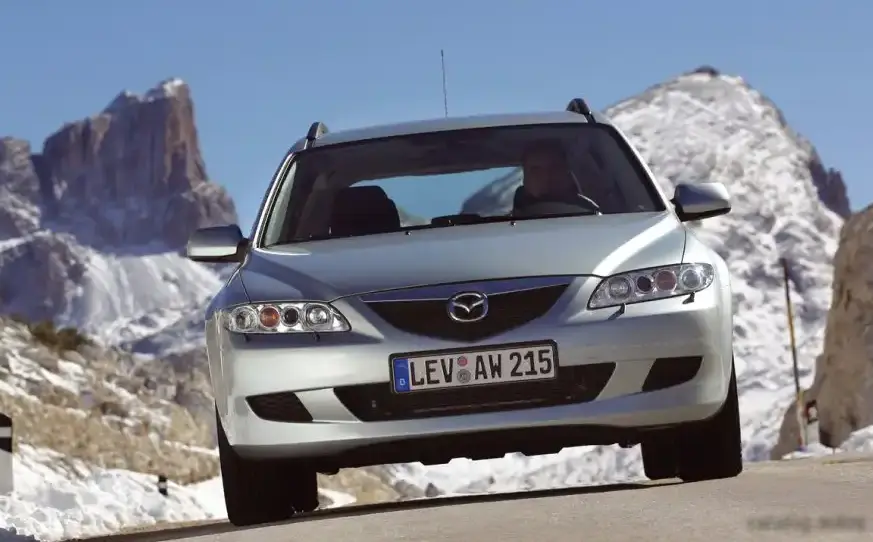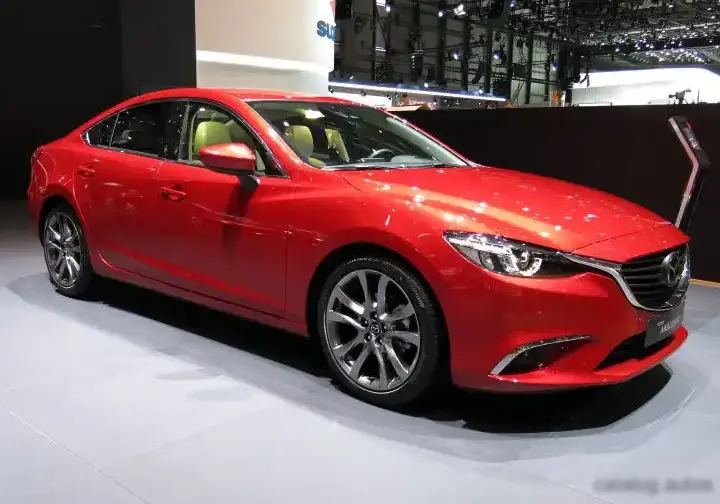
The Mazda 6 III Sedan, specifically the facelifted version produced from 2015 to 2017, represented a significant evolution of Mazda’s mid-size offering. Within the GJ generation, the 2.5-liter SKYACTIV-G engine paired with a six-speed automatic transmission and i-ELOOP regenerative braking system was a key variant, positioned as a premium offering balancing performance, fuel efficiency, and comfort. This configuration aimed to appeal to buyers seeking a more refined driving experience than the base engine options, while remaining more accessible than potential future performance trims. It was primarily marketed towards the North American and Australian markets, where larger displacement engines were favored.
Technical Specifications
| Brand | Mazda |
| Model | 6 |
| Generation | 6 III Sedan (GJ, facelift 2015) |
| Type (Engine) | 2.5 SKYACTIV-G (192 Hp) i-ELOOP Automatic |
| Start of production | 2015 |
| End of production | 2017 |
| Powertrain Architecture | Internal Combustion engine |
| Body type | Sedan |
| Seats | 5 |
| Doors | 4 |
| Fuel consumption (urban) | 8.5 l/100 km (27.7 US mpg, 33.2 UK mpg, 11.8 km/l) |
| Fuel consumption (extra urban) | 5 l/100 km (47 US mpg, 56.5 UK mpg, 20 km/l) |
| Fuel consumption (combined) | 6.3 l/100 km (37.3 US mpg, 44.8 UK mpg, 15.9 km/l) |
| CO2 emissions | 148 g/km |
| Fuel Type | Petrol (Gasoline) |
| Acceleration 0 – 100 km/h | 7.8 sec |
| Acceleration 0 – 62 mph | 7.8 sec |
| Acceleration 0 – 60 mph | 7.4 sec |
| Maximum speed | 223 km/h (138.57 mph) |
| Emission standard | Euro 6 |
| Weight-to-power ratio | 7.4 kg/Hp, 134.7 Hp/tonne |
| Weight-to-torque ratio | 5.6 kg/Nm, 179.6 Nm/tonne |
| Power | 192 Hp @ 5700 rpm |
| Power per litre | 77.2 Hp/l |
| Torque | 256 Nm @ 3500 rpm (188.82 lb.-ft. @ 3500 rpm) |
| Engine layout | Front, Transverse |
| Engine displacement | 2488 cm3 (151.83 cu. in.) |
| Number of cylinders | 4 |
| Engine configuration | Inline |
| Cylinder Bore | 89 mm (3.5 in.) |
| Piston Stroke | 100 mm (3.94 in.) |
| Compression ratio | 13:1 |
| Number of valves per cylinder | 4 |
| Fuel injection system | Direct injection |
| Engine aspiration | Naturally aspirated engine |
| Engine oil capacity | 4.5 l (4.76 US qt | 3.96 UK qt) |
| Coolant | 7.3 l (7.71 US qt | 6.42 UK qt) |
| Kerb Weight | 1425-1529 kg (3141.59 – 3370.87 lbs.) |
| Max. weight | 2040 kg (4497.43 lbs.) |
| Max load | 511-615 kg (1126.56 – 1355.84 lbs.) |
| Trunk (boot) space – minimum | 480 l (16.95 cu. ft.) |
| Fuel tank capacity | 62 l (16.38 US gal | 13.64 UK gal) |
| Max. roof load | 75 kg (165.35 lbs.) |
| Permitted trailer load with brakes (8%) | 1700 kg (3747.86 lbs.) |
| Permitted trailer load with brakes (12%) | 1500 kg (3306.93 lbs.) |
| Permitted trailer load without brakes | 680 kg (1499.14 lbs.) |
| Permitted towbar download | 75 kg (165.35 lbs.) |
| Length | 4870 mm (191.73 in.) |
| Width | 1840 mm (72.44 in.) |
| Height | 1450 mm (57.09 in.) |
| Wheelbase | 2830 mm (111.42 in.) |
| Ride height (ground clearance) | 165 mm (6.5 in.) |
| Minimum turning circle | 11.2 m (36.75 ft.) |
| Drivetrain Architecture | Front wheel drive |
| Number of gears and type of gearbox | 6 gears, automatic transmission |
| Front brakes | Ventilated discs |
| Rear brakes | Disc |
Powertrain & Engine Architecture
At the heart of this Mazda 6 variant lies the 2.5-liter SKYACTIV-G four-cylinder engine, designated as the PY-VPS. This engine is a cornerstone of Mazda’s efficiency-focused SKYACTIV technology. It features a high compression ratio of 13:1, achieved through careful engineering and precise fuel injection. The direct injection system, coupled with optimized intake port and piston designs, promotes a homogeneous air-fuel mixture, maximizing combustion efficiency. The engine utilizes a dual overhead camshaft (DOHC) valvetrain with four valves per cylinder, enhancing volumetric efficiency and power output. The six-speed automatic transmission, also part of the SKYACTIV suite, is designed for smooth and responsive shifting, prioritizing fuel economy without sacrificing drivability. The i-ELOOP system, a capacitor-based regenerative braking system, captures kinetic energy during deceleration and stores it to power electrical components, reducing the load on the alternator and further improving fuel efficiency.
Driving Characteristics
The 192 horsepower and 256 Nm (188.82 lb-ft) of torque delivered by the 2.5L engine and six-speed automatic provided a comfortable and capable driving experience. While not overtly sporty, the combination offered adequate acceleration, with a 0-60 mph time around 7.4 seconds. The automatic transmission was tuned for smooth shifts and prioritized fuel economy, meaning it wasn’t as aggressively geared for performance as some competitors. Compared to the base 2.0-liter engine, the 2.5L offered noticeably more power, especially during highway merging and overtaking. However, it lacked the enthusiast appeal of the manual transmission options or the potential for tuning found in some other Mazda models. The i-ELOOP system was largely transparent to the driver, contributing to improved fuel economy without any noticeable impact on driving feel.
Equipment & Trim Levels
The 2.5L SKYACTIV-G automatic typically came in higher trim levels, such as the ‘Grand Touring’ or equivalent depending on the market. Standard features often included leather upholstery, a premium sound system, dual-zone automatic climate control, and a suite of advanced safety technologies like blind-spot monitoring, rear cross-traffic alert, and lane departure warning. Optional extras could include a power moonroof, navigation system, and adaptive front lighting. Interior appointments were generally well-executed, with a focus on quality materials and a driver-centric layout. The dashboard featured a clean and modern design, with a central infotainment screen controlled by a rotary dial and buttons.
Chassis & Braking
The Mazda 6 III Sedan utilized a front-engine, front-wheel-drive layout. The suspension consisted of MacPherson struts at the front and multi-link suspension at the rear, providing a good balance between ride comfort and handling. Braking duties were handled by ventilated discs at the front and solid discs at the rear. Anti-lock braking system (ABS) and electronic brakeforce distribution (EBD) were standard features. The steering system was an electric power-assisted rack and pinion, offering precise and responsive steering feel. Stabilizer bars were fitted to both the front and rear axles to reduce body roll during cornering.
Market Reception & Comparison
The 2.5L SKYACTIV-G automatic Mazda 6 was generally well-received by automotive critics. It was praised for its refined driving experience, fuel efficiency, and spacious interior. Compared to competitors like the Honda Accord and Toyota Camry, the Mazda 6 offered a more engaging driving experience and a more stylish design. However, some critics noted that the automatic transmission could feel slightly hesitant at times, and the infotainment system wasn’t as intuitive as some rivals. Fuel economy figures were competitive, typically achieving around 37 mpg on the highway. Reliability was generally good, with few reported issues specific to the powertrain.
Legacy
The 2.5L SKYACTIV-G engine and six-speed automatic transmission have proven to be a reliable and durable combination. In the used car market, these Mazda 6 models are generally sought after for their blend of practicality, efficiency, and driving enjoyment. While not a high-performance variant, the 2.5L engine provides ample power for everyday driving and remains a solid choice for buyers looking for a well-rounded mid-size sedan. The i-ELOOP system, while not a revolutionary technology, contributed to the overall efficiency of the vehicle and helped to establish Mazda as a leader in fuel-saving innovations.