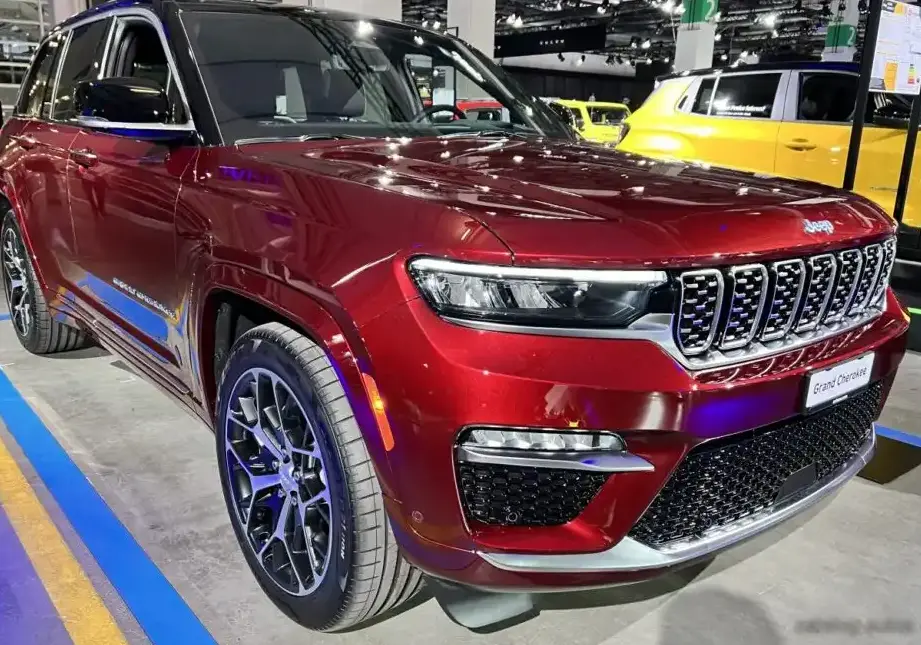
The Jeep Grand Cherokee V (WL) 2.0 Turbo 4xe, launched in September 2021, represents a significant step in Jeep’s electrification strategy for the North American market. This plug-in hybrid (PHEV) variant slots into the fifth generation (WL) of the Grand Cherokee lineup, offering a blend of off-road capability, luxury, and improved fuel efficiency. Positioned as a mid-range offering within the broader Grand Cherokee V portfolio, it caters to buyers seeking a more environmentally conscious SUV without sacrificing performance or refinement. The 4xe designation signifies Jeep’s commitment to electric vehicle technology, and this model is a key component of that initiative. It utilizes a 2.0-liter turbocharged inline-four engine paired with two electric motors and a 17.3 kWh battery pack, delivering a combined system output of 375 horsepower.
Technical Specifications
| Brand | Jeep |
| Model | Grand Cherokee |
| Generation | Grand Cherokee V (WL) |
| Type (Engine) | 2.0 Turbo (375 Hp) 4xe eTorque Torqueflite |
| Start of production | September, 2021 |
| Powertrain Architecture | PHEV (Plug-in Hybrid Electric Vehicle) |
| Body type | SUV |
| Seats | 5 |
| Doors | 5 |
| Combined fuel consumption (WLTP) | 2.6 l/100 km (90.5 US mpg, 108.6 UK mpg, 38.5 km/l) |
| CO2 emissions (WLTP) | 62 g/km |
| Fuel Type | Petrol / electricity |
| Weight-to-power ratio | 6.4 kg/Hp, 155.3 Hp/tonne |
| Weight-to-torque ratio | 3.8 kg/Nm, 263.8 Nm/tonne |
| Gross battery capacity | 17.3 kWh |
| Battery voltage | 400 V |
| Battery technology | Lithium-ion (Li-Ion) |
| Battery location | Below the floor |
| All-electric range (WLTP) | 51 km (31.69 mi) |
| All-electric range (EPA) | 40 km (24.85 mi) |
| Average Energy consumption (WLTP) | 25 kWh/100 km (40.23 kWh/100 mi, 84 MPGe, 4 km/kWh, 2.5 mi/kWh) |
| Max speed (electric) | 130 km/h (80.78 mph) |
| Electric motor 1 power | 44 Hp |
| Electric motor 1 Torque | 53 Nm (39.09 lb.-ft.) |
| Electric motor 1 location | Front, Longitudinal |
| Electric motor 2 power | 134 Hp |
| Electric motor 2 Torque | 245 Nm (180.7 lb.-ft.) |
| Electric motor 2 location | Between the combustion engine and the transmission |
| System power | 375 Hp @ 5250 rpm |
| System torque | 637 Nm @ 3000 rpm (469.83 lb.-ft. @ 3000 rpm) |
| Internal combustion engine power | 270 Hp @ 5250 rpm |
| Power per litre | 135.3 Hp/l |
| Internal combustion engine torque | 400 Nm @ 3000 rpm (295.02 lb.-ft. @ 3000 rpm) |
| Maximum engine speed | 5800 rpm |
| Engine layout | Front, Longitudinal |
| Engine displacement | 1995 cm3 (121.74 cu. in.) |
| Number of cylinders | 4 |
| Engine configuration | Inline |
| Cylinder Bore | 84 mm (3.31 in.) |
| Piston Stroke | 90 mm (3.54 in.) |
| Compression ratio | 10:1 |
| Number of valves per cylinder | 4 |
| Fuel injection system | Direct injection |
| Engine aspiration | Twin-scroll turbo, Intercooler |
| Valvetrain | DOHC |
| Engine oil capacity | 4.7 l (4.97 US qt | 4.14 UK qt) |
| Coolant capacity | 9.5 l (10.04 US qt | 8.36 UK qt) |
| Kerb Weight | 2415-2521 kg (5324.16 – 5557.85 lbs.) |
| Max. weight | 3043 kg (6708.67 lbs.) |
| Max load | 522-628 kg (1150.81 – 1384.5 lbs.) |
| Trunk (boot) space – minimum | 1068 l (37.72 cu. ft.) |
| Trunk (boot) space – maximum | 2005 l (70.81 cu. ft.) |
| Fuel tank capacity | 72 l (19.02 US gal | 15.84 UK gal) |
| Permitted trailer load with brakes (12%) | 2722 kg (6000.98 lbs.) |
| Length | 4914 mm (193.46 in.) |
| Width | 1968 mm (77.48 in.) |
| Width with mirrors folded | 1968 mm (77.48 in.) |
| Width including mirrors | 2149 mm (84.61 in.) |
| Height | 1799-1801 mm (70.83 – 70.91 in.) |
| Wheelbase | 2964 mm (116.69 in.) |
| Front track | 1660 mm (65.35 in.) |
| Rear (Back) track | 1660 mm (65.35 in.) |
| Ride height (ground clearance) | 214-278 mm (8.43 – 10.94 in.) |
| Drag coefficient (Cd) | 0.357 |
| Minimum turning circle (turning diameter) | 11.58 m (37.99 ft.) |
| Approach angle | 20.5-35.7° |
| Departure angle | 26.6-30° |
| Ramp-over (brakeover) angle | 16.3-22.3° |
| Wading depth | 610 mm (24.02 in.) |
| Drivetrain Architecture | The Internal combustion engine (ICE) and Two electric motors drive permanently the rear wheels of the vehicle, with a capabllity of running in full electric or mixed mode, and if necessary through the electrically or mechanically controlled clutch, the front wheels are driven. |
| Drive wheel | All wheel drive (4×4) |
| Number of gears and type of gearbox | 8 gears, automatic transmission Torqueflite |
| Front suspension | Independent multi-link suspension |
| Rear suspension | Independent multi-link suspension |
| Front brakes | Ventilated discs, 354×28 mm |
| Rear brakes | Ventilated discs, 350×22 mm |
INTRODUCTION
The Jeep Grand Cherokee V (WL) 2.0 Turbo 4xe, introduced for the 2022 model year, represents a pivotal moment for the iconic SUV. Built on the 1HX0/A3 platform shared with other Stellantis products, this variant aims to broaden the Grand Cherokee’s appeal by offering a compelling alternative to traditional gasoline-powered models. The 4xe system allows for all-electric driving for a limited range, reducing emissions and fuel consumption, while still providing the capability and luxury expected from a Grand Cherokee. This model is primarily targeted towards environmentally conscious consumers in North America and Europe who desire a premium SUV with enhanced fuel efficiency and a reduced carbon footprint.
Powertrain & Engine Architecture
At the heart of the Grand Cherokee 4xe lies a 2.0-liter turbocharged inline-four cylinder engine, designated as the GME-T20. This engine utilizes direct fuel injection and a twin-scroll turbocharger to produce 270 horsepower and 295 lb-ft of torque. The engine is paired with two electric motors: a 44 hp motor integrated into the transmission and a 134 hp motor located between the engine and transmission. These electric motors draw power from a 17.3 kWh lithium-ion battery pack positioned under the floor of the vehicle. The combined system output is 375 horsepower and 470 lb-ft of torque. The transmission is an eight-speed automatic, specifically the Torqueflite 8HP75, optimized for the hybrid powertrain. The 4xe system allows for three distinct modes of operation: Hybrid, Electric, and eSave. Hybrid mode blends power from the engine and electric motors for optimal efficiency. Electric mode prioritizes all-electric driving until the battery is depleted. eSave mode conserves battery power for later use, relying primarily on the gasoline engine.
Driving Characteristics
The 2.0 Turbo 4xe Grand Cherokee offers a unique driving experience compared to its gasoline-only counterparts. The instant torque from the electric motors provides brisk acceleration, particularly from a standstill. While not as overtly powerful as the V6 or V8 models, the 4xe delivers ample performance for everyday driving and highway merging. The eight-speed automatic transmission is well-tuned, providing smooth and responsive shifts. In electric mode, the vehicle operates silently and smoothly, offering a refined driving experience. The hybrid mode seamlessly transitions between electric and gasoline power, minimizing any noticeable disruption. The added weight of the battery pack does slightly impact handling, but the Grand Cherokee maintains its composure and provides a comfortable ride. The gear ratios are optimized for both efficiency and performance, with a focus on maximizing electric range and minimizing emissions.
Equipment & Trim Levels
The 2.0 Turbo 4xe trim typically comes well-equipped with standard features such as leather upholstery, a large touchscreen infotainment system with Apple CarPlay and Android Auto compatibility, a premium sound system, and a suite of advanced driver-assistance systems (ADAS) including adaptive cruise control, lane departure warning, and automatic emergency braking. Optional extras include a panoramic sunroof, ventilated front seats, and a rear-seat entertainment system. Interior trim levels vary, with higher trims offering more luxurious materials and finishes. The dashboard configuration is similar to other Grand Cherokee V models, with a focus on modern design and user-friendly controls.
Chassis & Braking
The Grand Cherokee 4xe utilizes an independent multi-link suspension system both front and rear, providing a comfortable and controlled ride. The suspension is tuned to accommodate the added weight of the battery pack. Braking duties are handled by ventilated discs on all four wheels, with the front discs measuring 354×28 mm and the rear discs measuring 350×22 mm. The vehicle is equipped with an anti-lock braking system (ABS) and electronic stability control (ESC) as standard. The steering system is an electric power-assisted rack and pinion setup, providing precise and responsive steering feel.
Market Reception & Comparison
The Grand Cherokee 4xe has been generally well-received by critics, who praise its fuel efficiency, refined driving experience, and commitment to electrification. Compared to the V6 and V8 models, the 4xe offers significantly improved fuel economy, particularly in urban driving conditions. However, the 4xe’s higher price point and slightly reduced towing capacity may be drawbacks for some buyers. Compared to other PHEV SUVs in its class, the Grand Cherokee 4xe stands out with its combination of luxury, capability, and off-road prowess. Reliability reports are still emerging, but early indications suggest that the 4xe powertrain is proving to be relatively reliable.
Legacy
The Jeep Grand Cherokee V 2.0 Turbo 4xe represents a significant step towards a more sustainable future for the brand. As battery technology continues to improve and charging infrastructure expands, the 4xe variant is likely to become increasingly popular. The powertrain’s long-term reliability remains to be seen, but Jeep’s commitment to supporting its electrified vehicles suggests that the 4xe will be a viable option for years to come. In the used car market, the 4xe is expected to hold its value well, particularly among buyers seeking a fuel-efficient and environmentally friendly SUV.