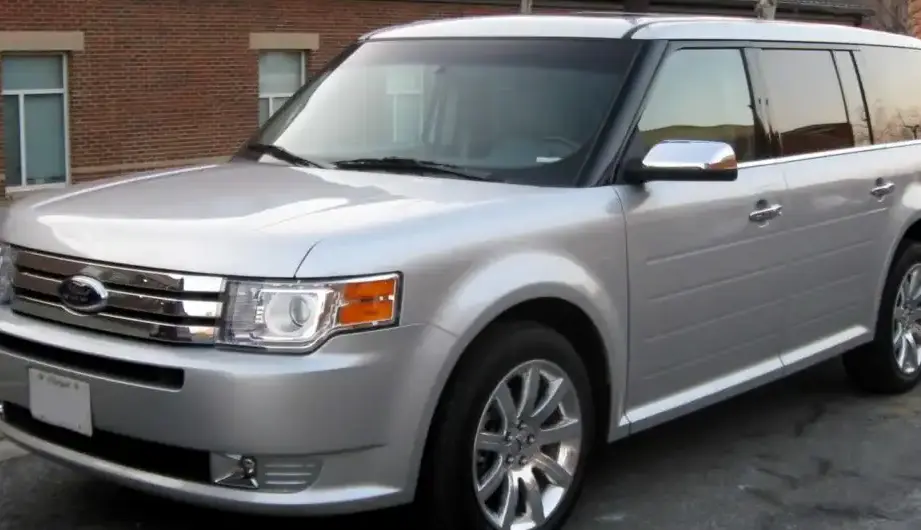
The Ford Flex, particularly the facelifted version produced from 2013 to 2019, represented a unique offering in the American automotive landscape. This large, boxy crossover SUV aimed to blend the practicality of a minivan with the styling cues of a traditional SUV. The 3.5-liter V6 engine producing 364 horsepower, coupled with an all-wheel-drive system and a six-speed automatic transmission, was a top-tier configuration within the Flex lineup, positioned as a premium option for buyers needing substantial space and towing capacity. It served as a direct competitor to vehicles like the Chevrolet Traverse, Honda Pilot, and Toyota Highlander, though the Flex distinguished itself with its retro-inspired design and spacious interior.
Technical Specifications
| Brand | Ford |
| Model | Flex |
| Generation | Flex (facelift 2013) |
| Type (Engine) | 3.5 V6 (364 Hp) AWD Automatic |
| Start of production | 2013 |
| End of production | 2019 |
| Powertrain Architecture | Internal Combustion engine |
| Body type | SUV |
| Seats | 6-7 |
| Doors | 5 |
| Fuel consumption (economy) – urban | 14.7 l/100 km (16 US mpg, 19.2 UK mpg, 6.8 km/l) |
| Fuel consumption (economy) – extra urban | 10.2 l/100 km (23.1 US mpg, 27.7 UK mpg, 9.8 km/l) |
| Fuel consumption (economy) – combined | 13.1 l/100 km (18 US mpg, 21.6 UK mpg, 7.6 km/l) |
| Fuel Type | Petrol (Gasoline) |
| Emission standard | Euro 4 |
| Power | 364 Hp @ 5500 rpm |
| Power per litre | 104.1 Hp/l |
| Torque | 475 Nm @ 1500-3500 rpm (350.34 lb.-ft. @ 1500-3500 rpm) |
| Engine layout | Front, Transverse |
| Engine displacement | 3496 cm3 (213.34 cu. in.) |
| Number of cylinders | 6 |
| Engine configuration | V-engine |
| Compression ratio | 10:1 |
| Number of valves per cylinder | 4 |
| Fuel injection system | Direct injection |
| Engine oil capacity | 5.7 l (6.02 US qt | 5.02 UK qt) |
| Coolant | 13 l (13.74 US qt | 11.44 UK qt) |
| Trunk (boot) space – minimum | 566 l (19.99 cu. ft.) |
| Fuel tank capacity | 71 l (18.76 US gal | 15.62 UK gal) |
| Length | 5130 mm (201.97 in.) |
| Width | 1930 mm (75.98 in.) |
| Height | 1727 mm (67.99 in.) |
| Wheelbase | 2995 mm (117.91 in.) |
| Front track | 1661 mm (65.39 in.) |
| Rear (Back) track | 1661 mm (65.39 in.) |
| Ride height (ground clearance) | 150 mm (5.91 in.) |
| Drive wheel | All wheel drive (4×4) |
| Number of gears and type of gearbox | 6 gears, automatic transmission |
| Front brakes | Ventilated discs |
| Rear brakes | Disc |
| Assisting systems | ABS (Anti-lock braking system) |
| Tires size | 235/60 R17 |
| Wheel rims size | 17 |
Powertrain & Engine Architecture
The heart of this Flex variant is the 3.5-liter EcoBoost V6 engine, designated with the engine code 3.5L EcoBoost. This engine utilizes a twin-turbocharged configuration, providing a significant boost in power and torque compared to naturally aspirated engines. Direct fuel injection is employed to optimize combustion efficiency and power output. The engine features a 60-degree V-angle, contributing to a smoother engine operation. The six-speed automatic transmission, specifically the 6F55, was chosen for its ability to handle the engine’s substantial torque output and provide relatively smooth shifts. This transmission features a wide gear ratio spread, aiding both acceleration and highway cruising. The all-wheel-drive system is primarily front-wheel drive, engaging the rear wheels as needed for improved traction.
Driving Characteristics
The 364-horsepower Flex delivers brisk acceleration, especially considering its size and weight. The twin-turbochargers provide a noticeable surge of power, with peak torque available from a low 1500 rpm, making it capable of towing up to 4,500 pounds. The six-speed automatic transmission generally shifts smoothly, although some drivers noted occasional hesitation during downshifts. Compared to the base 3.5-liter V6 Flex, this EcoBoost version offers a significantly more engaging driving experience. While not a sports car, the Flex EcoBoost provides ample power for merging onto highways and passing other vehicles. The all-wheel-drive system enhances stability in inclement weather conditions.
Equipment & Trim Levels
The 3.5L EcoBoost AWD Flex typically came standard with features like leather upholstery, heated front seats, a power liftgate, and a premium audio system. Higher trim levels, such as the Limited, added features like navigation, a panoramic sunroof, and automatic climate control. Optional extras included a rear-seat entertainment system, adaptive cruise control, and blind-spot monitoring. The interior design was generally considered comfortable and spacious, with ample headroom and legroom for all passengers. The third-row seats, while usable, were best suited for children or shorter adults.
Chassis & Braking
The Flex utilizes a fully independent suspension system, featuring MacPherson struts in the front and a multi-link setup in the rear. This suspension configuration provides a comfortable ride, absorbing bumps and irregularities in the road surface effectively. The steering is relatively light and precise, making it easy to maneuver in city traffic. Braking duties are handled by ventilated discs on all four wheels, providing adequate stopping power. The anti-lock braking system (ABS) helps to maintain control during emergency braking situations. Stabilizer bars are present on both the front and rear axles to reduce body roll during cornering.
Market Reception & Comparison
Critics generally praised the Flex EcoBoost for its powerful engine, spacious interior, and comfortable ride. However, its fuel economy was often cited as a drawback, averaging around 18 mpg in combined driving. Compared to the base 3.5-liter V6 Flex, the EcoBoost version offered a significant performance upgrade, but at a higher price point. The Flex also faced competition from other large crossovers, such as the Chevrolet Traverse and Honda Pilot, which offered similar levels of space and practicality. The Flex’s unique styling, however, helped it stand out from the crowd.
Legacy
The Ford Flex, particularly the 3.5L EcoBoost AWD variant, has developed a loyal following among owners who appreciate its distinctive styling, spacious interior, and powerful engine. While production ended in 2019, the Flex remains a relatively common sight on used car lots. The 3.5L EcoBoost engine has proven to be generally reliable, although some owners have reported issues with the turbochargers and fuel injectors. Regular maintenance, including oil changes and spark plug replacements, is crucial for ensuring the longevity of this powertrain. The Flex’s unique combination of minivan practicality and SUV styling has cemented its place as a memorable and somewhat quirky vehicle in American automotive history.