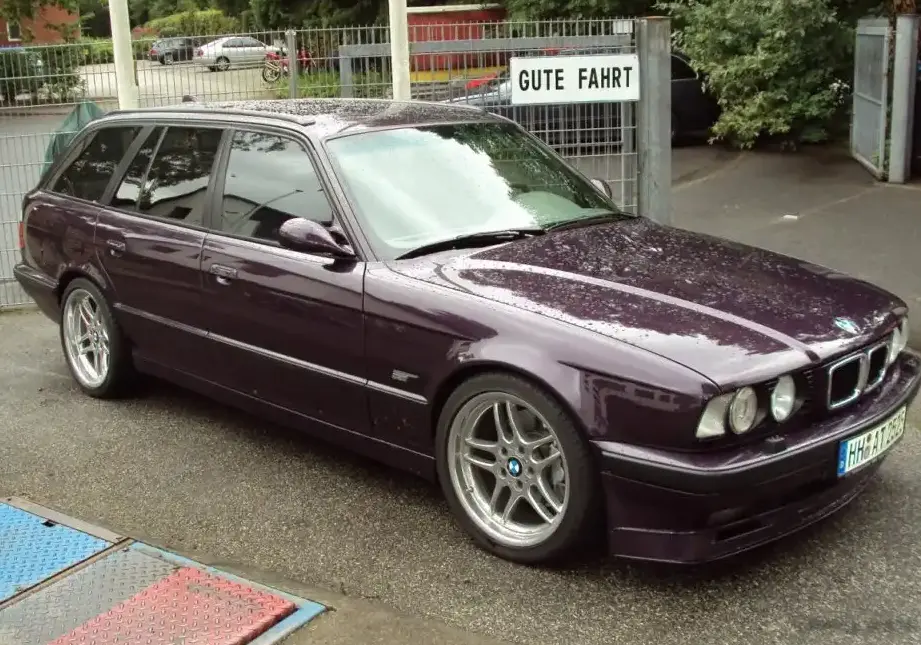
The BMW 5 Series Touring (E34) 525tds, produced between 1991 and 1997, represents a unique offering within the E34 generation of BMW’s mid-size executive car. This variant combined the practicality of the Touring (estate/wagon) body style with BMW’s renowned diesel engine technology, specifically the M51D25 engine. Positioned as a fuel-efficient and capable long-distance cruiser, the 525tds catered to buyers seeking a blend of performance, economy, and space. It occupied a middle ground in the E34 Touring lineup, offering a step up in performance from the naturally aspirated diesel models while remaining more affordable than the petrol-powered six and eight-cylinder options.
Technical Specifications
| Brand | BMW |
| Model | 5 Series |
| Generation | 5 Series Touring (E34) |
| Type (Engine) | 525tds (143 Hp) |
| Start of production | 1991 |
| End of production | 1997 |
| Powertrain Architecture | Internal Combustion engine |
| Body type | Station wagon (estate) |
| Seats | 5 |
| Doors | 5 |
| Fuel consumption (economy) – combined | 7.2 l/100 km |
| Fuel consumption (economy) – combined | 32.7 US mpg |
| Fuel consumption (economy) – combined | 39.2 UK mpg |
| Fuel consumption (economy) – combined | 13.9 km/l |
| Fuel Type | Diesel |
| Acceleration 0 – 100 km/h | 11.6 sec |
| Acceleration 0 – 62 mph | 11.6 sec |
| Acceleration 0 – 60 mph | 11 sec |
| Maximum speed | 202 km/h |
| Maximum speed | 125.52 mph |
| Weight-to-power ratio | 10.9 kg/Hp |
| Weight-to-power ratio | 91.7 Hp/tonne |
| Weight-to-torque ratio | 6 kg/Nm |
| Weight-to-torque ratio | 166.7 Nm/tonne |
| Power | 143 Hp @ 4800 rpm |
| Power per litre | 57.2 Hp/l |
| Torque | 260 Nm @ 2200 rpm |
| Torque | 191.77 lb.-ft. @ 2200 rpm |
| Engine layout | Front, Longitudinal |
| Engine Model/Code | M51D25 |
| Engine displacement | 2498 cm3 |
| Engine displacement | 152.44 cu. in. |
| Number of cylinders | 6 |
| Engine configuration | Inline |
| Cylinder Bore | 80 mm |
| Cylinder Bore | 3.15 in. |
| Piston Stroke | 82.8 mm |
| Piston Stroke | 3.26 in. |
| Compression ratio | 22:1 |
| Number of valves per cylinder | 2 |
| Fuel injection system | Precombustion chamber injection |
| Engine aspiration | Turbocharger, Intercooler |
| Valvetrain | OHC |
| Engine oil capacity | 6.75 l |
| Engine oil capacity | 7.13 US qt | 5.94 UK qt |
| Coolant | 9.75 l |
| Coolant | 10.3 US qt | 8.58 UK qt |
| Kerb Weight | 1560 kg |
| Kerb Weight | 3439.21 lbs. |
| Max. weight | 2110 kg |
| Max. weight | 4651.75 lbs. |
| Max load | 550 kg |
| Max load | 1212.54 lbs. |
| Trunk (boot) space – minimum | 460 l |
| Trunk (boot) space – minimum | 16.24 cu. ft. |
| Trunk (boot) space – maximum | 910 l |
| Trunk (boot) space – maximum | 32.14 cu. ft. |
| Fuel tank capacity | 80 l |
| Fuel tank capacity | 21.13 US gal | 17.6 UK gal |
| Length | 4720 mm |
| Length | 185.83 in. |
| Width | 1751 mm |
| Width | 68.94 in. |
| Height | 1417 mm |
| Height | 55.79 in. |
| Wheelbase | 2761 mm |
| Wheelbase | 108.7 in. |
| Front track | 1470 mm |
| Front track | 57.87 in. |
| Rear (Back) track | 1495 mm |
| Rear (Back) track | 58.86 in. |
| Drivetrain Architecture | The Internal combustion engine (ICE) drives the rear wheels of the vehicle. |
| Drive wheel | Rear wheel drive |
| Number of gears and type of gearbox | 5 gears, manual transmission |
| Front suspension | Wishbone |
| Rear suspension | Spring Strut |
| Front brakes | Ventilated discs |
| Rear brakes | Disc |
| Assisting systems | ABS (Anti-lock braking system) |
| Power steering | Hydraulic Steering |
| Tires size | 205/65 R15 |
| Wheel rims size | 15 |
Powertrain & Engine Architecture
The heart of the 525tds is the M51D25 engine, a 2.5-liter inline-six diesel. This engine utilized a precombustion chamber injection system, a common technology for diesel engines of the era, designed to improve combustion efficiency and reduce noise. A turbocharger with an intercooler was employed to boost power output to 143 horsepower and 260 Nm (191.77 lb-ft) of torque. The M51 engine family was known for its durability and relatively smooth operation for a diesel. The 5-speed manual transmission was standard, providing a balance between fuel economy and driver control. The engine is longitudinally mounted, driving the rear wheels, a classic BMW configuration.
Driving Characteristics
The 525tds offered a distinctly different driving experience compared to its petrol-powered siblings. While lacking the outright acceleration of the 525i or 530i, the 525tds delivered strong low-end torque, making it well-suited for everyday driving and long-distance cruising. The manual transmission allowed for precise control, but the gear ratios were optimized for fuel efficiency rather than outright performance. Acceleration to 60 mph took around 11 seconds, and top speed was approximately 125 mph. Compared to the naturally aspirated diesel models, the 525tds provided a noticeable performance improvement, while remaining significantly more economical than the petrol engines.
Equipment & Trim Levels
The 525tds typically came with a reasonable level of standard equipment, including power windows, central locking, and an anti-lock braking system (ABS). Interior upholstery was usually cloth, although leather was available as an option. Dashboard configuration was typical of the E34, with a functional and straightforward layout. Optional extras included a sunroof, air conditioning, and upgraded audio systems. The trim level was generally considered mid-range, offering a good balance of comfort and features without the luxury appointments of the higher-end models.
Chassis & Braking
The E34 5 Series utilized a robust chassis with independent suspension at all four wheels. The front suspension employed a MacPherson strut design, while the rear featured a semi-trailing arm setup. The 525tds, due to its weight, often featured slightly stiffer spring rates compared to lighter models. Braking was handled by ventilated discs at the front and solid discs at the rear, providing adequate stopping power for most driving situations. The hydraulic power steering offered a good balance between assistance and road feel.
Market Reception & Comparison
The 525tds was generally well-received by automotive critics as a practical and economical option within the E34 range. It was praised for its fuel efficiency, comfortable ride, and durable engine. However, some critics noted its relatively slow acceleration compared to petrol-powered models. Compared to the 525i, the 525tds offered significantly better fuel economy but lacked the same level of performance. Against the naturally aspirated diesel models, the 525tds provided a substantial performance boost. Its reliability was also a strong point, making it a popular choice for high-mileage drivers.
Legacy
The M51D25 engine and the E34 525tds have developed a reputation for long-term reliability. Properly maintained examples can still be found on the road today, often with very high mileage. The engine is known for its robustness and ability to withstand significant use. In the used car market, the 525tds is often sought after by enthusiasts who appreciate its blend of practicality, economy, and classic BMW driving characteristics. While not as collectible as some of the higher-performance E34 models, the 525tds represents a valuable and durable member of the E34 family.