Technical Specifications
| Brand | Opel |
| Model | Astra |
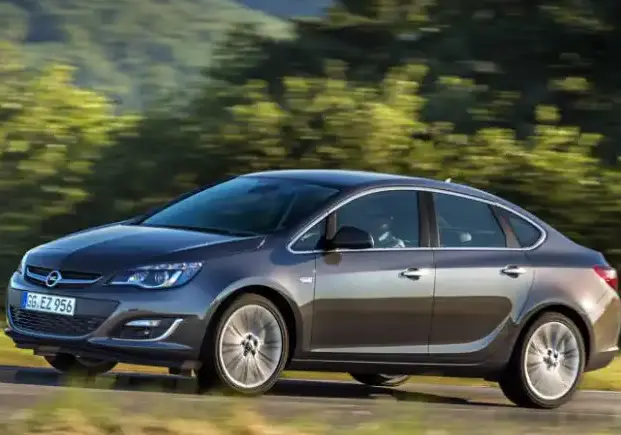
| Generation | Astra J Sedan |
| Type (Engine) | 1.4 (100 Hp) |
| Start of production | 2012 |
| End of production | 2013 |
| Powertrain Architecture | Internal Combustion engine |
| Body type | Sedan |
| Seats | 5 |
| Doors | 4 |
| Fuel consumption (urban) | 7.2 l/100 km (32.7 US mpg) |
| Fuel consumption (extra urban) | 4.8 l/100 km (49 US mpg) |
| Fuel consumption (combined) | 5.7 l/100 km (41.3 US mpg) |
| CO2 emissions | 133 g/km |
| Fuel Type | Petrol (Gasoline) |
| Acceleration 0 – 100 km/h | 14.2 sec |
| Acceleration 0 – 62 mph | 14.2 sec |
| Acceleration 0 – 60 mph | 13.5 sec |
| Maximum speed | 183 km/h (113.71 mph) |
| Emission standard | Euro 5 |
| Weight-to-power ratio | 13.9 kg/Hp |
| Weight-to-torque ratio | 10.7 kg/Nm |
| Power | 100 Hp @ 6000 rpm |
| Torque | 130 Nm @ 4000 rpm (95.88 lb.-ft. @ 4000 rpm) |
| Engine layout | Front, Transverse |
| Engine Model/Code | A14XER |
| Engine displacement | 1398 cm3 (85.31 cu. in.) |
| Number of cylinders | 4 |
| Engine configuration | Inline |
| Cylinder Bore | 73.4 mm (2.89 in.) |
| Piston Stroke | 82.6 mm (3.25 in.) |
| Number of valves per cylinder | 4 |
| Fuel injection system | Multi-port manifold injection |
| Engine aspiration | Naturally aspirated engine |
| Engine oil capacity | 4 l (4.23 US qt | 3.52 UK qt) |
| Coolant capacity | 6.2 l (6.55 US qt | 5.46 UK qt) |
| Kerb Weight | 1393 kg (3071.04 lbs.) |
| Max. weight | 1935 kg (4265.94 lbs.) |
| Max load | 542 kg (1194.91 lbs.) |
| Trunk (boot) space – minimum | 460 l (16.24 cu. ft.) |
| Trunk (boot) space – maximum | 1010 l (35.67 cu. ft.) |
| Fuel tank capacity | 56 l (14.79 US gal | 12.32 UK gal) |
| Length | 4658 mm (183.39 in.) |
| Width | 1814 mm (71.42 in.) |
| Width including mirrors | 2013 mm (79.25 in.) |
| Height | 1500 mm (59.06 in.) |
| Wheelbase | 2685 mm (105.71 in.) |
| Front track | 1541 mm (60.67 in.) |
| Rear (Back) track | 1551 mm (61.06 in.) |
| Front overhang | 974 mm (38.35 in.) |
| Rear overhang | 999 mm (39.33 in.) |
| Minimum turning circle | 11.5 m (37.73 ft.) |
| Drivetrain Architecture | Front wheel drive |
| Number of gears | 5 |
| Gearbox type | Manual transmission |
| Front brakes | Ventilated discs |
| Assisting systems | ABS (Anti-lock braking system) |
| Steering type | Steering rack and pinion |
| Power steering | Electric Steering |
| Tires size | 205/60 R16; 215/50 R17 |
| Wheel rims size | 16; 17 |
The Opel Astra J Sedan 1.4 (100 hp) was introduced in 2012 as part of the Astra J Sedan lineup, representing an affordable entry point into the model range. Built on the GM Delta II platform (also known as the 1HX0 platform), it shared its underpinnings with other vehicles like the Chevrolet Cruze. The sedan body style was particularly popular in markets where traditional three-box designs were favored. This variant aimed to appeal to budget-conscious buyers who prioritized fuel efficiency and practicality over outright performance. It served as a direct competitor to other compact sedans like the Ford Focus, Volkswagen Jetta, and Peugeot 308.
Powertrain & Engine Architecture
At the heart of the Astra J Sedan 1.4 was the A14XER engine, a 1.4-liter inline-four cylinder gasoline engine. This engine featured multi-point fuel injection and a single overhead camshaft (SOHC) valvetrain with four valves per cylinder. The A14XER was known for its relatively simple design and focus on fuel economy. It produced 100 horsepower at 6000 rpm and 130 Nm (95.88 lb-ft) of torque at 4000 rpm. The engine was paired with a five-speed manual transmission, which was the standard offering for this trim level. The transmission was chosen for its cost-effectiveness and simplicity, contributing to the overall affordability of the vehicle. The engine’s design prioritized reliability and ease of maintenance over high performance. The A14XER engine, while not a powerhouse, was a common and well-understood unit within the Opel/Vauxhall range, benefitting from economies of scale in production and readily available parts.
Driving Characteristics
The 1.4-liter engine and five-speed manual transmission combination resulted in a driving experience focused on efficiency rather than spirited acceleration. Acceleration from 0 to 100 km/h (0-62 mph) took approximately 14.2 seconds, and the top speed was limited to 183 km/h (113.71 mph). The gear ratios were tuned for fuel economy, meaning the engine often needed to be revved to achieve brisk acceleration. Compared to higher-output Astra J variants, such as those with 1.6-liter or turbocharged engines, the 1.4-liter model felt noticeably less powerful. However, the relatively light weight of the vehicle helped to mitigate some of the performance deficit. The steering was light and precise, making it easy to maneuver in urban environments. The suspension provided a comfortable ride, although it wasn’t particularly sporty, leaning towards a softer setup to prioritize ride quality over handling sharpness. Drivers accustomed to more powerful engines would find the 1.4L demanding of frequent downshifts, particularly when overtaking or climbing hills.
Equipment & Trim Levels
The Astra J Sedan 1.4 (100 hp) typically came with a basic level of equipment. Standard features generally included power windows, central locking, air conditioning, and an audio system with MP3 compatibility. Safety features such as ABS (Anti-lock Braking System) and front airbags were also standard. Interior upholstery was typically cloth, and the dashboard featured a functional but relatively simple design. Optional extras included alloy wheels, a more advanced audio system, and parking sensors. The trim level was positioned as the entry-level offering, meaning it lacked some of the more luxurious features found in higher-spec Astra J Sedans. The interior plastics, while durable, were of a lower grade compared to higher trim levels, reflecting the vehicle’s price point.
Chassis & Braking
The Astra J Sedan 1.4 utilized a MacPherson strut front suspension and a torsion beam rear suspension. This setup provided a good balance between ride comfort and handling. The front brakes were ventilated discs, while the rear brakes were typically drum brakes, a cost-saving measure for the entry-level trim. The steering system was an electric power steering (EPS) system, which provided light and precise steering feel. The chassis was designed to be lightweight, contributing to the vehicle’s fuel efficiency. Stabilizer bars were included on both the front and rear axles to reduce body roll during cornering. The use of drum brakes on the rear was a common practice for entry-level models in this segment, helping to keep production costs down.
Market Reception & Comparison
The Astra J Sedan 1.4 (100 hp) received mixed reviews from automotive critics. While it was praised for its fuel efficiency and affordability, it was often criticized for its lack of power and relatively basic equipment level. Compared to other trims in the Astra J Sedan lineup, such as the 1.6-liter or turbocharged variants, the 1.4-liter model offered significantly less performance. However, it was more affordable to purchase and operate. Fuel economy figures of around 5.7 l/100 km (41.3 US mpg) were considered competitive for its class. Reliability was generally good, with the A14XER engine proving to be a durable and dependable unit. Some reviewers noted that the engine could feel strained under heavy load, particularly when fully occupied with passengers and luggage.
Legacy
The Opel Astra J Sedan 1.4 (100 hp) remains a relatively common sight on European roads today. The A14XER engine is known for its long-term reliability, and maintenance costs are generally reasonable. In the used car market, this variant represents an affordable option for buyers seeking a practical and fuel-efficient sedan. While it may not offer the performance or features of higher-spec Astra J Sedans, it provides a dependable and economical mode of transportation. Its simplicity and durability have contributed to its continued popularity among budget-conscious buyers. Parts availability remains good, and the relatively straightforward mechanical design makes it a viable option for DIY mechanics. The Astra J 1.4L continues to be a popular choice for first-time car owners and those seeking a reliable and economical daily driver.