Technical Specifications
| Brand | Jeep |
| Model | Grand Cherokee |
| Generation | Grand Cherokee V (WL, facelift 2025) |
| Type (Engine) | 2.0 Turbo (324 Hp) 4×4 TorqueFlite |
| Start of production | October, 2025 |
| Powertrain Architecture | Internal Combustion engine |
| Body type | SUV |
| Seats | 5 |
| Doors | 5 |
| Fuel Type | Petrol (Gasoline) |
| Power | 324 Hp @ 6000 rpm |
| Power per litre | 162.4 Hp/l |
| Torque | 450 Nm @ 3000-4500 rpm |
| Torque (lb.-ft.) | 331.9 lb.-ft. @ 3000-4500 rpm |
| Maximum engine speed | 6500 rpm |
| Engine layout | Front, Longitudinal |
| Engine Model/Code | Hurricane |
| Engine displacement | 1995 cm3 |
| Engine displacement (cu. in.) | 121.74 cu. in. |
| Number of cylinders | 4 |
| Engine configuration | Inline |
| Cylinder Bore | 84 mm |
| Cylinder Bore (in.) | 3.31 in. |
| Piston Stroke | 90 mm |
| Piston Stroke (in.) | 3.54 in. |
| Compression ratio | 12:1 |
| Number of valves per cylinder | 4 |
| Fuel injection system | Direct injection and Multi-port manifold injection |
| Engine aspiration | Turbocharger, Intercooler |
| Valvetrain | DOHC |
| Engine oil capacity | 4.7 l |
| Engine oil capacity (US qt/UK qt) | 4.97 US qt | 4.14 UK qt |
| Coolant capacity | 10 l |
| Coolant capacity (US qt/UK qt) | 10.57 US qt | 8.8 UK qt |
| Engine systems | Start & Stop System |
| Max. weight | 2744 kg |
| Max. weight (lbs.) | 6049.48 lbs. |
| Trunk (boot) space – minimum | 1068 l |
| Trunk (boot) space – minimum (cu. ft.) | 37.72 cu. ft. |
| Trunk (boot) space – maximum | 2005 l |
| Trunk (boot) space – maximum (cu. ft.) | 70.81 cu. ft. |
| Fuel tank capacity | 87 l |
| Fuel tank capacity (US gal/UK gal) | 22.98 US gal | 19.14 UK gal |
| Permitted trailer load with brakes (12%) | 2818 kg |
| Permitted trailer load with brakes (12%) (lbs.) | 6212.63 lbs. |
| Length | 4914 mm |
| Length (in.) | 193.46 in. |
| Width | 1968 mm |
| Width (in.) | 77.48 in. |
| Width with mirrors folded | 1968 mm |
| Width with mirrors folded (in.) | 77.48 in. |
| Width including mirrors | 2149 mm |
| Width including mirrors (in.) | 84.61 in. |
| Height | 1799-1801 mm |
| Height (in.) | 70.83 – 70.91 in. |
| Wheelbase | 2964 mm |
| Wheelbase (in.) | 116.69 in. |
| Front track | 1660 mm |
| Front track (in.) | 65.35 in. |
| Rear (Back) track | 1660 mm |
| Rear (Back) track (in.) | 65.35 in. |
| Ride height (ground clearance) | 214-276 mm |
| Ride height (ground clearance) (in.) | 8.43 – 10.87 in. |
| Drag coefficient (Cd) | 0.357 |
| Minimum turning circle (turning diameter) | 11.58 m |
| Minimum turning circle (turning diameter) (ft.) | 37.99 ft. |
| Approach angle | 20.5-30.1° |
| Departure angle | 19.1-24° |
| Ramp-over (brakeover) angle | 26.6° |
| Drivetrain Architecture | The Internal combustion engine (ICE) drives permanently the four wheels of the vehicle. |
| Drive wheel | All wheel drive (4×4) |
| Number of gears and type of gearbox | 8 gears, automatic transmission TorqueFlite |
| Front suspension | Coil spring, Independent multi-link suspension, Transverse stabilizer, Air Suspension – Optional |
| Rear suspension | Independent multi-link spring suspension with stabilizer, Air Suspension – Optional |
| Front brakes | Ventilated discs, 354×28 mm |
| Rear brakes | Ventilated discs, 350×22 mm |
| Assisting systems | ABS (Anti-lock braking system) |
| Steering type | Steering rack and pinion |
| Power steering | Electric Steering |
| Tires size | 245/70 R17; 265/60 R18; 265/50 R20; 275/45 R21 |
| Wheel rims size | 8J x 17; 8J x 18; 8.5J x 20; 9J x 21 |
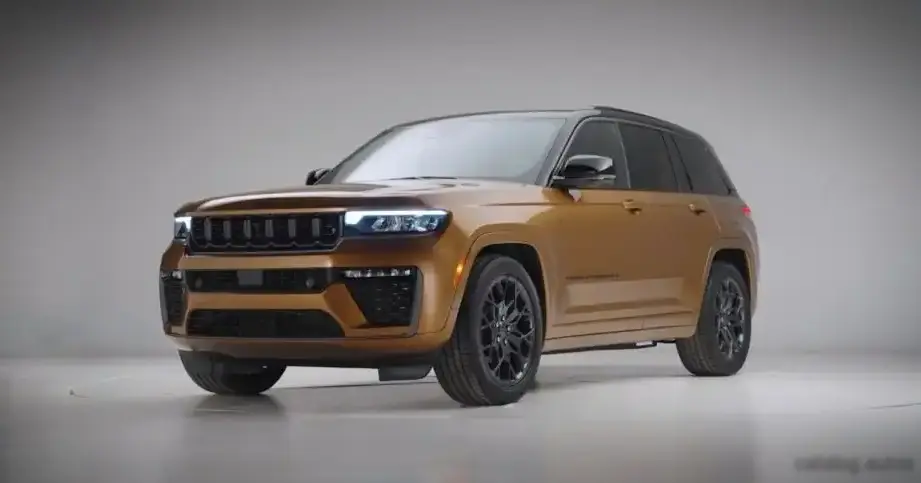
The 2025 Jeep Grand Cherokee V, equipped with the 2.0-liter Hurricane turbocharged engine and TorqueFlite automatic transmission, represents a key offering in the redesigned WL series. Introduced in October 2025, this variant aims to provide a more fuel-efficient and accessible entry point into the Grand Cherokee range without sacrificing the brand’s core values of capability and refinement. Positioned as a mid-range option, it slots below the more powerful V6 and V8 models, targeting buyers who prioritize everyday usability and lower running costs. The WL platform, shared with the Dodge Durango, represents a significant leap forward in terms of interior space, technology, and overall driving experience compared to its predecessor.
Powertrain & Engine Architecture
At the heart of this Grand Cherokee variant lies the 2.0-liter Hurricane four-cylinder engine. This engine, internally designated as part of the Global Small Engine (GSE) family, utilizes a direct injection and multi-port fuel injection system to optimize combustion efficiency and power delivery. The engine boasts a relatively high 12:1 compression ratio and is equipped with a twin-scroll turbocharger and intercooler to minimize turbo lag and maximize boost. The DOHC (Double Overhead Camshaft) valvetrain further enhances breathing and contributes to the engine’s overall performance. The TorqueFlite eight-speed automatic transmission is a cornerstone of Chrysler’s powertrain strategy, known for its smooth shifts and wide gear ratio spread. This transmission is specifically tuned to complement the characteristics of the 2.0-liter engine, providing responsive acceleration and efficient cruising.
Driving Characteristics
The 324 horsepower and 331.9 lb.-ft. of torque generated by the 2.0-liter engine provide adequate performance for most driving situations. While not as exhilarating as the V6 or V8 models, the turbocharged four-cylinder delivers a respectable 0-60 mph time in the low-7 second range. The TorqueFlite transmission’s eight gears help keep the engine in its optimal power band, providing smooth and predictable acceleration. Compared to manual transmission options (not offered with this engine), the automatic prioritizes convenience and ease of use. The gear ratios are optimized for both on-road comfort and off-road crawling, allowing the Grand Cherokee to tackle a variety of terrains. However, drivers seeking a more engaging driving experience may find the automatic transmission slightly less responsive than a manual counterpart.
Equipment & Trim Levels
The 2.0-liter Turbo 4×4 Grand Cherokee typically comes standard with a generous array of features. These generally include a large touchscreen infotainment system with Apple CarPlay and Android Auto compatibility, a suite of advanced driver-assistance systems (ADAS) such as adaptive cruise control, lane departure warning, and automatic emergency braking, and premium cloth upholstery. Higher trim levels offer upgrades such as leather seats, a panoramic sunroof, a premium sound system, and ventilated front seats. Optional extras often include air suspension, which provides adjustable ride height and improved off-road capability, and a rear-seat entertainment system.
Chassis & Braking
The Grand Cherokee WL utilizes an independent front and rear suspension system, designed to provide a comfortable ride and capable handling. The front suspension features coil springs and a multi-link design, while the rear suspension employs a similar multi-link setup. Air suspension is available as an option, offering adjustable ride height and improved off-road performance. Braking duties are handled by ventilated discs on all four wheels, providing ample stopping power. The standard anti-lock braking system (ABS) enhances safety and stability during emergency braking maneuvers. Stabilizer bars are fitted to both the front and rear axles to minimize body roll during cornering.
Market Reception & Comparison
The 2.0-liter Turbo Grand Cherokee has been generally well-received by critics, who praise its fuel efficiency and comfortable ride. Compared to the V6 models, the 2.0-liter offers a noticeable improvement in fuel economy, making it an attractive option for buyers who prioritize running costs. However, some reviewers have noted that the four-cylinder engine lacks the refinement and power of the larger engines. In terms of reliability, the Hurricane engine has proven to be relatively robust, although long-term data is still being collected. Compared to the V8 models, the 2.0-liter is likely to require less frequent and less expensive maintenance.
Legacy
The 2.0-liter Hurricane engine represents a significant step forward in Jeep’s efforts to improve fuel efficiency and reduce emissions. While it may not have the same iconic status as the brand’s traditional V8 engines, it provides a compelling alternative for buyers who prioritize practicality and economy. On the used car market, the 2025 Grand Cherokee V with the 2.0-liter engine is expected to hold its value well, particularly among buyers seeking a well-equipped and capable SUV with a reasonable price tag. Its long-term reliability, coupled with the Grand Cherokee’s reputation for durability, should ensure continued demand for this variant in the years to come.