Technical Specifications
| Brand | BMW |
| Model | 5 Series |
| Generation | 5 Series Touring (E39) |
| Type (Engine) | 520i (150 Hp) Automatic |
| Start of production | 1995 |
| End of production | 1998 |
| Powertrain Architecture | Internal Combustion engine |
| Body type | Station wagon (estate) |
| Seats | 5 |
| Doors | 5 |
| Fuel consumption (economy) – urban | 15.3 l/100 km (15.4 US mpg, 18.5 UK mpg, 6.5 km/l) |
| Fuel consumption (economy) – extra urban | 7.8 l/100 km (30.2 US mpg, 36.2 UK mpg, 12.8 km/l) |
| Fuel Type | Petrol (Gasoline) |
| Acceleration 0 – 100 km/h | 12.2 sec |
| Acceleration 0 – 62 mph | 12.2 sec |
| Acceleration 0 – 60 mph | 11.6 sec |
| Maximum speed | 209 km/h (129.87 mph) |
| Weight-to-power ratio | 10.5 kg/Hp, 95.5 Hp/tonne |
| Weight-to-torque ratio | 8.3 kg/Nm, 121 Nm/tonne |
| Power | 150 Hp @ 5900 rpm |
| Power per litre | 75.3 Hp/l |
| Torque | 190 Nm @ 4200 rpm (140.14 lb.-ft. @ 4200 rpm) |
| Engine layout | Front, Longitudinal |
| Engine Model/Code | M52B20 |
| Engine displacement | 1991 cm3 (121.5 cu. in.) |
| Number of cylinders | 6 |
| Engine configuration | Inline |
| Cylinder Bore | 80 mm (3.15 in.) |
| Piston Stroke | 66 mm (2.6 in.) |
| Compression ratio | 11:1 |
| Number of valves per cylinder | 4 |
| Fuel injection system | Multi-port manifold injection |
| Engine aspiration | Naturally aspirated engine |
| Valvetrain | DOHC |
| Engine oil capacity | 6.5 l (6.87 US qt | 5.72 UK qt) |
| Coolant | 10.5 l (11.1 US qt | 9.24 UK qt) |
| Kerb Weight | 1570 kg (3461.26 lbs.) |
| Max. weight | 2195 kg (4839.15 lbs.) |
| Max load | 625 kg (1377.89 lbs.) |
| Trunk (boot) space – minimum | 410 l (14.48 cu. ft.) |
| Trunk (boot) space – maximum | 1525 l (53.85 cu. ft.) |
| Fuel tank capacity | 70 l (18.49 US gal | 15.4 UK gal) |
| Length | 4805 mm (189.17 in.) |
| Width | 1800 mm (70.87 in.) |
| Height | 1440 mm (56.69 in.) |
| Wheelbase | 2830 mm (111.42 in.) |
| Front track | 1512 mm (59.53 in.) |
| Rear (Back) track | 1526 mm (60.08 in.) |
| Drivetrain Architecture | The Internal combustion engine (ICE) drives the rear wheels of the vehicle. |
| Drive wheel | Rear wheel drive |
| Number of gears and type of gearbox | 5 gears, automatic transmission |
| Front suspension | Wishbone |
| Rear suspension | Inclined Lever |
| Front brakes | Ventilated discs |
| Rear brakes | Disc |
| Assisting systems | ABS (Anti-lock braking system) |
| Steering type | Steering rack and pinion |
| Power steering | Hydraulic Steering |
| Tires size | 205/65 VR15 |
| Wheel rims size | 15 |
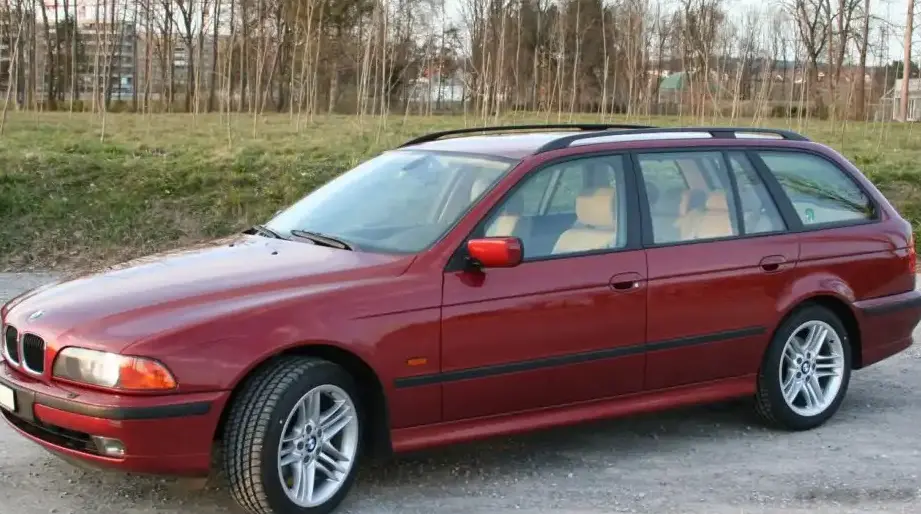
The E39 5 Series Touring, launched in 1996, brought BMW’s popular mid-size executive car into the practical world of estate wagons. The 520i Automatic variant, powered by the 2.0-liter M52B20 engine, served as the entry-level offering in many markets. It was designed to appeal to buyers who desired the prestige and driving experience of a BMW, but didn’t require the higher performance of the 528i or 540i models. This model occupied a unique space, offering a balance between affordability, fuel efficiency, and the inherent qualities of the E39 platform. Production spanned from 1995 to 1998, with minor updates occurring throughout its lifespan.
Powertrain & Engine Architecture
The heart of the 520i Touring Automatic is the M52B20, a 2.0-liter inline-six cylinder engine. This engine is renowned for its smooth operation and relatively simple design. It features a cast iron block with an aluminum cylinder head, and utilizes a dual overhead camshaft (DOHC) valvetrain with four valves per cylinder. Fuel delivery is managed by a Bosch Motronic multi-port fuel injection system, ensuring precise fuel metering for optimal performance and emissions. The M52B20 produces 150 horsepower at 5900 rpm and 190 Nm (140 lb-ft) of torque at 4200 rpm. Paired with this engine is a 5-speed automatic transmission (typically the ZF 5HP19), known for its smooth shifts and reliability. This transmission was a staple in BMWs of the era and contributed to the comfortable driving experience of the 520i.
Driving Characteristics
The 520i Automatic, while not a performance leader, offered a refined and comfortable driving experience. Acceleration from 0-60 mph took around 11.6 seconds, and top speed was limited to 129.87 mph. The automatic transmission, while providing convenience, did slightly diminish the engine’s responsiveness compared to the available manual gearbox. Gear ratios were tuned for fuel efficiency and smooth cruising, rather than aggressive acceleration. The engine delivered its peak torque at a relatively accessible 4200 rpm, providing adequate power for everyday driving situations. Compared to the more powerful 528i and 540i models, the 520i felt less urgent, but still maintained the BMW hallmark of balanced handling and precise steering.
Equipment & Trim Levels
The 520i Touring Automatic typically came standard with features such as power windows, power locks, air conditioning, and an AM/FM stereo. Interior upholstery was usually cloth, although leather was available as an option. Dashboard configuration was typical of the E39, with a clear and functional layout. Optional extras included a sunroof, heated seats, automatic climate control, and a premium sound system. The Touring model, in particular, benefited from features like a self-leveling rear suspension to compensate for varying cargo loads. Trim levels varied slightly depending on the market, but generally focused on adding comfort and convenience features.
Chassis & Braking
The E39 5 Series Touring utilized a robust chassis with a MacPherson strut front suspension and an independent multi-link rear suspension. The 520i typically featured a smaller stabilizer bar compared to the higher-performance models. Braking duties were handled by ventilated discs at the front and solid discs at the rear. Anti-lock braking system (ABS) was standard, enhancing safety and control. The suspension was tuned for a balance between comfort and handling, providing a stable and predictable ride. The rear suspension was designed to maintain a level ride height even when the vehicle was fully loaded with cargo.
Market Reception & Comparison
The 520i Touring Automatic was generally well-received by automotive critics as a practical and comfortable family car. It was praised for its spacious interior, smooth ride, and fuel efficiency. However, some reviewers noted that the engine lacked the punch of its larger counterparts. Compared to the 528i, the 520i offered significantly lower running costs and a more accessible price point. Against competitors like the Mercedes-Benz E-Class Estate and the Volvo V70, the 520i stood out for its engaging driving dynamics and premium feel. Fuel economy was a strong point, averaging around 30 mpg on the highway.
Legacy
The M52B20 engine, found in the 520i Touring Automatic, is known for its durability and relatively simple maintenance requirements. While not as sought-after as the higher-performance engines in the E39 lineup, the 520i remains a popular choice in the used car market, particularly for buyers seeking a reliable and affordable BMW estate. Common maintenance items include oil changes, coolant flushes, and occasional repairs to the cooling system. The ZF 5HP19 automatic transmission is also generally reliable, but may require servicing or rebuilding after high mileage. Today, well-maintained examples of the 520i Touring Automatic are appreciated by enthusiasts for their classic BMW styling and driving experience.