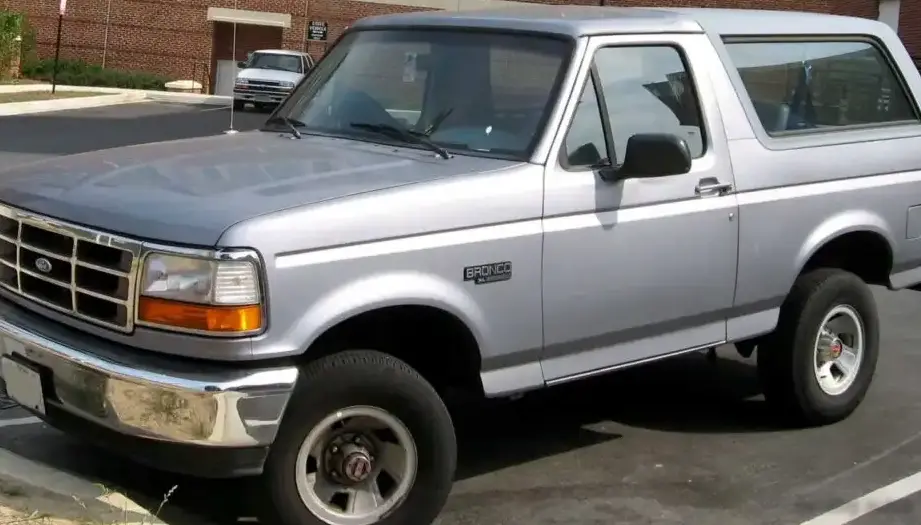
The Ford Bronco V with the 5.8-liter V8 engine and four-speed automatic transmission, produced between 1992 and 1996, represents a unique chapter in the Bronco’s history. This variant occupied the top performance tier of the fifth-generation Bronco (1992-1996), offering a substantial power upgrade over the inline-six cylinder options. It was positioned as the premium choice for buyers seeking robust capability and a powerful driving experience in a relatively compact SUV package. The Bronco V, built on the Ford Bronco platform, was exclusively available with a three-door body style and catered to those desiring a blend of on-road comfort and off-road prowess.
Technical Specifications
| Brand | Ford |
| Model | Bronco |
| Generation | Bronco V |
| Type (Engine) | 5.8 V8 (203 Hp) AWD Automatic |
| Start of production | 1992 |
| End of production | 1996 |
| Powertrain Architecture | Internal Combustion engine |
| Body type | SUV |
| Seats | 5 |
| Doors | 3 |
| Fuel consumption (economy) – urban | 19.6 l/100 km (12 US mpg, 14.4 UK mpg, 5.1 km/l) |
| Fuel consumption (economy) – extra urban | 14.7 l/100 km (16 US mpg, 19.2 UK mpg, 6.8 km/l) |
| Fuel consumption (economy) – combined | 18.1 l/100 km (13 US mpg, 15.6 UK mpg, 5.5 km/l) |
| Fuel Type | Petrol (Gasoline) |
| Power | 203 Hp @ 3800 rpm |
| Power per litre | 35.2 Hp/l |
| Torque | 407 Nm @ 2800 rpm (300.19 lb.-ft. @ 2800 rpm) |
| Engine layout | Front, Longitudinal |
| Engine Model/Code | Windsor |
| Engine displacement | 5766 cm3 (351.86 cu. in.) |
| Number of cylinders | 8 |
| Engine configuration | V-engine |
| Cylinder Bore | 101.6 mm (4 in.) |
| Piston Stroke | 88.9 mm (3.5 in.) |
| Compression ratio | 8.8:1 |
| Number of valves per cylinder | 2 |
| Fuel injection system | Multi-port manifold injection |
| Engine aspiration | Naturally aspirated engine |
| Valvetrain | OHC |
| Engine oil capacity | 4.7 l (4.97 US qt | 4.14 UK qt) |
| Coolant | 15 l (15.85 US qt | 13.2 UK qt) |
| Max. weight | 2150 kg (4739.94 lbs.) |
| Trunk (boot) space – minimum | 917 l (32.38 cu. ft.) |
| Trunk (boot) space – maximum | 1857 l (65.58 cu. ft.) |
| Fuel tank capacity | 121 l (31.96 US gal | 26.62 UK gal) |
| Length | 4663 mm (183.58 in.) |
| Width | 2009 mm (79.09 in.) |
| Height | 1892 mm (74.49 in.) |
| Wheelbase | 2659 mm (104.69 in.) |
| Front track | 1654 mm (65.12 in.) |
| Rear (Back) track | 1636 mm (64.41 in.) |
| Drag coefficient (Cd) | 0.60 |
| Minimum turning circle (turning diameter) | 11.4 m (37.4 ft.) |
| Drive wheel | All wheel drive (4×4) |
| Number of gears and type of gearbox | 4 gears, automatic transmission |
| Front suspension | Several levers and rods |
| Rear suspension | Leaf spring |
| Front brakes | Disc |
| Rear brakes | Drum |
| Assisting systems | ABS (Anti-lock braking system) |
| Tires size | 235/75 R15 |
| Wheel rims size | 15 |
Powertrain & Engine Architecture
The heart of the Bronco V was the 5.8-liter (351 cubic inch) Windsor V8 engine. This engine, a staple of Ford’s truck and SUV lineup for decades, was known for its robust construction and ample low-end torque. The Windsor engine featured a cast iron block and cylinder heads, with a two-barrel carburetor feeding the intake manifold. While not a technologically advanced engine by the 1990s standards, its simplicity contributed to its durability. The 5.8L V8 utilized a single overhead camshaft (OHC) valvetrain with two valves per cylinder. The automatic transmission paired with this engine was a four-speed unit, providing smooth, if not particularly quick, shifts. This transmission was chosen to balance usability with the engine’s substantial power output, making it suitable for both on-road cruising and off-road challenges.
Driving Characteristics
The 5.8L V8-equipped Bronco offered a distinctly different driving experience compared to the inline-six models. The V8 provided significantly more power and torque, resulting in quicker acceleration and improved towing capacity. However, the added weight of the V8 engine and the four-speed automatic transmission did impact fuel economy. The automatic transmission, while convenient, wasn’t as responsive as the available five-speed manual. Gear ratios were optimized for low-end torque, making it ideal for rock crawling and navigating challenging terrain. On the highway, the Bronco V felt capable but not particularly refined, with noticeable engine noise and a somewhat floaty ride due to the suspension setup.
Equipment & Trim Levels
The Bronco V typically came with a relatively well-equipped interior for its time. Standard features included cloth upholstery, air conditioning, and a basic AM/FM stereo. Optional extras included leather upholstery, power windows and locks, and a premium sound system. The Bronco V also often featured upgraded interior trim and exterior styling cues to differentiate it from the lower trim levels. The dashboard layout was functional and straightforward, prioritizing usability over aesthetics.
Chassis & Braking
The Bronco V utilized a body-on-frame construction, providing a rugged and durable platform. The front suspension consisted of a multi-link setup, while the rear suspension employed leaf springs. This combination offered a good balance of ride comfort and off-road capability. Braking duties were handled by disc brakes in the front and drum brakes in the rear. Anti-lock brakes (ABS) were available as an option, enhancing safety and control. The Bronco V’s chassis was designed to withstand the stresses of off-road driving, with a robust frame and heavy-duty suspension components.
Market Reception & Comparison
The Bronco V with the 5.8L V8 was generally well-received by automotive critics and enthusiasts. It was praised for its powerful engine, off-road capability, and rugged styling. However, its poor fuel economy and relatively high price tag were often cited as drawbacks. Compared to the inline-six Bronco models, the V offered a significant performance upgrade but came at a premium. It also differed from competitors like the Jeep Cherokee, which offered a more refined driving experience but lacked the Bronco’s raw power and off-road prowess.
Legacy
Today, the 1992-1996 Ford Bronco V with the 5.8L V8 engine is a sought-after vehicle among collectors and enthusiasts. Its combination of power, capability, and classic styling has made it a popular choice for restoration and customization projects. While the Windsor V8 engine is known for its durability, regular maintenance is essential to ensure its longevity. Parts availability is generally good, but some components can be difficult to find. The Bronco V represents a high point in the Bronco’s history, offering a unique and compelling blend of performance and practicality.