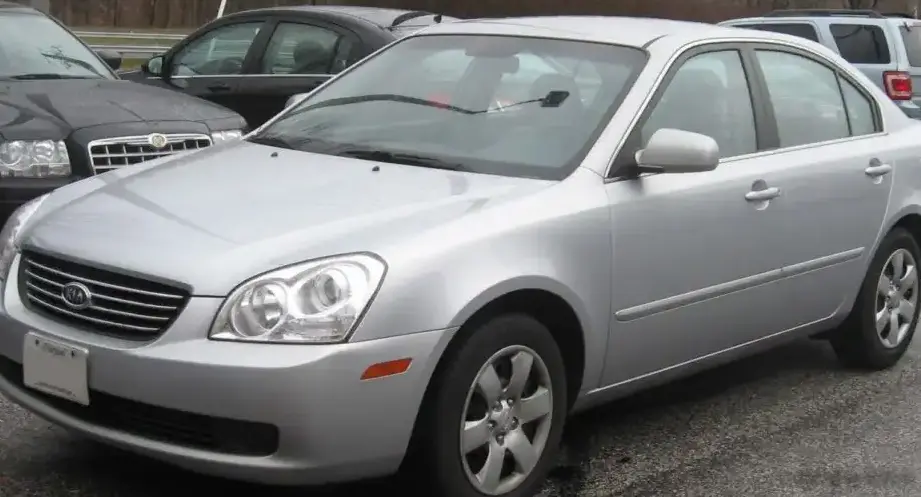
The Kia Optima II 2.0 CVVT (144 hp) was a mid-size sedan produced by the South Korean manufacturer Kia between 2005 and 2008. Representing the second generation of the Optima (known as the Magentis in some markets), this variant played a crucial role in Kia’s efforts to establish itself as a mainstream competitor in the global automotive market, particularly in North America and Europe. The 2.0 CVVT model occupied a central position in the Optima II lineup, offering a balance between performance, fuel efficiency, and affordability. It aimed to appeal to buyers seeking a comfortable and well-equipped family sedan without the higher price tag of flagship trims.
Technical Specifications
| Brand | Kia |
| Model | Optima |
| Generation | Optima II |
| Type (Engine) | 2.0 CVVT (144 Hp) |
| Start of production | 2005 |
| End of production | 2008 |
| Powertrain Architecture | Internal Combustion engine |
| Body type | Sedan |
| Seats | 5 |
| Doors | 4 |
| Fuel consumption (urban) | 10.5 l/100 km (22.4 US mpg, 26.9 UK mpg, 9.5 km/l) |
| Fuel consumption (extra urban) | 6.1 l/100 km (38.6 US mpg, 46.3 UK mpg, 16.4 km/l) |
| Fuel consumption (combined) | 7.7 l/100 km (30.5 US mpg, 36.7 UK mpg, 13 km/l) |
| CO2 emissions | 185 g/km |
| Fuel Type | Petrol (Gasoline) |
| Acceleration 0 – 100 km/h | 10.2 sec |
| Acceleration 0 – 62 mph | 10.2 sec |
| Acceleration 0 – 60 mph | 9.7 sec |
| Maximum speed | 208 km/h (129.25 mph) |
| Emission standard | Euro 4 |
| Weight-to-power ratio | 9.8 kg/Hp, 102.3 Hp/tonne |
| Weight-to-torque ratio | 7.5 kg/Nm, 133.5 Nm/tonne |
| Power | 144 Hp @ 6200 rpm |
| Power per litre | 72.1 Hp/l |
| Torque | 188 Nm @ 4250 rpm (138.66 lb.-ft. @ 4250 rpm) |
| Engine layout | Front, Transverse |
| Engine Model/Code | Theta II / G4KA |
| Engine displacement | 1998 cm3 (121.93 cu. in.) |
| Number of cylinders | 4 |
| Engine configuration | Inline |
| Cylinder Bore | 86 mm (3.39 in.) |
| Piston Stroke | 86 mm (3.39 in.) |
| Compression ratio | 10.5:1 |
| Number of valves per cylinder | 4 |
| Fuel injection system | Multi-port manifold injection |
| Engine aspiration | Naturally aspirated engine |
| Valvetrain | DOHC |
| Engine oil capacity | 4.3 l (4.54 US qt | 3.78 UK qt) |
| Coolant | 6.6 l (6.97 US qt | 5.81 UK qt) |
| Kerb Weight | 1408 kg (3104.11 lbs.) |
| Max. weight | 1960 kg (4321.06 lbs.) |
| Max load | 552 kg (1216.95 lbs.) |
| Trunk (boot) space – minimum | 496 l (17.52 cu. ft.) |
| Trunk (boot) space – maximum | 816 l (28.82 cu. ft.) |
| Fuel tank capacity | 62 l (16.38 US gal | 13.64 UK gal) |
| Max. roof load | 80 kg (176.37 lbs.) |
| Permitted trailer load with brakes (12%) | 1700 kg (3747.86 lbs.) |
| Permitted trailer load without brakes | 700 kg (1543.24 lbs.) |
| Permitted towbar download | 80 kg (176.37 lbs.) |
| Length | 4735 mm (186.42 in.) |
| Width | 1805 mm (71.06 in.) |
| Height | 1480 mm (58.27 in.) |
| Wheelbase | 2720 mm (107.09 in.) |
| Front track | 1563 mm (61.54 in.) |
| Rear (Back) track | 1552 mm (61.1 in.) |
| Minimum turning circle | 11.8 m (38.71 ft.) |
| Drivetrain Architecture | The Internal combustion engine (ICE) drives the front wheels of the vehicle. |
| Drive wheel | Front wheel drive |
| Number of gears and type of gearbox | 5 gears, manual transmission |
| Front suspension | Independent, type McPherson with coil spring and anti-roll bar |
| Rear suspension | Independent multi-link suspension |
| Front brakes | Ventilated discs |
| Rear brakes | Disc |
| Assisting systems | ABS (Anti-lock braking system) |
| Steering type | Steering rack and pinion |
| Power steering | Hydraulic Steering |
| Tires size | 205/60 R16 |
| Wheel rims size | 6.5J x 16 |
Powertrain & Engine Architecture
The heart of the Optima II 2.0 CVVT was the Kia Theta II engine, specifically the G4KA variant. This 1.998-liter (121.93 cubic inches) inline-four cylinder engine featured a cast iron block and an aluminum cylinder head. The “CVVT” designation stands for Continuously Variable Valve Timing, a technology that optimizes valve opening and closing times based on engine speed and load, improving both performance and fuel efficiency. The engine utilized a multi-point fuel injection system, delivering fuel directly to the intake ports. The Theta II engine produced 144 horsepower at 6200 rpm and 188 Nm (138.66 lb-ft) of torque at 4250 rpm. This engine was paired with a 5-speed manual transmission in the base models, providing a relatively direct connection between the engine and the front wheels.
Driving Characteristics
The 2.0L CVVT Optima offered adequate, but not exhilarating, performance. Acceleration from 0 to 60 mph took approximately 9.7 seconds, and the top speed was around 129.25 mph. The 5-speed manual transmission provided reasonable control, but the gear ratios were tuned more for fuel economy than outright speed. Compared to higher-trim Optimas equipped with the 2.4L engine, the 2.0L felt noticeably less powerful, especially when fully loaded or climbing hills. However, the 2.0L’s lighter weight and more efficient engine contributed to better fuel economy, making it a practical choice for daily commuting. The ride quality was generally comfortable, thanks to the independent front and rear suspension systems.
Equipment & Trim Levels
The 2.0 CVVT Optima typically came standard with features such as air conditioning, power windows and locks, a basic audio system, and ABS brakes. Higher trim levels added features like alloy wheels, a sunroof, upgraded audio systems, and leather upholstery. The interior was generally functional and well-built for its price point, although the materials were not as luxurious as those found in more expensive sedans. Optional extras included a CD changer, cruise control, and a power driver’s seat.
Chassis & Braking
The Optima II utilized a front-wheel-drive layout with an independent McPherson strut suspension in the front and an independent multi-link suspension in the rear. This suspension setup provided a good balance between ride comfort and handling. The front brakes were ventilated discs, while the rear brakes were solid discs. ABS (Anti-lock Braking System) was standard, enhancing safety during emergency braking situations. The steering was rack-and-pinion with hydraulic power assistance, providing a reasonably responsive feel.
Market Reception & Comparison
The Kia Optima II 2.0 CVVT was generally well-received by automotive critics as a solid and affordable mid-size sedan. It was praised for its comfortable ride, spacious interior, and good value for money. However, some critics noted that the 2.0L engine lacked the power of its competitors and that the interior materials were not as refined as those found in some other vehicles in its class. Compared to the higher-trim Optimas with the 2.4L engine, the 2.0L offered better fuel economy but less performance. It also provided a more affordable entry point into the Optima lineup, appealing to budget-conscious buyers.
Legacy
The Kia Optima II 2.0 CVVT has proven to be a relatively reliable vehicle, with many examples still on the road today. The Theta II engine is generally considered to be durable, although regular maintenance is essential to prevent issues such as oil leaks and timing chain wear. The 5-speed manual transmission is also known for its reliability. In the used car market, the 2.0 CVVT Optima represents a good value proposition for buyers seeking an affordable and practical mid-size sedan. While it may not offer the performance or luxury of more expensive vehicles, it provides a comfortable and reliable transportation option.