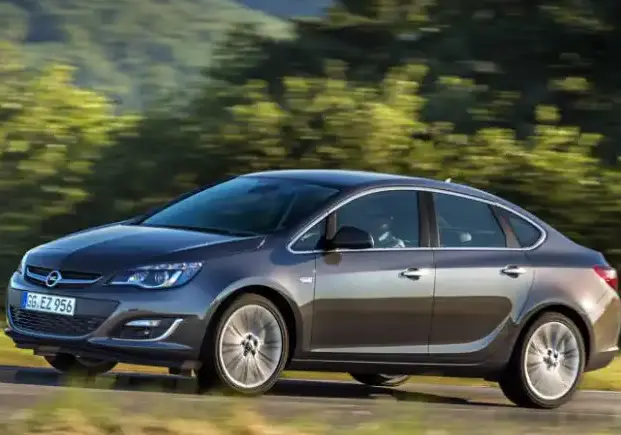
The Opel Astra J Sedan 1.7 CDTI, producing 100 horsepower, was a key variant within the Astra J Sedan range, manufactured between 2012 and 2014. Positioned as an entry-level to mid-range offering, it aimed to provide fuel efficiency and practicality for everyday commuting and family use. This model was primarily sold in European markets, where the Astra J competed with rivals like the Ford Focus, Volkswagen Golf, and Peugeot 308. The Astra J Sedan itself represented Opel’s attempt to cater to the growing demand for compact sedans, offering a more traditional trunk design compared to the hatchback version, particularly appealing to customers in regions where sedans were preferred.
Technical Specifications
| Brand | Opel |
| Model | Astra |
| Generation | Astra J Sedan |
| Type (Engine) | 1.7 CDTI (100 Hp) |
| Start of production | 2012 |
| End of production | 2014 |
| Powertrain Architecture | Internal Combustion engine |
| Body type | Sedan |
| Seats | 5 |
| Doors | 4 |
| Fuel consumption (urban) | 5.6 l/100 km (42 US mpg, 50.4 UK mpg, 17.9 km/l) |
| Fuel consumption (extra urban) | 4 l/100 km (58.8 US mpg, 70.6 UK mpg, 25 km/l) |
| Fuel consumption (combined) | 4.6 l/100 km (51.1 US mpg, 61.4 UK mpg, 21.7 km/l) |
| CO2 emissions | 122 g/km |
| Fuel Type | Diesel |
| Acceleration 0 – 100 km/h | 12.4 sec |
| Acceleration 0 – 62 mph | 12.4 sec |
| Acceleration 0 – 60 mph | 11.8 sec |
| Maximum speed | 188 km/h (116.82 mph) |
| Emission standard | Euro 5 |
| Weight-to-power ratio | 14.1 kg/Hp, 71.2 Hp/tonne |
| Weight-to-torque ratio | 5.4 kg/Nm, 185.1 Nm/tonne |
| Power | 100 Hp @ 4000 rpm |
| Power per litre | 59.3 Hp/l |
| Torque | 260 Nm @ 1750-2500 rpm (191.77 lb.-ft. @ 1750-2500 rpm) |
| Engine layout | Front, Transverse |
| Engine Model/Code | A17DTL, A17DTN |
| Engine displacement | 1686 cm3 (102.89 cu. in.) |
| Number of cylinders | 4 |
| Engine configuration | Inline |
| Cylinder Bore | 79 mm (3.11 in.) |
| Piston Stroke | 86 mm (3.39 in.) |
| Number of valves per cylinder | 4 |
| Fuel injection system | Diesel Commonrail |
| Engine aspiration | Turbocharger, Intercooler |
| Engine oil capacity | 5.4 l (5.71 US qt | 4.75 UK qt) |
| Coolant | 6.2 l (6.55 US qt | 5.46 UK qt) |
| Kerb Weight | 1405 kg (3097.49 lbs.) |
| Max. weight | 1895 kg (4177.76 lbs.) |
| Max load | 490 kg (1080.27 lbs.) |
| Trunk (boot) space – minimum | 460 l (16.24 cu. ft.) |
| Trunk (boot) space – maximum | 1010 l (35.67 cu. ft.) |
| Fuel tank capacity | 56 l (14.79 US gal | 12.32 UK gal) |
| Length | 4658 mm (183.39 in.) |
| Width | 1814 mm (71.42 in.) |
| Width including mirrors | 2013 mm (79.25 in.) |
| Height | 1500 mm (59.06 in.) |
| Wheelbase | 2685 mm (105.71 in.) |
| Front track | 1541 mm (60.67 in.) |
| Rear (Back) track | 1551 mm (61.06 in.) |
| Front overhang | 974 mm (38.35 in.) |
| Rear overhang | 999 mm (39.33 in.) |
| Minimum turning circle | 11.5 m (37.73 ft.) |
| Drivetrain Architecture | ICE to Front Wheels |
| Drive wheel | Front wheel drive |
| Number of gears | 6 |
| Gearbox type | Manual transmission |
| Front brakes | Ventilated discs |
| Assisting systems | ABS |
| Steering type | Steering rack and pinion |
| Power steering | Electric |
Powertrain & Engine Architecture
The Astra J Sedan 1.7 CDTI utilized Opel’s A17DTL or A17DTN engine code, a 1.7-liter inline-four cylinder diesel engine. This engine was part of Opel’s ‘ecoFlex’ range, emphasizing fuel efficiency. It featured a common rail direct injection system, delivering fuel directly into the combustion chamber at high pressure for optimized combustion. A turbocharger with an intercooler was employed to boost power output and improve torque across a wider rev range. The engine also incorporated four valves per cylinder, enhancing breathing and contributing to its overall efficiency. The 100 horsepower output was achieved at 4000 rpm, while peak torque of 260 Nm (191.77 lb-ft) was available between 1750 and 2500 rpm. This engine was paired with a six-speed manual transmission, chosen for its balance of fuel economy and driver engagement. While an automatic transmission was offered on other Astra J variants, it wasn’t typically paired with this specific 1.7 CDTI engine.
Driving Characteristics
The 1.7 CDTI with the manual transmission offered a practical and economical driving experience. Acceleration was modest, taking around 12.4 seconds to reach 62 mph (100 km/h), making it less suited for spirited driving. However, the engine’s strong low-end torque made it feel responsive in everyday driving situations, such as overtaking and merging onto highways. The six-speed gearbox was well-matched to the engine’s characteristics, allowing drivers to keep the engine in its optimal torque band. Compared to the more powerful 1.4 Turbo or 2.0 CDTI variants, the 1.7 CDTI prioritized fuel economy over outright performance. The manual transmission provided more driver control than an automatic would have, but also required more driver involvement.
Equipment & Trim Levels
The Astra J Sedan 1.7 CDTI typically came with a reasonable level of standard equipment. This included air conditioning, electric front windows, a basic audio system with USB connectivity, and ABS brakes. Higher trim levels, such as ‘Enjoy’ or ‘Cosmo’, added features like alloy wheels, cruise control, a more advanced infotainment system, and parking sensors. Interior upholstery was typically cloth, with options for upgraded materials on higher trims. The dashboard layout was functional and straightforward, prioritizing ease of use. Optional extras included a sunroof, leather seats, and a navigation system.
Chassis & Braking
The Astra J Sedan featured a MacPherson strut front suspension and a torsion beam rear suspension. This setup provided a good balance of ride comfort and handling. The front brakes were ventilated discs, offering adequate stopping power, while the rear brakes were typically drum brakes on the base models, upgraded to discs on higher trims. Electric power steering was standard, providing light and precise steering feel. Stabilizer bars were fitted to both the front and rear axles to reduce body roll during cornering.
Market Reception & Comparison
The Astra J Sedan 1.7 CDTI was generally well-received by critics for its fuel efficiency and practicality. It was seen as a sensible choice for drivers prioritizing economy over performance. Compared to the more powerful Astra J variants, the 1.7 CDTI offered significantly better fuel economy, making it an attractive option for high-mileage drivers. However, its slower acceleration and less refined engine note were noted as drawbacks. Reliability was generally good, with the 1.7 CDTI engine proving to be durable and relatively trouble-free.
Legacy
The Opel Astra J Sedan 1.7 CDTI remains a common sight on European roads today. The A17DTL/A17DTN engine has proven to be a reliable unit, and well-maintained examples can still provide years of service. In the used car market, this variant represents a good value proposition for buyers seeking an affordable and economical compact sedan. While not the most exciting Astra J variant, its fuel efficiency and practicality have ensured its enduring popularity.