Technical Specifications
| Brand | Citroen |
| Model | Nemo |
| Generation | Nemo Panel Van |
| Type (Engine) | 1.4 (75 Hp) |
| Start of production | 2008 year |
| End of production | 2016 year |
| Powertrain Architecture | Internal Combustion engine |
| Body type | Minivan |
| Seats | 2 |
| Doors | 3-5 |
| Fuel consumption (economy) – urban | 8-8.8 l/100 km (29.4 – 26.7 US mpg, 35.3 – 32.1 UK mpg, 12.5 – 11.4 km/l) |
| Fuel consumption (economy) – extra urban | 5.4-5.9 l/100 km (43.6 – 39.9 US mpg, 52.3 – 47.9 UK mpg, 18.5 – 16.9 km/l) |
| Fuel consumption (economy) – combined | 6.4-6.9 l/100 km (36.8 – 34.1 US mpg, 44.1 – 40.9 UK mpg, 15.6 – 14.5 km/l) |
| CO2 emissions | 148-164 g/km |
| Fuel Type | Petrol (Gasoline) |
| Acceleration 0 – 100 km/h | 15 sec |
| Acceleration 0 – 62 mph | 15 sec |
| Acceleration 0 – 60 mph | 14.3 sec |
| Maximum speed | 157 km/h (97.56 mph) |
| Emission standard | Euro 5 |
| Weight-to-power ratio | 14.3 kg/Hp, 70.1 Hp/tonne |
| Weight-to-torque ratio | 9.1 kg/Nm, 110.3 Nm/tonne |
| Power | 75 Hp @ 5200 rpm |
| Power per litre | 55.1 Hp/l |
| Torque | 118 Nm @ 2600 rpm (87.03 lb.-ft. @ 2600 rpm) |
| Engine layout | Front, Transverse |
| Engine Model/Code | KFT TU3AE5, KFV TU3A |
| Engine displacement | 1360 cm3 (82.99 cu. in.) |
| Number of cylinders | 4 |
| Engine configuration | Inline |
| Cylinder Bore | 75 mm (2.95 in.) |
| Piston Stroke | 77 mm (3.03 in.) |
| Number of valves per cylinder | 2 |
| Fuel injection system | Multi-port manifold injection |
| Engine aspiration | Naturally aspirated engine |
| Valvetrain | SOHC |
| Engine oil capacity | 3 l (3.17 US qt | 2.64 UK qt) |
| Coolant | 5.3 l (5.6 US qt | 4.66 UK qt) |
| Kerb Weight | 1070 kg (2358.95 lbs.) |
| Max. weight | 1680 kg (3703.77 lbs.) |
| Max load | 610 kg (1344.82 lbs.) |
| Trunk (boot) space – minimum | 2500 l (88.29 cu. ft.) |
| Trunk (boot) space – maximum | 2800 l (98.88 cu. ft.) |
| Fuel tank capacity | 45 l (11.89 US gal | 9.9 UK gal) |
| Max. roof load | 75 kg (165.35 lbs.) |
| Permitted trailer load with brakes (12%) | 600 kg (1322.77 lbs.) |
| Permitted trailer load without brakes | 400 kg (881.85 lbs.) |
| Permitted towbar download | 60 kg (132.28 lbs.) |
| Length | 3864 mm (152.13 in.) |
| Width | 1716 mm (67.56 in.) |
| Width with mirrors folded | 1816 mm (71.5 in.) |
| Width including mirrors | 2019 mm (79.49 in.) |
| Height | 1721 mm (67.76 in.) |
| Wheelbase | 2513 mm (98.94 in.) |
| Front track | 1469 mm (57.83 in.) |
| Rear (Back) track | 1465 mm (57.68 in.) |
| Front overhang | 760 mm (29.92 in.) |
| Rear overhang | 591 mm (23.27 in.) |
| Minimum turning circle (turning diameter) | 9.95 m (32.64 ft.) |
| Drivetrain Architecture | The Internal combustion engine (ICE) drives the front wheels of the vehicle. |
| Drive wheel | Front wheel drive |
| Number of gears and type of gearbox | 5 gears, manual transmission |
| Front suspension | Independent, type McPherson with coil spring and anti-roll bar |
| Rear suspension | Transverse stabilizer, Trailing arm, Coil spring, Torsion |
| Front brakes | Ventilated discs |
| Rear brakes | Drum |
| Assisting systems | ABS (Anti-lock braking system) |
| Steering type | Steering rack and pinion |
| Power steering | Hydraulic Steering |
| Tires size | 175/70 R14; 185/65 R15 |
| Wheel rims size | 5.5J x 14; 6J x 15 |
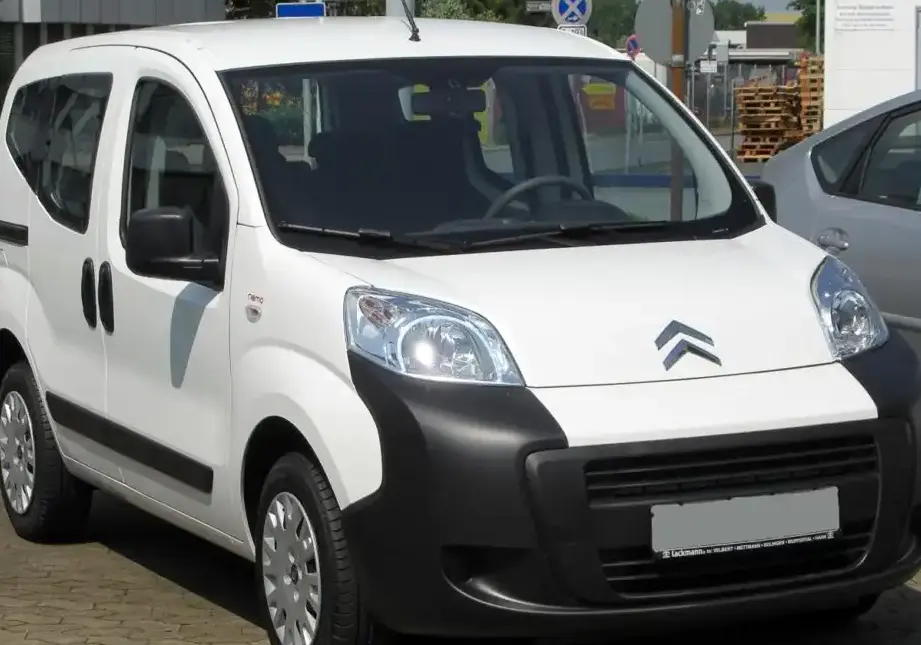
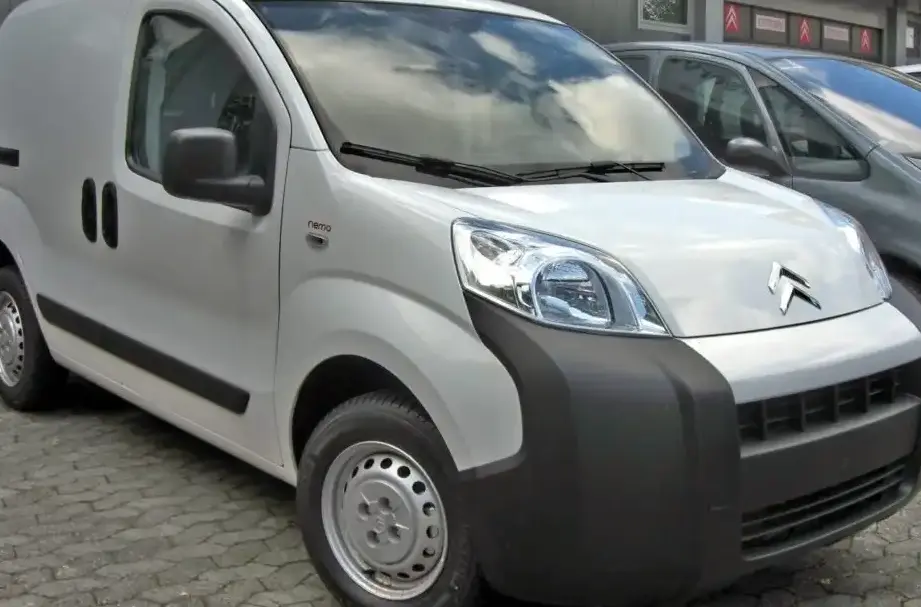
The Citroen Nemo Panel Van 1.4 (75 hp) represents a practical and economical light commercial vehicle produced by Citroen between 2008 and 2016. Part of the first generation Nemo (codenamed AY), it was developed in collaboration with Fiat and Peugeot, resulting in the closely related Fiat Fiorino and Peugeot Bipper. The Nemo Panel Van specifically targeted small businesses and tradespeople requiring a compact, fuel-efficient vehicle for urban deliveries and service calls. This 75 horsepower variant, paired with a manual transmission, served as the entry point into the Nemo Panel Van range, prioritizing affordability and running costs over outright performance. It was a key player in the microvan segment in Europe, offering a viable alternative to larger, more expensive vans.
Powertrain & Engine Architecture
The Citroen Nemo 1.4 (75 hp) utilizes the KFT/KFV TU3A engine family, a naturally aspirated, inline-four cylinder petrol engine. This engine, common in various European small cars of the era, features a single overhead camshaft (SOHC) valvetrain operating two valves per cylinder. Fuel delivery is managed by a multi-point fuel injection system. The 1360cc displacement provides a modest 75 horsepower at 5200 rpm and 118 Nm (87 lb-ft) of torque at 2600 rpm. The engine is transversely mounted at the front of the vehicle, driving the front wheels. The standard transmission for this variant was a five-speed manual gearbox, chosen for its simplicity and contribution to fuel efficiency. While an automated manual transmission was offered on some Nemo models, it wasn’t typically paired with this specific 75 hp engine.
Driving Characteristics
The Nemo 1.4 (75 hp) offers a utilitarian driving experience. Acceleration is modest, taking approximately 15 seconds to reach 62 mph (100 km/h). The engine feels strained when fully loaded or climbing hills. The five-speed manual transmission is well-matched to the engine’s characteristics, allowing drivers to keep the engine in its optimal torque band. Gear ratios are relatively long, prioritizing fuel economy over spirited performance. Compared to the more powerful 1.6L petrol or diesel variants, the 1.4L feels noticeably slower, but it provides adequate performance for urban deliveries and short trips. The steering is light and easy, making maneuvering in tight spaces straightforward.
Equipment & Trim Levels
The 1.4 (75 hp) Nemo Panel Van typically represented the base trim level. Standard equipment included a driver’s airbag, central locking, and power steering. The interior was functional and durable, with hard-wearing plastics and basic cloth upholstery. The cabin focused on practicality, with ample storage compartments and a driver-focused layout. Optional extras included air conditioning, a passenger airbag, and electric windows. Higher trim levels added features like body-colored bumpers, upgraded interior trim, and a radio/CD player.
Chassis & Braking
The Nemo Panel Van utilizes a McPherson strut front suspension with a coil spring and anti-roll bar, providing a comfortable ride for a light commercial vehicle. The rear suspension employs a trailing arm setup with coil springs and a torsion beam. Braking duties are handled by ventilated discs at the front and drum brakes at the rear. Anti-lock Braking System (ABS) was standard, enhancing safety. The relatively light weight of the vehicle contributes to its manageable handling characteristics.
Market Reception & Comparison
The Citroen Nemo 1.4 (75 hp) was generally well-received as an affordable and fuel-efficient option in the microvan segment. Critics praised its practicality and low running costs, but noted its limited performance. Compared to the Fiat Fiorino and Peugeot Bipper – its mechanically identical siblings – the Nemo differentiated itself primarily through branding and minor styling differences. The 1.4L petrol engine offered a lower purchase price than the diesel alternatives, but at the expense of fuel economy and torque. The diesel variants were favored by those covering higher mileages.
Legacy
The Citroen Nemo Panel Van 1.4 (75 hp) remains a common sight on European roads, particularly among small businesses. The TU3A engine is known for its reliability and relatively simple maintenance requirements. While not a performance icon, the Nemo 1.4’s durability and low operating costs have ensured its longevity in the used car market. Parts availability remains good, making it a practical and affordable choice for those seeking a compact, economical van.