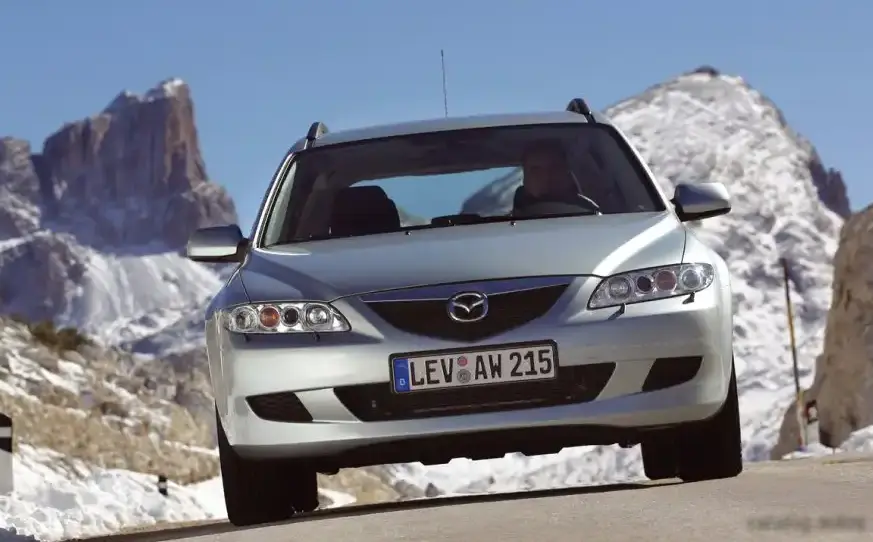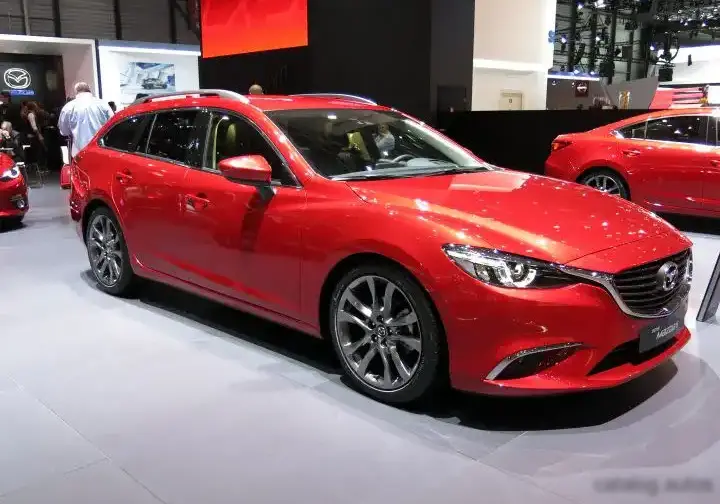
The Mazda 6 III Sport Combi, specifically the facelifted model produced from 2015 to 2017, represented a significant evolution of Mazda’s mid-size wagon. The 2.0 SKYACTIV-G variant, producing 165 horsepower and paired with a six-speed automatic transmission, occupied a central position within the lineup, offering a balance between performance, fuel efficiency, and affordability. This model, designated internally as GJ, was primarily aimed at the European and Asian markets, where the station wagon (estate) body style remained popular. It built upon the success of the GJ generation, introduced in 2012, with styling refinements and technological updates.
Technical Specifications
| Brand | Mazda |
| Model | 6 |
| Generation | 6 III Sport Combi (GJ, facelift 2015) |
| Type (Engine) | 2.0 SKYACTIV-G (165 Hp) Automatic |
| Start of production | 2015 |
| End of production | 2017 |
| Powertrain Architecture | Internal Combustion engine |
| Body type | Station wagon (estate) |
| Seats | 5 |
| Doors | 5 |
| Fuel consumption (urban) | 7.7 l/100 km (30.5 US mpg, 36.7 UK mpg, 13 km/l) |
| Fuel consumption (extra urban) | 5 l/100 km (47 US mpg, 56.5 UK mpg, 20 km/l) |
| Fuel consumption (combined) | 6 l/100 km (39.2 US mpg, 47.1 UK mpg, 16.7 km/l) |
| CO2 emissions | 139 g/km |
| Fuel Type | Petrol (Gasoline) |
| Acceleration 0 – 100 km/h | 10.2 sec |
| Acceleration 0 – 62 mph | 10.2 sec |
| Acceleration 0 – 60 mph | 9.7 sec |
| Maximum speed | 205 km/h (127.38 mph) |
| Emission standard | Euro 6 |
| Weight-to-power ratio | 8.6 kg/Hp, 116.6 Hp/tonne |
| Weight-to-torque ratio | 6.7 kg/Nm, 148.4 Nm/tonne |
| Power | 165 Hp @ 6000 rpm |
| Power per litre | 82.6 Hp/l |
| Torque | 210 Nm @ 4000 rpm (154.89 lb.-ft. @ 4000 rpm) |
| Engine layout | Front, Transverse |
| Engine displacement | 1998 cm3 (121.93 cu. in.) |
| Number of cylinders | 4 |
| Engine configuration | Inline |
| Cylinder Bore | 83.5 mm (3.29 in.) |
| Piston Stroke | 91.2 mm (3.59 in.) |
| Compression ratio | 14:1 |
| Number of valves per cylinder | 4 |
| Fuel injection system | Direct injection |
| Engine aspiration | Naturally aspirated engine |
| Engine oil capacity | 4.2 l (4.44 US qt | 3.7 UK qt) |
| Coolant | 6.9 l (7.29 US qt | 6.07 UK qt) |
| Kerb Weight | 1415-1517 kg (3119.54 – 3344.41 lbs.) |
| Max. weight | 2020 kg (4453.34 lbs.) |
| Max load | 503-605 kg (1108.93 – 1333.8 lbs.) |
| Trunk (boot) space – minimum | 522 l (18.43 cu. ft.) |
| Trunk (boot) space – maximum | 1664 l (58.76 cu. ft.) |
| Fuel tank capacity | 62 l (16.38 US gal | 13.64 UK gal) |
| Max. roof load | 100 kg (220.46 lbs.) |
| Permitted trailer load with brakes (8%) | 1700 kg (3747.86 lbs.) |
| Permitted trailer load with brakes (12%) | 1500 kg (3306.93 lbs.) |
| Permitted trailer load without brakes | 680 kg (1499.14 lbs.) |
| Permitted towbar download | 75 kg (165.35 lbs.) |
| Length | 4805 mm (189.17 in.) |
| Width | 1840 mm (72.44 in.) |
| Height | 1480 mm (58.27 in.) |
| Wheelbase | 2750 mm (108.27 in.) |
| Minimum turning circle | 11 m (36.09 ft.) |
| Drivetrain Architecture | The Internal combustion engine (ICE) drives the front wheels of the vehicle. |
| Drive wheel | Front wheel drive |
| Number of gears and type of gearbox | 6 gears, automatic transmission |
| Front brakes | Ventilated discs |
| Rear brakes | Disc |
| Assisting systems | ABS (Anti-lock braking system) |
| Steering type | Steering rack and pinion |
| Power steering | Electric Steering |
Powertrain & Engine Architecture
At the heart of the 2.0 SKYACTIV-G variant lies Mazda’s PE-VPH engine, a 1998cc inline-four cylinder gasoline engine. This engine is a cornerstone of Mazda’s SKYACTIV technology, designed to maximize combustion efficiency. Key features include a high compression ratio of 14:1, achieved through careful engineering and knock control strategies. Direct injection is employed to precisely deliver fuel into the combustion chamber, optimizing the air-fuel mixture. The engine utilizes a dual-overhead camshaft (DOHC) valvetrain with four valves per cylinder, enhancing volumetric efficiency. The six-speed automatic transmission, also part of the SKYACTIV suite, is designed for smooth and responsive shifting, prioritizing fuel economy without sacrificing drivability. Unlike some competitors, Mazda eschewed turbocharging in this configuration, focusing instead on maximizing the potential of naturally aspirated combustion.
Driving Characteristics
The 165 horsepower and 154.89 lb-ft of torque produced by the 2.0 SKYACTIV-G engine, when coupled with the six-speed automatic, provided adequate, though not exhilarating, performance. Acceleration from 0-60 mph took approximately 9.7 seconds. The automatic transmission was tuned for efficiency, with gear ratios selected to keep the engine operating within its optimal range. Compared to the manual transmission version, the automatic offered slightly reduced acceleration due to inherent transmission losses. It also differed significantly from higher-output variants, such as those equipped with the 2.5-liter engine, which offered considerably more power and a sportier driving experience. The focus of this variant was on comfortable cruising and everyday usability rather than outright performance.
Equipment & Trim Levels
The 2.0 SKYACTIV-G Automatic typically came equipped with a respectable level of standard features. These included air conditioning, power windows and mirrors, a basic audio system with USB connectivity, and alloy wheels. Higher trim levels, often denoted by suffixes like ‘Sport’ or ‘Touring’, added features such as a touchscreen infotainment system, navigation, leather upholstery, and advanced safety technologies like lane departure warning and automatic emergency braking. Interior upholstery was generally cloth on base models, with leather options available on higher trims. Dashboard configuration was consistent across the range, featuring a clean and modern design.
Chassis & Braking
The Mazda 6 Sport Combi featured a front-wheel-drive layout with independent suspension at the front (typically MacPherson strut) and either independent multi-link or a twist-beam setup at the rear, depending on the specific trim level and market. Braking consisted of ventilated discs at the front and solid discs at the rear. Anti-lock Braking System (ABS) was standard. The suspension was tuned for a balance between comfort and handling, providing a relatively compliant ride without sacrificing stability. Stabilizer bars were fitted front and rear to reduce body roll during cornering.
Market Reception & Comparison
The 2.0 SKYACTIV-G Automatic variant of the Mazda 6 Sport Combi was generally well-received by automotive critics. It was praised for its fuel efficiency, comfortable ride, and refined interior. However, some reviewers noted that the engine lacked the punch of its turbocharged competitors. Compared to the 2.2-liter diesel variants, the gasoline engine offered lower torque but was quieter and more responsive at higher engine speeds. Fuel economy was competitive with other gasoline-powered vehicles in its class, but the diesel models offered significantly better mileage. Reliability proved to be good, with few widespread issues reported.
Legacy
The 2.0 SKYACTIV-G engine, in both manual and automatic forms, has proven to be a reliable and durable powertrain. The six-speed automatic transmission has also demonstrated good longevity. On the used car market, these models are generally sought after for their blend of practicality, fuel efficiency, and Mazda’s reputation for build quality. While not the most powerful or sporty variant of the Mazda 6, the 2.0 SKYACTIV-G Automatic remains a sensible and appealing choice for buyers seeking a comfortable and reliable family wagon.