
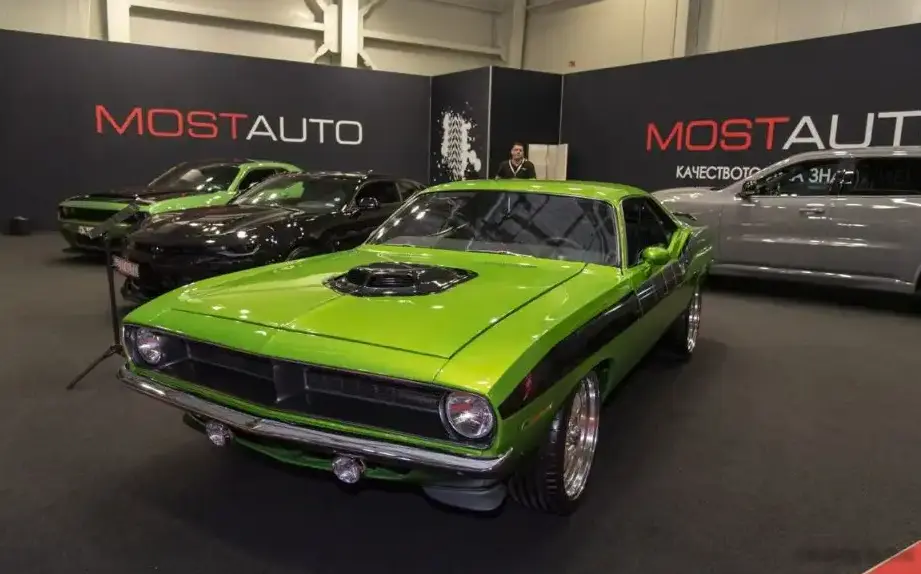
The Plymouth Barracuda III, specifically equipped with the 7.0-liter (426.19 cubic inch) Hemi V8 engine and TorqueFlite automatic transmission, represents a high-performance pinnacle of the second-generation Barracuda line. Produced solely for the 1970 model year, this variant was positioned as the ultimate expression of muscle car performance within the Barracuda range. It occupied the top tier of available powertrains, significantly outperforming the slant-six and smaller V8 options. The ’70 Barracuda, and particularly the Hemi version, is now a highly sought-after collector car, embodying the spirit of the American muscle car era.
Technical Specifications
| Brand | Plymouth |
| Model | Barracuda |
| Generation | Barracuda III |
| Type (Engine) | 7.0 V8 (425 Hp) TorqueFlite |
| Start of production | 1970 |
| End of production | 1970 |
| Powertrain Architecture | Internal Combustion engine |
| Body type | Coupe |
| Seats | 4 |
| Doors | 2 |
| Fuel Type | Petrol (Gasoline) |
| Power | 425 Hp @ 5000 rpm |
| Power per litre | 60.9 Hp/l |
| Torque | 664 Nm @ 4000 rpm / 489.74 lb.-ft. @ 4000 rpm |
| Engine layout | Front, Longitudinal |
| Engine Model/Code | Hemi |
| Engine displacement | 6984 cm3 / 426.19 cu. in. |
| Number of cylinders | 8 |
| Engine configuration | V-engine |
| Cylinder Bore | 108 mm / 4.25 in. |
| Piston Stroke | 95.3 mm / 3.75 in. |
| Compression ratio | 10.25:1 |
| Number of valves per cylinder | 2 |
| Fuel injection system | Carburettor |
| Engine aspiration | Naturally aspirated engine |
| Valvetrain | OHV |
| Engine oil capacity | 4.7 l / 4.97 US qt | 4.14 UK qt |
| Trunk (boot) space – minimum | 167 l / 5.9 cu. ft. |
| Fuel tank capacity | 72 l / 19.02 US gal | 15.84 UK gal |
| Length | 4742 mm / 186.69 in. |
| Width | 1902 mm / 74.88 in. |
| Height | 1293 mm / 50.91 in. |
| Wheelbase | 2743 mm / 107.99 in. |
| Front track | 1516 mm / 59.69 in. |
| Rear (Back) track | 1542 mm / 60.71 in. |
| Drivetrain Architecture | The Internal combustion engine (ICE) drives the rear wheels of the vehicle. |
| Drive wheel | Rear wheel drive |
| Number of gears and type of gearbox | 3 gears, automatic transmission TorqueFlite |
| Front suspension | Independent torsion bar, double wishbone, Transverse stabilizer |
| Rear suspension | Rigid axle suspension, Transverse stabilizer, Leaf spring |
| Front brakes | Drum, 279.4×76.2 mm |
| Rear brakes | Drum, 279.4×63.5 mm |
| Steering type | Cone worm with recirculation balls |
| Wheel rims size | 6J x 15 |
Powertrain & Engine Architecture
The heart of the 1970 Barracuda Hemi was the 426 cubic inch (7.0L) Hemi V8 engine. This engine, designated the E-Hemi, was a significant departure from the earlier wedge-head Chrysler V8s. It featured a hemispherical combustion chamber design, hence the “Hemi” name, which allowed for larger valves and improved airflow. The engine utilized a cast iron block and aluminum cylinder heads. Fuel delivery was managed by a single four-barrel carburetor, and the valvetrain employed overhead valves (OHV) with a hydraulic lifter system. The 426 Hemi produced 425 horsepower at 5,000 rpm and 490 lb-ft of torque at 4,000 rpm. This power was channeled through the Chrysler A727 TorqueFlite three-speed automatic transmission, known for its durability and ability to handle high horsepower. The TorqueFlite was specifically reinforced to cope with the Hemi’s output.
Driving Characteristics
The combination of the 426 Hemi and TorqueFlite transmission resulted in a truly formidable driving experience. While not as nimble as some of the lighter Barracuda models, the Hemi version delivered breathtaking acceleration. The TorqueFlite’s gear ratios were optimized for straight-line performance, providing strong off-the-line launches and impressive mid-range power. Compared to the manual transmission options, the TorqueFlite offered ease of use, but at the expense of some driver control. The Hemi’s substantial torque meant that frequent downshifting wasn’t necessary for most driving situations. However, the car’s weight and the automatic transmission did impact fuel economy, making it a less practical daily driver.
Equipment & Trim Levels
The 1970 Barracuda Hemi was generally well-equipped, though options were still available. Standard features included a vinyl interior, basic instrumentation, and a steering wheel. However, buyers could add options such as power steering, power brakes, air conditioning, and a premium sound system. The Hemi package itself included specific features like a heavy-duty cooling system, reinforced suspension components, and a unique hood scoop. Interior trim options included various colors and materials, allowing buyers to personalize their vehicle. Bucket seats were a popular choice, adding to the car’s sporty appeal.
Chassis & Braking
The Barracuda III chassis was based on a unibody construction, providing a good balance of strength and weight. The front suspension utilized an independent torsion bar system with a transverse stabilizer bar, while the rear suspension employed a solid axle with leaf springs and a transverse stabilizer bar. This setup provided a reasonably comfortable ride, although it wasn’t as sophisticated as some contemporary European sports cars. Braking duties were handled by drum brakes on all four wheels. While adequate for the time, the drum brakes were a limitation compared to the disc brakes offered on some other performance cars. The Hemi-equipped Barracudas often received heavier-duty suspension components to handle the increased power and weight.
Market Reception & Comparison
The 1970 Plymouth Barracuda Hemi was met with considerable excitement by automotive enthusiasts. Critics praised its raw power and acceleration, but also noted its high price and limited practicality. Compared to other Barracuda trims, such as those equipped with the 318 or 340 cubic inch V8s, the Hemi version was significantly more expensive and less fuel-efficient. However, it offered a level of performance that those engines simply couldn’t match. The Hemi Barracuda was often compared to other muscle cars of the era, such as the Chevrolet Chevelle SS 454 and the Ford Mustang Mach 1. In terms of straight-line speed, the Hemi Barracuda was often considered to be among the fastest of these cars.
Legacy
Today, the 1970 Plymouth Barracuda Hemi is a highly collectible and valuable muscle car. Its rarity, combined with its iconic status and impressive performance, has made it a favorite among collectors. The 426 Hemi engine is considered to be one of the greatest engines ever produced by Chrysler, and the Barracuda Hemi represents the ultimate expression of this legendary powerplant. While maintenance can be costly due to the engine’s complexity and the car’s age, the Hemi Barracuda remains a symbol of American muscle car dominance. The powertrain, when properly maintained, is known for its durability, and many examples are still being enjoyed by enthusiasts today. Finding original, unrestored examples is becoming increasingly difficult, driving up their value in the collector car market.
