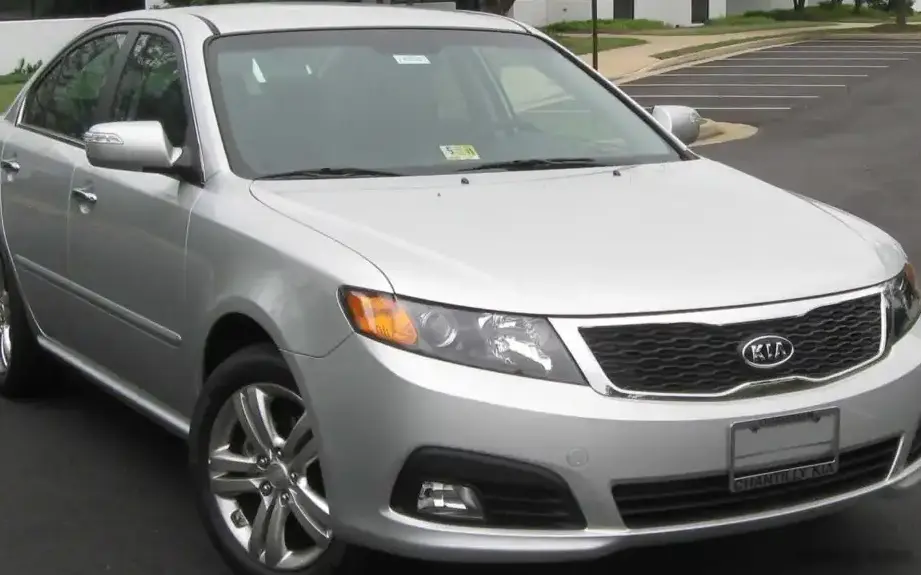
The Kia Optima II, specifically the facelifted version released in 2008, represented a significant step forward for the Korean automaker in the mid-size sedan segment. Offered globally, including a notable presence in the North American market, the Optima aimed to challenge established Japanese and American competitors with a combination of style, features, and value. The 2.7-liter V6 engine paired with a five-speed automatic transmission was a mid-range offering within the Optima II lineup, positioned above the base 2.4-liter four-cylinder but below any potential higher-performance trims. Production of this specific configuration ran from 2008 to 2009.
Technical Specifications
| Brand | Kia |
| Model | Optima |
| Generation | Optima II (facelift 2008) |
| Type (Engine) | 2.7 V6 (193 Hp) Automatic |
| Start of production | 2008 |
| End of production | 2009 |
| Powertrain Architecture | Internal Combustion engine |
| Body type | Sedan |
| Seats | 5 |
| Doors | 4 |
| Fuel consumption (urban) | 13 l/100 km (18.1 US mpg, 21.7 UK mpg, 7.7 km/l) |
| Fuel consumption (extra urban) | 6.8 l/100 km (34.6 US mpg, 41.5 UK mpg, 14.7 km/l) |
| Fuel consumption (combined) | 9.1 l/100 km (25.8 US mpg, 31 UK mpg, 11 km/l) |
| CO2 emissions | 215 g/km |
| Fuel Type | Petrol (Gasoline) |
| Acceleration 0 – 100 km/h | 9 sec |
| Acceleration 0 – 62 mph | 9 sec |
| Acceleration 0 – 60 mph | 8.6 sec |
| Maximum speed | 220 km/h (136.7 mph) |
| Emission standard | Euro 4 |
| Weight-to-power ratio | 7.8 kg/Hp, 128 Hp/tonne |
| Weight-to-torque ratio | 6.1 kg/Nm, 163.8 Nm/tonne |
| Power | 193 Hp @ 6000 rpm |
| Power per litre | 72.7 Hp/l |
| Torque | 247 Nm @ 4500 rpm (182.18 lb.-ft. @ 4500 rpm) |
| Engine layout | Front, Transverse |
| Engine displacement | 2656 cm3 (162.08 cu. in.) |
| Number of cylinders | 6 |
| Engine configuration | V-engine |
| Cylinder Bore | 86.7 mm (3.41 in.) |
| Piston Stroke | 75 mm (2.95 in.) |
| Compression ratio | 10.4:1 |
| Number of valves per cylinder | 4 |
| Fuel injection system | Multi-port manifold injection |
| Engine aspiration | Naturally aspirated engine |
| Engine oil capacity | 4.5 l (4.76 US qt | 3.96 UK qt) |
| Coolant | 8.2 l (8.66 US qt | 7.21 UK qt) |
| Kerb Weight | 1508 kg (3324.57 lbs.) |
| Max. weight | 2020 kg (4453.34 lbs.) |
| Max load | 512 kg (1128.77 lbs.) |
| Trunk (boot) space – minimum | 500 l (17.66 cu. ft.) |
| Trunk (boot) space – maximum | 816 l (28.82 cu. ft.) |
| Fuel tank capacity | 62 l (16.38 US gal | 13.64 UK gal) |
| Max. roof load | 80 kg (176.37 lbs.) |
| Permitted trailer load with brakes (12%) | 1700 kg (3747.86 lbs.) |
| Permitted trailer load without brakes | 750 kg (1653.47 lbs.) |
| Permitted towbar download | 80 kg (176.37 lbs.) |
| Length | 4800 mm (188.98 in.) |
| Width | 1805 mm (71.06 in.) |
| Height | 1480 mm (58.27 in.) |
| Wheelbase | 2720 mm (107.09 in.) |
| Front track | 1560 mm (61.42 in.) |
| Rear (Back) track | 1550 mm (61.02 in.) |
| Minimum turning circle (turning diameter) | 11.8 m (38.71 ft.) |
| Drivetrain Architecture | The Internal combustion engine (ICE) drives the front wheels of the vehicle. |
| Drive wheel | Front wheel drive |
| Number of gears and type of gearbox | 5 gears, automatic transmission |
| Front suspension | Independent, type McPherson with coil spring and anti-roll bar |
| Rear suspension | Independent multi-link suspension |
| Front brakes | Ventilated discs |
| Rear brakes | Disc |
| Assisting systems | ABS (Anti-lock braking system) |
| Steering type | Steering rack and pinion |
| Tires size | 215/50 R17 |
| Wheel rims size | 17 |
INTRODUCTION
The 2008 facelift of the Kia Optima II brought revised styling, improved interior materials, and refinements to the chassis. This mid-cycle update aimed to enhance the Optima’s appeal in a competitive segment. The 2.7-liter V6 Automatic variant occupied a middle ground in the Optima lineup, offering a balance between performance and fuel efficiency. It was designed to appeal to buyers who desired a more powerful engine than the base four-cylinder but didn’t necessarily require the sportier characteristics of any potential performance-oriented trims. The Optima II, in general, was Kia’s attempt to shed its reputation for producing budget-focused vehicles and establish itself as a maker of genuinely desirable cars.
Powertrain & Engine Architecture
The heart of this Optima variant is the Kia-developed 2.7-liter DOHC V6 engine, internally designated as the G6EB. This engine features a 60-degree V-angle and utilizes a cast iron block with an aluminum cylinder head. It employs multi-point fuel injection and a variable intake manifold to optimize performance across the rev range. The engine produces 193 horsepower at 6000 rpm and 247 Nm (182 lb-ft) of torque at 4500 rpm. The five-speed automatic transmission, sourced from Hyundai (Kia’s parent company), was chosen for its smooth operation and relatively quick shifts. This transmission featured electronically controlled shift points and a ‘hold’ function for more aggressive driving. While not a cutting-edge transmission by modern standards, it was considered adequate for the engine’s power output and provided a comfortable driving experience.
Driving Characteristics
The 2.7-liter V6 Optima offered noticeably quicker acceleration than the base 2.4-liter four-cylinder model. The 0-60 mph sprint took approximately 8.6 seconds, making it competitive with other V6-powered mid-size sedans of the era. The automatic transmission, while smooth, wasn’t particularly sporty. Shift points were geared towards fuel efficiency, resulting in a somewhat relaxed driving experience. Compared to a manual transmission equipped Optima (if offered in certain markets), the automatic version felt less engaging. However, the V6 provided ample power for highway merging and passing maneuvers. The gear ratios were optimized for cruising comfort, with a relatively tall final drive contributing to decent fuel economy on the open road.
Equipment & Trim Levels
The 2.7 V6 Automatic Optima typically came standard with features such as air conditioning, power windows and locks, a CD player with MP3 compatibility, and keyless entry. Higher trim levels added features like leather upholstery, a sunroof, heated front seats, and a premium sound system. Safety features included dual front airbags, side airbags, and ABS brakes. Optional extras often included a navigation system and upgraded alloy wheels. The interior design was generally considered functional and well-built for its price point, although it lacked the premium feel of some of its Japanese competitors.
Chassis & Braking
The Optima II utilized a front-wheel-drive layout with an independent McPherson strut suspension in the front and an independent multi-link suspension in the rear. This suspension setup provided a comfortable ride quality, absorbing bumps and imperfections in the road effectively. The front brakes were ventilated discs, while the rear brakes were solid discs. ABS was standard, providing enhanced braking performance in emergency situations. The steering was a rack-and-pinion system, offering reasonable precision and feedback. Stabilizer bars were fitted to both the front and rear axles to reduce body roll during cornering.
Market Reception & Comparison
Critics generally praised the 2008 Kia Optima for its stylish design, spacious interior, and generous standard features. The 2.7-liter V6 engine was considered a strong performer, providing adequate power for most driving situations. However, some reviewers noted that the automatic transmission could feel sluggish at times. Compared to the base 2.4-liter four-cylinder model, the V6 offered a significant performance upgrade, but at the cost of slightly lower fuel economy. Against competitors like the Honda Accord and Toyota Camry, the Optima offered a compelling value proposition, often undercutting them in price while providing similar levels of equipment.
Legacy
The Kia Optima II, particularly the 2.7-liter V6 Automatic variant, has proven to be a relatively reliable vehicle in the used car market. The G6EB V6 engine is known for its durability, and the five-speed automatic transmission is generally dependable. Common maintenance issues include routine items such as oil changes, spark plug replacements, and occasional sensor failures. While not as sought-after as some of its Japanese rivals, the Optima II represents a significant milestone in Kia’s history, demonstrating the brand’s ability to produce a competitive and well-rounded mid-size sedan. Today, these vehicles can be found at affordable prices, offering a practical and reliable transportation option for budget-conscious buyers.