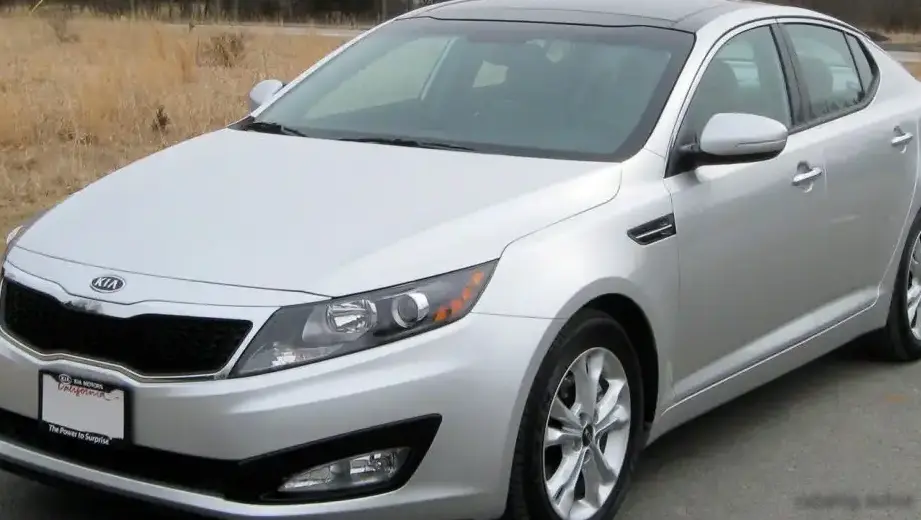
The Kia Optima III, launched in 2011, represented a significant step forward for the Korean automaker in the mid-size sedan segment. This generation, internally designated as the TF, aimed to challenge established players like the Toyota Camry and Honda Accord with a combination of stylish design, a generous feature set, and a competitive price point. The 2.0 CVVT 16V (165 hp) variant, equipped with a six-speed manual transmission, served as a core offering within the Optima III lineup, positioned as a balance between affordability and acceptable performance. Production of this specific configuration ran throughout the 2011 model year.
Technical Specifications
| Brand | Kia |
| Model | Optima |
| Generation | Optima III |
| Type (Engine) | 2.0 CVVT 16V (165 Hp) |
| Start of production | 2011 |
| End of production | 2011 |
| Powertrain Architecture | Internal Combustion engine |
| Body type | Sedan |
| Seats | 5 |
| Doors | 4 |
| Fuel consumption (combined) | 7.9 l/100 km |
| Fuel consumption (US mpg) | 29.8 US mpg |
| Fuel consumption (UK mpg) | 35.8 UK mpg |
| Fuel consumption (km/l) | 12.7 km/l |
| CO2 emissions | 188 g/km |
| Fuel Type | Petrol (Gasoline) |
| Acceleration 0 – 100 km/h | 9.8 sec |
| Acceleration 0 – 62 mph | 9.8 sec |
| Acceleration 0 – 60 mph | 9.3 sec |
| Maximum speed | 210 km/h (130.49 mph) |
| Emission standard | Euro 4 |
| Weight-to-power ratio | 8.5 kg/Hp |
| Weight-to-torque ratio | 7.1 kg/Nm |
| Power | 165 Hp @ 6200 rpm |
| Power per litre | 82.6 Hp/l |
| Torque | 198 Nm @ 4200 rpm (146.04 lb.-ft. @ 4200 rpm) |
| Engine layout | Front, Transverse |
| Engine Model/Code | G4KD |
| Engine displacement | 1998 cm3 (121.93 cu. in.) |
| Number of cylinders | 4 |
| Engine configuration | Inline |
| Cylinder Bore | 86 mm (3.39 in.) |
| Piston Stroke | 86 mm (3.39 in.) |
| Compression ratio | 10.5:1 |
| Number of valves per cylinder | 4 |
| Fuel injection system | Multi-port manifold injection |
| Engine aspiration | Naturally aspirated engine |
| Valvetrain | DOHC, CVVT |
| Engine oil capacity | 4.1 l (4.33 US qt | 3.61 UK qt) |
| Coolant capacity | 6.6 l (6.97 US qt | 5.81 UK qt) |
| Kerb Weight | 1404 kg (3095.29 lbs.) |
| Max. weight | 1980 kg (4365.15 lbs.) |
| Max load | 576 kg (1269.86 lbs.) |
| Trunk (boot) space – minimum | 436 l (15.4 cu. ft.) |
| Fuel tank capacity | 70 l (18.49 US gal | 15.4 UK gal) |
| Length | 4845 mm (190.75 in.) |
| Width | 1830 mm (72.05 in.) |
| Height | 1455 mm (57.28 in.) |
| Wheelbase | 2795 mm (110.04 in.) |
| Front track | 1601 mm (63.03 in.) |
| Rear track | 1601 mm (63.03 in.) |
| Front overhang | 965 mm (37.99 in.) |
| Rear overhang | 1085 mm (42.72 in.) |
| Minimum turning circle | 10.9 m (35.76 ft.) |
| Drivetrain Architecture | Front wheel drive |
| Number of gears | 6 |
| Gearbox type | Manual transmission |
| Front suspension | Independent, McPherson with coil spring and anti-roll bar |
| Rear suspension | Independent multi-link suspension |
| Front brakes | Ventilated discs |
| Rear brakes | Disc |
| Assisting systems | ABS (Anti-lock braking system) |
| Steering type | Steering rack and pinion |
| Tires size | 205/65 R16 |
| Wheel rims size | 6.5J x 16 |
Powertrain & Engine Architecture
The heart of this Optima variant is the Kia-developed 2.0-liter inline-four cylinder engine, designated G4KD. This engine utilizes a cast iron block with an aluminum cylinder head, a common configuration for balancing durability and weight. The engine features a double overhead camshaft (DOHC) design with Kia’s Continuously Variable Valve Timing (CVVT) technology on both intake and exhaust valves. CVVT optimizes valve timing based on engine speed and load, improving both fuel efficiency and power output. Fuel delivery is handled by a multi-point fuel injection system. The 165 horsepower and 198 Nm (146 lb-ft) of torque are respectable figures for this displacement, but not class-leading. The six-speed manual transmission provides drivers with direct control over the engine’s power, offering a more engaging driving experience than the available automatic option.
Driving Characteristics
The 2.0L manual Optima III delivers a reasonably engaging driving experience. Acceleration to 60 mph takes approximately 9.3 seconds, which is adequate for everyday driving but doesn’t provide particularly brisk performance. The six-speed manual transmission is well-matched to the engine’s powerband, allowing drivers to keep the engine in its optimal rev range. Gear ratios are spaced to provide good acceleration in lower gears and comfortable cruising at highway speeds. Compared to the automatic transmission version, the manual offers better fuel economy and a more connected feel. However, it falls short of the performance offered by the higher-trim 2.4L engine, which provides significantly more horsepower and torque.
Equipment & Trim Levels
The 2.0 CVVT 16V manual Optima III typically came standard with features such as air conditioning, power windows and locks, a basic audio system with CD player and auxiliary input, and ABS brakes. Higher trim levels, such as the EX and Limited, added features like leather upholstery, a sunroof, upgraded audio systems, and additional safety features. The base model focused on providing essential features at an affordable price point, while the higher trims catered to buyers seeking more luxury and convenience. Optional extras included a navigation system and a rear backup camera.
Chassis & Braking
The Optima III utilizes a front-wheel-drive layout with an independent McPherson strut suspension in the front and an independent multi-link suspension in the rear. This suspension setup provides a comfortable ride quality while maintaining reasonable handling characteristics. The front brakes are ventilated discs, providing good stopping power, while the rear brakes are solid discs. The steering is a rack-and-pinion system, offering precise and responsive steering feel. The standard tire size is 205/65 R16, providing a good balance between ride comfort and handling.
Market Reception & Comparison
The 2.0L manual Optima III was generally well-received by critics as a solid value proposition. It offered a good combination of features, fuel economy, and driving dynamics for its price. However, some reviewers noted that the engine lacked the refinement and power of some of its competitors. Compared to the 2.4L engine option, the 2.0L offered better fuel economy but significantly less performance. The 2.0L was often seen as a good choice for budget-conscious buyers who prioritized fuel efficiency and a manual transmission.
Legacy
The G4KD engine, while not without its quirks, proved to be a relatively reliable powertrain when properly maintained. Common issues include oil consumption and occasional sensor failures. The Optima III, in general, has established a reputation for being a dependable and affordable used car. The 2.0L manual variant remains a popular choice for those seeking a fuel-efficient and engaging mid-size sedan. Parts availability is generally good, and maintenance costs are reasonable, making it a practical option for budget-minded car buyers.