
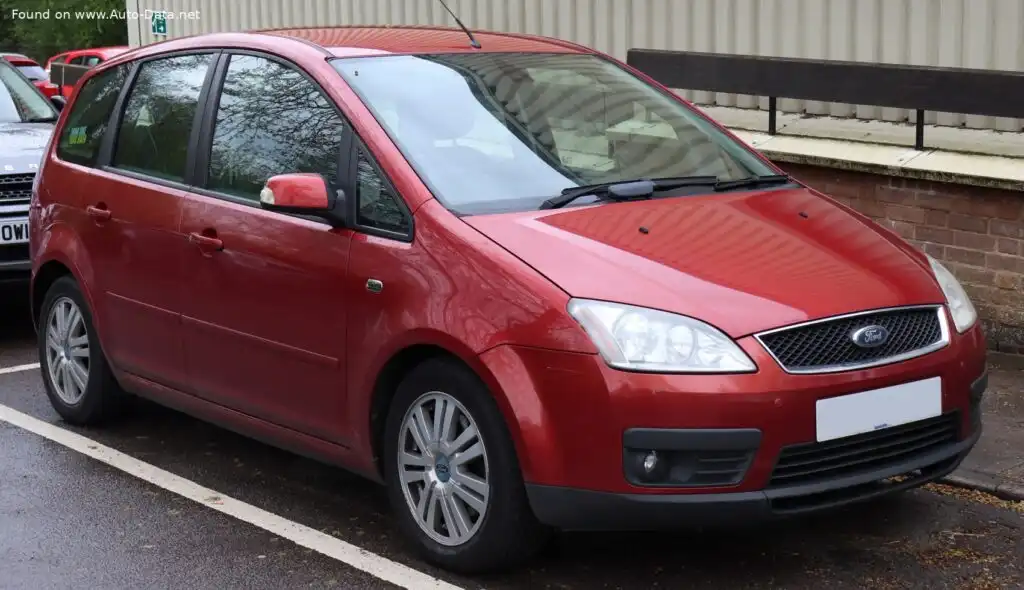
The Ford C-MAX 1.6 TDCi (90 hp) was a compact multi-purpose vehicle (MPV) produced by Ford between 2005 and 2007. Positioned as an entry-level offering within the first generation C-MAX range (internally designated as the C214), it aimed to provide affordable and fuel-efficient transportation for families. This variant played a significant role in establishing the C-MAX as a popular choice in the European market, offering a practical alternative to traditional hatchbacks and small estates. It was never officially sold in the North American market.
Technical Specifications
| Brand | Ford |
| Model | C-MAX |
| Generation | C-MAX |
| Type (Engine) | 1.6 TDCi (90 Hp) |
| Start of production | 2005 |
| End of production | 2007 |
| Powertrain Architecture | Internal Combustion engine |
| Body type | MPV |
| Seats | 5 |
| Doors | 5 |
| Fuel Type | Diesel |
| Power | 90 Hp @ 4000 rpm |
| Power per litre | 57.7 Hp/l |
| Torque | 215 Nm @ 1750 rpm (158.58 lb.-ft. @ 1750 rpm) |
| Engine layout | Front, Transverse |
| Engine Model/Code | HHDA |
| Engine displacement | 1560 cm3 (95.2 cu. in.) |
| Number of cylinders | 4 |
| Engine configuration | Inline |
| Fuel injection system | Diesel Commonrail |
| Engine aspiration | Turbocharger, Intercooler |
| Engine oil capacity | 3.8 l (4.02 US qt | 3.34 UK qt) |
| Coolant | 7.3 l (7.71 US qt | 6.42 UK qt) |
| Max. weight | 1920 kg (4232.88 lbs) |
| Trunk (boot) space – minimum | 460 l (16.24 cu. ft.) |
| Trunk (boot) space – maximum | 1620 l (57.21 cu. ft.) |
| Fuel tank capacity | 55 l (14.53 US gal | 12.1 UK gal) |
| Permitted trailer load with brakes (12%) | 1200 kg (2645.55 lbs) |
| Permitted trailer load without brakes | 695 kg (1532.21 lbs) |
| Length | 4333 mm (170.59 in) |
| Width | 1825 mm (71.85 in) |
| Wheelbase | 2640 mm (103.94 in) |
| Front track | 1535 mm (60.43 in) |
| Rear (Back) track | 1531 mm (60.28 in) |
| Minimum turning circle (turning diameter) | 10.7 m (35.1 ft) |
| Drivetrain Architecture | The Internal combustion engine (ICE) drives the front wheels of the vehicle. |
| Drive wheel | Front wheel drive |
| Front brakes | Disc |
| Rear brakes | Disc |
| Assisting systems | ABS (Anti-lock braking system) |
| Tires size | 205/55 R16 |
| Wheel rims size | 16 |
Powertrain & Engine Architecture
The C-MAX 1.6 TDCi utilized the HHDA engine code, a 1.6-liter inline-four cylinder diesel engine. This engine was part of Ford’s Duratorq family, known for its robust construction and relatively simple design. The engine featured a turbocharger with an intercooler to improve efficiency and power output. Crucially, it employed a common rail direct injection system, delivering fuel directly into the combustion chamber at high pressure for optimized combustion. The common rail system, supplied by Bosch, allowed for precise control over injection timing and quantity, contributing to improved fuel economy and reduced emissions. The engine’s valvetrain consisted of two valves per cylinder (SOHC). The 90 hp variant was paired exclusively with a four-speed automatic transmission, a Jatco unit known for its smoothness but not its outright speed.
Driving Characteristics
The 1.6 TDCi automatic C-MAX offered a comfortable, if not particularly exhilarating, driving experience. With 90 horsepower, acceleration was modest, taking approximately 13-14 seconds to reach 60 mph. The four-speed automatic transmission, while smooth, lacked the responsiveness of a manual gearbox or a more modern automatic with additional gears. Gear ratios were optimized for fuel efficiency rather than performance. In real-world driving, the engine felt strained when climbing hills or overtaking at higher speeds. Compared to the more powerful 1.8-liter petrol versions or the 2.0-liter TDCi, the 1.6 TDCi automatic was noticeably slower. However, it provided adequate power for everyday commuting and urban driving. The focus was on usability and economy, making it a practical choice for drivers prioritizing fuel costs over performance.
Equipment & Trim Levels
The 1.6 TDCi automatic typically represented the entry-level trim within the C-MAX range. Standard equipment generally included air conditioning, power steering, electric front windows, and a basic audio system. Safety features such as ABS and front airbags were also standard. Interior upholstery was typically cloth, with a relatively simple dashboard design. Optional extras included alloy wheels, rear parking sensors, and an upgraded audio system with CD player. Higher trim levels, such as the Titanium, offered more luxurious features like climate control, upgraded upholstery, and additional safety equipment. The 1.6 TDCi was often seen as a base model, frequently purchased by fleet buyers and those seeking a cost-effective family vehicle.
Chassis & Braking
The C-MAX 1.6 TDCi featured a MacPherson strut front suspension and a multi-link rear suspension, providing a comfortable ride quality. The suspension was tuned for everyday use, prioritizing comfort over sporty handling. Braking was handled by disc brakes on all four wheels, with ABS as standard. The braking system was adequate for the vehicle’s weight and performance, but not particularly powerful. Stabilizer bars were fitted to both the front and rear axles to reduce body roll during cornering. The relatively modest power output of the 1.6 TDCi engine meant that the braking system was generally sufficient for typical driving conditions.
Market Reception & Comparison
The Ford C-MAX 1.6 TDCi (90 hp) automatic received mixed reviews. Critics praised its fuel economy – typically around 45-50 mpg – and its practicality. However, the engine’s lack of power and the automatic transmission’s sluggishness were frequently criticized. Compared to the 1.8-liter petrol version, the 1.6 TDCi offered significantly better fuel economy but considerably less performance. The 2.0-liter TDCi provided a more balanced combination of power and economy, but at a higher price point. In terms of reliability, the 1.6 TDCi engine proved to be generally reliable, although issues with the fuel injection system and turbocharger were occasionally reported. The automatic transmission was also generally reliable, but required regular servicing to ensure smooth operation.
Legacy
The Ford C-MAX 1.6 TDCi (90 hp) automatic remains a relatively common sight on European roads today. Its affordability and fuel efficiency have contributed to its enduring popularity in the used car market. While not a performance car, it offers a practical and economical solution for families seeking a versatile MPV. The Duratorq engine, despite its age, is known for its durability, and many examples have exceeded 150,000 miles with proper maintenance. However, potential buyers should be aware of the possibility of issues with the fuel injection system and turbocharger, and should ensure that the automatic transmission has been regularly serviced. The C-MAX 1.6 TDCi represents a significant step in Ford’s development of fuel-efficient and practical family vehicles, paving the way for future generations of the C-MAX.
