
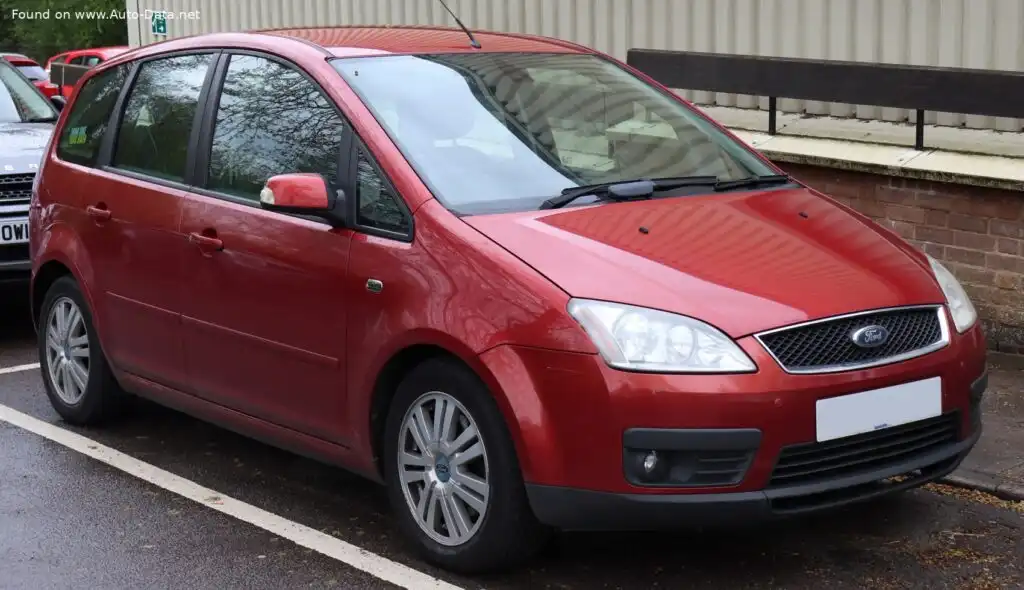
The Ford C-MAX 1.8 16V, produced between 2003 and 2007, represented Ford’s entry into the increasingly popular compact multi-purpose vehicle (MPV) segment in Europe. Positioned as a practical and versatile family car, the C-MAX aimed to offer the space and flexibility of a minivan in a more manageable and stylish package. This particular variant, equipped with the 1.8-liter 16-valve engine and a five-speed manual transmission, served as a core model within the C-MAX lineup, offering a balance between affordability, fuel efficiency, and acceptable performance. It was built on the Ford C170 platform, shared with the Focus of the same era.
Technical Specifications
| Brand | Ford |
| Model | C-MAX |
| Generation | C-MAX |
| Type (Engine) | 1.8 16V (120 Hp) |
| Start of production | 2003 |
| End of production | 2007 |
| Powertrain Architecture | Internal Combustion engine |
| Body type | MPV |
| Seats | 5 |
| Doors | 5 |
| Fuel consumption (urban) | 9.7 l/100 km (24.2 US mpg) |
| Fuel consumption (extra urban) | 5.6 l/100 km (42 US mpg) |
| Fuel consumption (combined) | 7.1 l/100 km (33.1 US mpg) |
| Fuel Type | Petrol (Gasoline) |
| Acceleration 0 – 100 km/h | 10.8 sec |
| Acceleration 0 – 62 mph | 10.8 sec |
| Acceleration 0 – 60 mph | 10.3 sec |
| Maximum speed | 193 km/h (119.92 mph) |
| Weight-to-power ratio | 10.7 kg/Hp |
| Weight-to-torque ratio | 7.8 kg/Nm |
| Power | 120 Hp @ 6000 rpm |
| Torque | 165 Nm @ 4000 rpm (121.7 lb.-ft. @ 4000 rpm) |
| Engine layout | Front, Transverse |
| Engine Model/Code | CSDA |
| Engine displacement | 1798 cm3 (109.72 cu. in.) |
| Number of cylinders | 4 |
| Engine configuration | Inline |
| Cylinder Bore | 83 mm (3.27 in.) |
| Piston Stroke | 83.1 mm (3.27 in.) |
| Compression ratio | 10.8:1 |
| Number of valves per cylinder | 4 |
| Fuel injection system | Multi-port manifold injection |
| Engine aspiration | Naturally aspirated engine |
| Valvetrain | DOHC |
| Engine oil capacity | 4.3 l (4.54 US qt | 3.78 UK qt) |
| Coolant | 6.5 l (6.87 US qt | 5.72 UK qt) |
| Kerb Weight | 1287 kg (2837.35 lbs.) |
| Fuel tank capacity | 55 l (14.53 US gal | 12.1 UK gal) |
| Length | 4330 mm (170.47 in.) |
| Width | 1820 mm (71.65 in.) |
| Height | 1600 mm (62.99 in.) |
| Wheelbase | 2640 mm (103.94 in.) |
| Minimum turning circle | 10.7 m (35.1 ft.) |
| Drivetrain Architecture | Front wheel drive |
| Number of gears | 5 |
| Type of gearbox | Manual transmission |
| Front brakes | Disc |
| Rear brakes | Disc |
| Assisting systems | ABS (Anti-lock braking system) |
| Steering type | Steering rack and pinion |
| Power steering | Hydraulic Steering |
| Tires size | 205/55 R16 |
| Wheel rims size | 16 |
Powertrain & Engine Architecture
The heart of this C-MAX variant is the Ford CSDA engine, an 1.8-liter inline-four cylinder gasoline engine. This engine belongs to the Ford Zetec family, known for its relatively simple and robust design. The CSDA features a dual overhead camshaft (DOHC) valvetrain with four valves per cylinder, contributing to improved breathing and power delivery. Fuel delivery is managed by a multi-port fuel injection system, providing precise fuel metering for optimal combustion. The engine produces 120 horsepower at 6000 rpm and 165 Nm (121.7 lb-ft) of torque at 4000 rpm. The five-speed manual transmission was the standard offering, providing a good balance between fuel economy and drivability. The transmission’s gear ratios were tuned for everyday use, prioritizing smooth shifts and reasonable acceleration rather than outright performance.
Driving Characteristics
The C-MAX 1.8 16V with a manual transmission offered a reasonably engaging driving experience for its class. While not particularly quick, the engine provided adequate power for typical commuting and highway driving. Acceleration from 0 to 60 mph took around 10.3 seconds, and the top speed was approximately 119.92 mph. The five-speed gearbox allowed drivers to keep the engine in its optimal power band, maximizing efficiency and responsiveness. Compared to the higher-output 2.0-liter Duratec engine offered in other C-MAX trims, the 1.8-liter felt less strained during acceleration, but also lacked the same level of outright punch. The manual transmission provided more driver control than the optional four-speed automatic, which often felt sluggish and reduced fuel economy.
Equipment & Trim Levels
The C-MAX 1.8 16V typically came equipped with a respectable level of standard features. These included power steering, ABS brakes, front airbags, and air conditioning. Interior appointments were generally functional and durable, with cloth upholstery and a straightforward dashboard layout. Higher trim levels, such as the Ghia, added features like alloy wheels, upgraded audio systems, and more luxurious interior trim. Optional extras included a sunroof, rear parking sensors, and heated front seats. The C-MAX was designed with practicality in mind, offering a flexible interior with folding rear seats and ample storage compartments.
Chassis & Braking
The C-MAX utilized a MacPherson strut front suspension and a multi-link rear suspension, providing a comfortable ride and decent handling characteristics. The suspension was tuned to prioritize ride comfort over sporty handling, making it well-suited for everyday driving. Brakes consisted of ventilated discs on all four wheels, providing adequate stopping power. The ABS system helped to maintain steering control during emergency braking situations. The C-MAX’s chassis was relatively lightweight, contributing to its fuel efficiency and agility.
Market Reception & Comparison
The Ford C-MAX 1.8 16V was generally well-received by automotive critics as a practical and affordable family car. It was praised for its spacious interior, comfortable ride, and decent fuel economy. However, some critics noted that the 1.8-liter engine could feel underpowered when fully loaded or driving uphill. Compared to other MPVs in its class, such as the Renault Scenic and the Opel Zafira, the C-MAX offered a competitive combination of features, price, and practicality. The manual transmission version was generally preferred over the automatic due to its improved performance and fuel efficiency.
Legacy
The Ford C-MAX 1.8 16V has proven to be a relatively reliable vehicle, with the CSDA engine being known for its durability. Common issues include occasional oil leaks and sensor failures, but these are generally not major concerns. In the used car market, the C-MAX 1.8 16V remains a popular choice for budget-conscious buyers seeking a practical and versatile family car. Its affordability, fuel efficiency, and relatively low maintenance costs make it an attractive option. While it may not offer the same level of performance or refinement as more modern MPVs, the C-MAX 1.8 16V continues to provide reliable transportation for many years.
