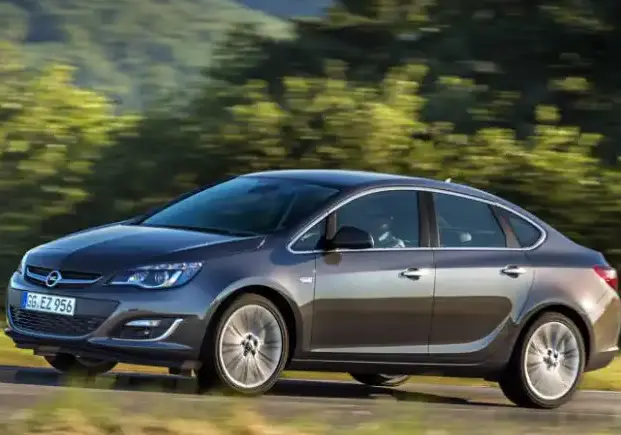
The Opel Astra J Sedan 1.7 CDTI (130 hp) ecoFLEX, produced from 2012 to 2014, represented a fuel-efficient offering within the broader Astra J Sedan range. Positioned as a mid-range trim, it aimed to balance practicality, economy, and reasonable performance for European drivers. This variant was particularly significant in markets prioritizing diesel fuel efficiency and lower emissions, aligning with Opel’s ecoFLEX initiative focused on reducing environmental impact. The Astra J Sedan itself was a key model for Opel, offering a more traditional sedan body style alongside the more popular hatchback version, catering to customers who preferred a separate trunk.
Technical Specifications
| Brand | Opel |
| Model | Astra |
| Generation | Astra J Sedan |
| Type (Engine) | 1.7 CDTI (130 Hp) Ecotec ecoFLEX |
| Start of production | 2012 |
| End of production | 2014 |
| Powertrain Architecture | Internal Combustion engine |
| Body type | Sedan |
| Seats | 5 |
| Doors | 4 |
| Fuel consumption (urban) | 4.3 l/100 km (54.7 US mpg, 65.7 UK mpg, 23.3 km/l) |
| Fuel consumption (extra urban) | 3.4 l/100 km (69.2 US mpg, 83.1 UK mpg, 29.4 km/l) |
| Fuel consumption (combined) | 3.7 l/100 km (63.6 US mpg, 76.3 UK mpg, 27 km/l) |
| CO2 emissions | 99 g/km |
| Fuel Type | Diesel |
| Acceleration 0 – 100 km/h | 11.3 sec |
| Acceleration 0 – 62 mph | 11.3 sec |
| Acceleration 0 – 60 mph | 10.7 sec |
| Maximum speed | 206 km/h (128 mph) |
| Emission standard | Euro 5 |
| Power | 130 Hp @ 4000 rpm |
| Torque | 300 Nm @ 2000-2500 rpm (221.27 lb.-ft. @ 2000-2500 rpm) |
| Engine layout | Front, Transverse |
| Engine Model/Code | A17DTF |
| Engine displacement | 1686 cm3 (102.89 cu. in.) |
| Number of cylinders | 4 |
| Engine configuration | Inline |
| Cylinder Bore | 79 mm (3.11 in.) |
| Piston Stroke | 86 mm (3.39 in.) |
| Number of valves per cylinder | 4 |
| Fuel injection system | Diesel Commonrail |
| Engine aspiration | Turbocharger, Intercooler |
| Engine oil capacity | 5.4 l (5.71 US qt, 4.75 UK qt) |
| Coolant capacity | 7.1 l (7.5 US qt, 6.25 UK qt) |
| Trunk (boot) space – minimum | 460 l (16.24 cu. ft.) |
| Trunk (boot) space – maximum | 1010 l (35.67 cu. ft.) |
| Fuel tank capacity | 56 l (14.79 US gal, 12.32 UK gal) |
| Length | 4658 mm (183.39 in.) |
| Width | 1814 mm (71.42 in.) |
| Width including mirrors | 2013 mm (79.25 in.) |
| Height | 1500 mm (59.06 in.) |
| Wheelbase | 2685 mm (105.71 in.) |
| Front track | 1541 mm (60.67 in.) |
| Rear track | 1551 mm (61.06 in.) |
| Front overhang | 974 mm (38.35 in.) |
| Rear overhang | 999 mm (39.33 in.) |
| Minimum turning circle | 11.5 m (37.73 ft.) |
| Drivetrain | Front wheel drive |
| Number of gears | 6 |
| Gearbox type | Manual transmission |
| Front brakes | Ventilated discs |
| Assisting systems | ABS (Anti-lock braking system) |
| Steering type | Steering rack and pinion |
| Power steering | Electric |
INTRODUCTION
The Opel Astra J Sedan 1.7 CDTI ecoFLEX, launched in 2012 and continuing through 2014, was a key component of Opel’s efforts to provide a fuel-efficient and practical sedan option within the competitive European C-segment. Built on the 1HX0/A3 platform shared with other Vauxhall/Opel and Chevrolet models, the Astra J Sedan aimed to broaden the appeal of the Astra range beyond the popular hatchback. The 1.7 CDTI engine, coupled with a six-speed manual transmission, was designed to deliver a balance of acceptable performance and exceptional fuel economy, making it a popular choice for fleet buyers and private motorists alike. The ecoFLEX designation indicated the inclusion of specific technologies aimed at reducing emissions and maximizing fuel efficiency.
Powertrain & Engine Architecture
The heart of this Astra variant is the A17DTF engine, a 1.7-liter inline-four cylinder diesel. This engine is a member of Opel/Fiat’s family of small-displacement diesel engines, known for its relatively simple construction and robust reliability. It utilizes a common rail direct injection system, delivering fuel at extremely high pressure for optimized combustion. A turbocharger with an intercooler is employed to boost power output and improve torque across a wider rev range. The engine produces 130 horsepower at 4000 rpm and 300 Nm (221 lb-ft) of torque between 2000 and 2500 rpm. The six-speed manual transmission was the standard offering, providing a good spread of gears for both fuel efficiency and responsive driving. The transmission’s gear ratios were tuned to complement the engine’s torque curve, prioritizing mid-range acceleration and minimizing the need for frequent gear changes.
Driving Characteristics
The Astra J Sedan 1.7 CDTI with the manual transmission offered a reasonably refined driving experience. While not particularly sporty, the engine provided adequate power for everyday driving situations. Acceleration from 0-60 mph took around 10.7 seconds, and top speed was rated at 128 mph. The turbocharger provided a noticeable boost in power once spooled up, but there was some degree of turbo lag at lower engine speeds. The six-speed gearbox was generally smooth and precise, although the shift linkage wasn’t as crisp as some competitors. Compared to higher-output Astra J variants, such as those equipped with the 2.0 CDTI engine, the 1.7 CDTI felt noticeably less powerful, particularly when fully loaded or tackling steep inclines. However, the trade-off was significantly improved fuel economy. The suspension setup provided a comfortable ride, absorbing most road imperfections effectively, but it wasn’t particularly engaging for enthusiastic drivers.
Equipment & Trim Levels
The 1.7 CDTI ecoFLEX trim typically included standard features such as air conditioning, electric front windows, a basic audio system with USB connectivity, and ABS brakes. Safety features like front and side airbags were also standard. Higher trim levels, available as options, added features like alloy wheels, a more advanced infotainment system with touchscreen display, cruise control, rear parking sensors, and automatic climate control. Interior upholstery was typically cloth, with options for upgraded materials. The dashboard layout was functional and straightforward, prioritizing ease of use over stylistic flair. The ecoFLEX trim often included specific aerodynamic enhancements, such as a lower ride height and optimized underbody panels, to further improve fuel efficiency.
Chassis & Braking
The Astra J Sedan 1.7 CDTI utilized a MacPherson strut front suspension and a torsion beam rear suspension. This configuration provided a good balance of ride comfort and handling stability. The front brakes were ventilated discs, offering good stopping power, while the rear brakes were typically solid discs. ABS (Anti-lock Braking System) was standard, enhancing safety during emergency braking situations. The steering was electrically assisted, providing a light and responsive feel. Stabilizer bars were fitted to both the front and rear axles to reduce body roll during cornering. The chassis was designed to be relatively lightweight, contributing to the car’s overall fuel efficiency.
Market Reception & Comparison
The Astra J Sedan 1.7 CDTI ecoFLEX was generally well-received by automotive critics for its impressive fuel economy and low emissions. It was often praised as a practical and affordable option for drivers seeking a fuel-efficient sedan. However, some reviewers noted that the engine lacked outright power and could feel strained when fully loaded. Compared to other trims in the Astra J lineup, such as the 2.0 CDTI, the 1.7 CDTI offered significantly better fuel economy but at the expense of performance. It also compared favorably to competitors like the Ford Focus 1.6 TDCi and Volkswagen Golf 1.6 TDI in terms of fuel efficiency and price, although some rivals offered a more refined driving experience.
Legacy
The A17DTF engine, while not without its occasional issues (such as potential EGR valve problems and DPF clogging), proved to be a relatively reliable powertrain when properly maintained. The Astra J Sedan 1.7 CDTI ecoFLEX remains a popular choice in the used car market, particularly for buyers seeking a fuel-efficient and affordable sedan. Its reputation for low running costs and reasonable reliability has helped it maintain a steady demand. Parts availability is generally good, and maintenance costs are relatively low, making it a practical option for budget-conscious buyers. However, potential buyers should be aware of the common diesel engine issues and ensure that the vehicle has been regularly serviced.