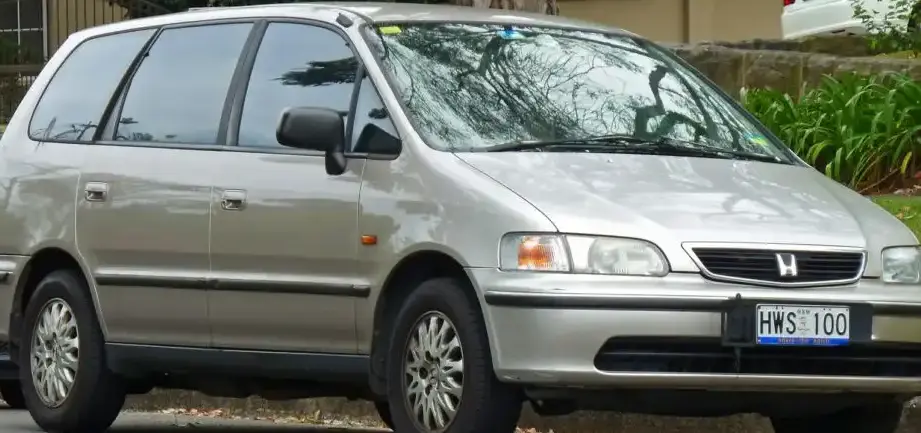
The Honda Odyssey I 2.2i, produced between 1994 and 1999, represents Honda’s initial foray into the minivan segment, primarily aimed at the North American market. Positioned as a competitor to established players like the Dodge Caravan and Toyota Previa, the Odyssey offered a blend of Honda reliability, spaciousness, and a focus on family-oriented features. This particular variant, equipped with the 2.2-liter inline-four engine producing 150 horsepower, served as the entry-level powertrain option for the first generation Odyssey, appealing to buyers prioritizing affordability and fuel efficiency over outright performance. It was built on the MC platform, shared with the Honda Accord and Acura Vigor.
Technical Specifications
| Brand | Honda |
| Model | Odyssey |
| Generation | Odyssey I |
| Type (Engine) | 2.2i (150 Hp) |
| Start of production | 1994 |
| End of production | 1999 |
| Powertrain Architecture | Internal Combustion engine |
| Body type | Minivan |
| Seats | 7 |
| Doors | 5 |
| Fuel Type | Petrol (Gasoline) |
| Power | 150 Hp @ 5900 rpm |
| Power per litre | 69.6 Hp/l |
| Torque | 198 Nm @ 5000 rpm / 146.04 lb.-ft. @ 5000 rpm |
| Engine layout | Front, Transverse |
| Engine Model/Code | F22B8 |
| Engine displacement | 2155 cm3 / 131.51 cu. in. |
| Number of cylinders | 4 |
| Engine configuration | Inline |
| Cylinder Bore | 85 mm / 3.35 in. |
| Piston Stroke | 95 mm / 3.74 in. |
| Compression ratio | 9.8:1 |
| Number of valves per cylinder | 4 |
| Fuel injection system | Multi-port manifold injection |
| Engine aspiration | Naturally aspirated engine |
| Valvetrain | OHC |
| Engine oil capacity | 3.8 l / 4.02 US qt | 3.34 UK qt |
| Coolant | 7.8 l / 8.24 US qt | 6.86 UK qt |
| Fuel tank capacity | 65 l / 17.17 US gal | 14.3 UK gal |
| Length | 4750 mm / 187.01 in. |
| Width | 1770 mm / 69.69 in. |
| Height | 1645 mm / 64.76 in. |
| Wheelbase | 2830 mm / 111.42 in. |
| Front track | 1525 mm / 60.04 in. |
| Rear (Back) track | 1540 mm / 60.63 in. |
| Drivetrain Architecture | The Internal combustion engine (ICE) drives the front wheels of the vehicle. |
| Drive wheel | Front wheel drive |
| Number of gears and type of gearbox | 5 gears, manual transmission |
| Front brakes | Disc |
| Rear brakes | Disc |
| Assisting systems | ABS (Anti-lock braking system) |
| Tires size | 205/65 R15 |
Powertrain & Engine Architecture
The heart of the Odyssey 2.2i is the F22B8 engine, a 2.2-liter inline-four cylinder powerplant. This engine utilizes a single overhead camshaft (SOHC) valvetrain operating 16 valves (four per cylinder). Fuel delivery is managed by a multi-point fuel injection system, contributing to relatively smooth operation and acceptable fuel economy for its class. The F22B8 is a non-interference engine, meaning that even if the timing belt breaks, the pistons will not collide with the valves, preventing catastrophic engine damage – a significant reliability benefit. The 150 horsepower output is achieved at 5900 rpm, while peak torque of 198 Nm (146 lb-ft) arrives at 5000 rpm. This engine was known for its durability, though it wasn’t particularly powerful compared to some of its competitors. The five-speed manual transmission was the standard offering, providing a direct connection between the engine and the front wheels.
Driving Characteristics
The 2.2i Odyssey, with its 150 hp and five-speed manual transmission, offered adequate, but not exhilarating, performance. Acceleration was best described as leisurely, with 0-60 mph times estimated around 11-12 seconds. The gear ratios were tuned for fuel efficiency and everyday drivability rather than sporty performance. The manual transmission allowed drivers to maintain control and extract the most from the engine, but it required more driver involvement than the available automatic option. Compared to the later 3.5-liter V6 engine offered in subsequent Odyssey generations, the 2.2i felt significantly underpowered, especially when fully loaded with passengers and cargo. However, for drivers prioritizing fuel economy and a comfortable ride, the 2.2i provided a reasonable experience.
Equipment & Trim Levels
The base Odyssey 2.2i typically came equipped with features considered standard for a family minivan in the mid-1990s. These included air conditioning, power steering, an AM/FM stereo, and cloth upholstery. Safety features included dual airbags and ABS (Anti-lock Braking System). Optional extras included power windows and locks, a sunroof, and upgraded audio systems. The interior was designed with practicality in mind, featuring a spacious cabin and flexible seating arrangements. The second-row seats could be removed entirely to create a larger cargo area. Trim levels were relatively simple, with the 2.2i representing the base model, and higher trims adding more convenience and comfort features.
Chassis & Braking
The Odyssey I utilized a front-wheel-drive layout with an independent front suspension featuring MacPherson struts and a multi-link rear suspension. This suspension setup aimed to provide a comfortable ride while maintaining reasonable handling characteristics. Brakes were disc brakes on all four wheels, providing adequate stopping power for the vehicle’s weight. The ABS system helped to prevent wheel lockup during hard braking, enhancing safety. The steering was a rack-and-pinion system, offering responsive steering feel. The chassis was designed to maximize interior space while maintaining structural rigidity.
Market Reception & Comparison
The Honda Odyssey I was generally well-received by critics and consumers alike. It was praised for its spacious interior, Honda reliability, and comfortable ride. However, the 2.2i engine was often criticized for its lack of power, particularly when compared to competitors offering larger displacement engines. Fuel economy was a strong point, with the 2.2i achieving around 20-24 mpg in combined driving. Compared to the Toyota Previa, the Odyssey offered more interior space but lacked the Previa’s mid-engine layout and unique driving dynamics. Against the Dodge Caravan, the Odyssey offered a more refined driving experience and a reputation for greater reliability, but the Caravan was typically more affordable.
Legacy
The Honda Odyssey I, particularly the 2.2i variant, established Honda as a serious contender in the minivan market. While the engine may have been underpowered by modern standards, it proved to be remarkably durable and reliable. Today, well-maintained examples of the Odyssey I are becoming increasingly rare, and are sought after by collectors and enthusiasts who appreciate their simplicity and Honda build quality. The F22B8 engine is known for its longevity, and with proper maintenance, can continue to provide reliable service for many years. The Odyssey I laid the foundation for the subsequent generations of Odyssey minivans, which have consistently ranked among the best in their class.