Technical Specifications
| Brand | Volkswagen |
| Model | Golf |
| Generation | Golf VIII Variant |
| Type (Engine) | 2.0 TDI (115 Hp) DSG |
| Start of production | 2020 year |
| End of production | 2023 year |
| Powertrain Architecture | Internal Combustion engine |
| Body type | Station wagon (estate) |
| Seats | 5 |
| Doors | 5 |
| Combined fuel consumption (WLTP) | 4.5-4.9 l/100 km (52.3 – 48 US mpg, 62.8 – 57.6 UK mpg, 22.2 – 20.4 km/l) |
| CO2 emissions (WLTP) | 119-128 g/km |
| Fuel Type | Diesel |
| Acceleration 0 – 100 km/h | 10.7 sec |
| Acceleration 0 – 62 mph | 10.7 sec |
| Acceleration 0 – 60 mph | 10.2 sec |
| Maximum speed | 202 km/h (125.52 mph) |
| Emission standard | Euro 6d |
| Weight-to-power ratio | 12.3 kg/Hp, 81.4 Hp/tonne |
| Weight-to-torque ratio | 5.7 kg/Nm, 176.9 Nm/tonne |
| Power | 115 Hp @ 3250 rpm |
| Power per litre | 58.4 Hp/l |
| Torque | 250 Nm @ 1600-3500 rpm (184.39 lb.-ft. @ 1600-3500 rpm) |
| Engine layout | Front, Transverse |
| Engine Model/Code | EA288 evo / DTRB |
| Engine displacement | 1968 cm3 (120.09 cu. in.) |
| Number of cylinders | 4 |
| Engine configuration | Inline |
| Cylinder Bore | 81 mm (3.19 in.) |
| Piston Stroke | 95.5 mm (3.76 in.) |
| Compression ratio | 16:1 |
| Number of valves per cylinder | 4 |
| Fuel injection system | Diesel Commonrail |
| Engine aspiration | Turbocharger, Intercooler |
| Valvetrain | DOHC |
| Engine oil capacity | 5.5 l (5.81 US qt | 4.84 UK qt) |
| Kerb Weight | 1413-1535 kg (3115.13 – 3384.1 lbs.) |
| Max. weight | 2010 kg (4431.29 lbs.) |
| Max load | 475-597 kg (1047.2 – 1316.16 lbs.) |
| Trunk (boot) space – minimum | 611 l (21.58 cu. ft.) |
| Trunk (boot) space – maximum | 1642 l (57.99 cu. ft.) |
| Fuel tank capacity | 45 l (11.89 US gal | 9.9 UK gal) |
| AdBlue tank | 12 l (3.17 US gal | 2.64 UK gal) |
| Max. roof load | 75 kg (165.35 lbs.) |
| Permitted trailer load with brakes (12%) | 1500 kg (3306.93 lbs.) |
| Permitted trailer load without brakes | 730 kg (1609.37 lbs.) |
| Permitted towbar download | 80 kg (176.37 lbs.) |
| Length | 4633 mm (182.4 in.) |
| Width | 1789 mm (70.43 in.) |
| Width including mirrors | 2073 mm (81.61 in.) |
| Height | 1498 mm (58.98 in.) |
| Wheelbase | 2669 mm (105.08 in.) |
| Front track | 1533-1549 mm (60.35 – 60.98 in.) |
| Rear (Back) track | 1504-1520 mm (59.21 – 59.84 in.) |
| Minimum turning circle (turning diameter) | 11.1 m (36.42 ft.) |
| Drivetrain Architecture | The Internal combustion engine (ICE) drives the front wheels of the vehicle. |
| Drive wheel | Front wheel drive |
| Number of gears and type of gearbox | 7 gears, automatic transmission DSG |
| Front suspension | Independent, type McPherson with coil spring and anti-roll bar |
| Rear suspension | Coil spring |
| Front brakes | Ventilated discs |
| Rear brakes | Disc |
| Assisting systems | ABS (Anti-lock braking system) |
| Steering type | Steering rack and pinion |
| Power steering | Electric Steering |
| Tires size | 205/55 R16 |
| Wheel rims size | 7J x 16 |
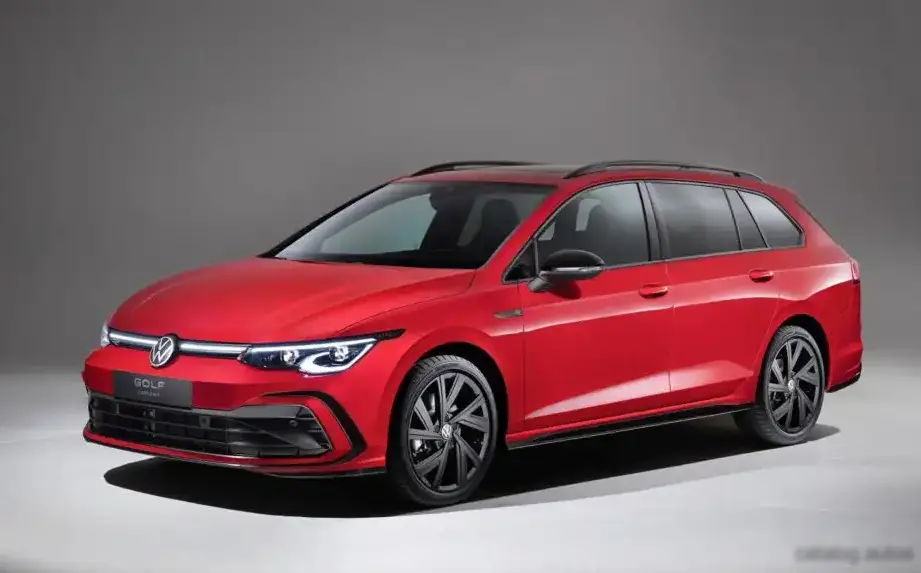
The Volkswagen Golf VIII Variant 2.0 TDI (115 hp) DSG, produced from 2020 to 2023, represents a significant offering within the eighth generation of Volkswagen’s renowned Golf lineup. This variant, a practical station wagon (estate) body style, was primarily aimed at European buyers seeking a blend of fuel efficiency, versatility, and contemporary technology. Positioned as a mid-range option, it sat comfortably between the lower-powered diesel and gasoline engines and the more performance-focused trims like the GTI. Built on the MQB Evo platform (also known as the A8 platform), the Golf VIII Variant sought to build upon the success of the Golf VII series by offering increased interior space, updated technology, and refined driving dynamics.
Powertrain & Engine Architecture
The core of the Golf VIII Variant 2.0 TDI (115 hp) is the EA288 evo series diesel engine, specifically the DTRB code. This 1968cc inline-four cylinder engine employs a common rail direct injection system, delivering fuel at exceptionally high pressures for optimized combustion efficiency. A turbocharger with an intercooler is integrated to boost power output and improve responsiveness. The engine’s DOHC (Double Overhead Camshaft) valvetrain, featuring four valves per cylinder, enhances airflow and contributes to overall performance. The engine is noted for its relatively quiet operation and strong low-end torque characteristics. The seven-speed dual-clutch transmission (DSG) is a critical component, providing rapid and seamless gear changes. This particular DSG variant is engineered for transverse engine layouts and is capable of handling the engine’s torque output effectively. The DSG significantly contributes to the vehicle’s fuel efficiency and overall driving experience.
Driving Characteristics
The 115 hp output, combined with the DSG transmission, delivers adequate performance for everyday driving needs. Acceleration from 0-60 mph takes approximately 10.2 seconds, and the vehicle has a top speed of 125.52 mph. While not designed for outright speed, the engine generates a useful 250 Nm (184 lb-ft) of torque between 1600-3500 rpm, making it suitable for overtaking maneuvers and highway cruising. The DSG transmission is programmed to prioritize fuel economy, often upshifting quickly to maintain lower engine speeds. Compared to the more powerful 2.0 TDI versions (typically around 150 hp or higher), this version feels less responsive, especially during rapid acceleration. However, the DSG helps to compensate for the power difference by providing precise and timely gear changes. Manual transmission versions, when offered, provided a more engaging driving experience, but typically at the expense of some fuel economy.
Equipment & Trim Levels
The Golf VIII Variant 2.0 TDI (115 hp) DSG generally came equipped with a solid array of standard features. These typically included air conditioning, a touchscreen infotainment system with Apple CarPlay and Android Auto compatibility, LED headlights, and a comprehensive suite of safety features such as automatic emergency braking and lane departure warning. Interior upholstery was usually cloth, with options for upgrades to leather or Alcantara. Higher trim levels offered enhancements like a larger touchscreen display, a digital instrument cluster, adaptive cruise control, and a panoramic sunroof. Optional extras included parking sensors, a premium sound system, and various styling packages to personalize the vehicle.
Chassis & Braking
The Golf VIII Variant’s chassis features an independent McPherson strut suspension at the front and a coil spring setup at the rear. This configuration strikes a good balance between ride comfort and handling precision. The front brakes are ventilated discs, while the rear brakes are solid discs. ABS (Anti-lock Braking System) is a standard safety feature. The suspension tuning is geared towards comfort, making it well-suited for longer journeys. Stabilizer bars are fitted to both the front and rear axles to minimize body roll during cornering. The weight distribution is relatively balanced, contributing to predictable and stable handling characteristics.
Market Reception & Comparison
The Golf VIII Variant 2.0 TDI (115 hp) DSG was generally well-received by automotive reviewers as a practical and efficient family car. Its fuel economy, ranging between 4.5 and 4.9 l/100 km, was a significant selling point. Compared to the higher-powered TDI variants, this version offered a lower purchase price and slightly improved fuel economy, albeit with a reduction in performance. The DSG transmission was lauded for its smoothness and efficiency, although some critics noted occasional hesitation at lower speeds. Reliability reports have been largely positive, with the EA288 evo engine proving to be a robust and durable unit.
Legacy
The Volkswagen Golf VIII Variant 2.0 TDI (115 hp) DSG continues to be a popular choice in the used car market. Its combination of practicality, fuel efficiency, and relatively low running costs makes it an appealing option for buyers seeking a dependable family vehicle. The EA288 evo engine, when properly maintained, is known for its longevity. However, prospective buyers should be aware of potential issues with the DSG transmission, such as mechatronic unit failures, and ensure the vehicle has a complete service history. The Golf VIII Variant remains a benchmark in the compact station wagon segment, offering a compelling blend of features and performance.