
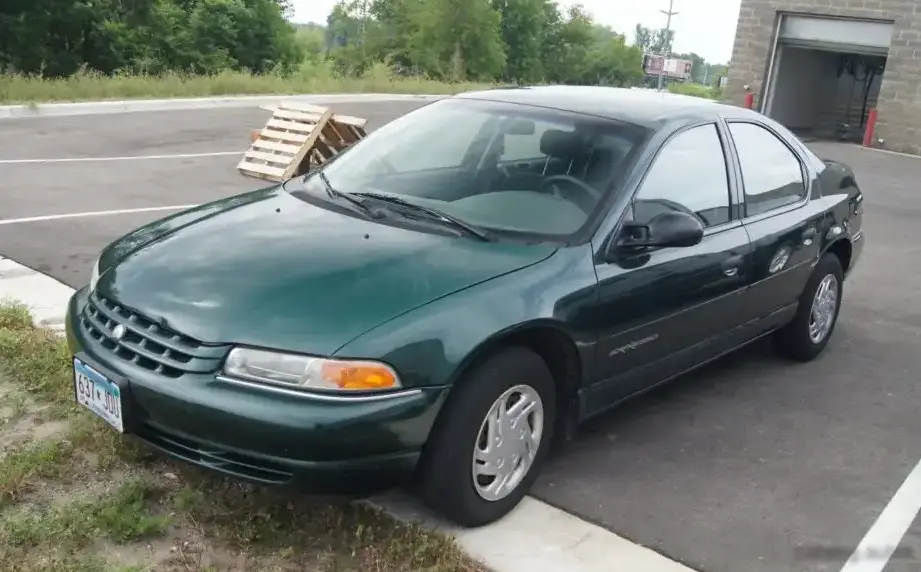
The Plymouth Breeze 2.4 16V, produced between 1995 and 2000, was a mid-size sedan positioned as a comfortable and practical family vehicle within the Plymouth lineup. It was part of the first generation of the Breeze (1995-1999), sharing its platform – the JA platform – with the Dodge Stratus and Chrysler Cirrus. The 2.4-liter engine variant represented a step up in performance from the base 2.0-liter engine, offering a balance between fuel economy and power for the American market. This model aimed to provide a more refined driving experience compared to more basic economy sedans, while remaining accessible in price.
Technical Specifications
| Brand | Plymouth |
| Model | Breeze |
| Generation | Breeze |
| Type (Engine) | 2.4 16V (152 Hp) |
| Start of production | 1995 |
| End of production | 2000 |
| Powertrain Architecture | Internal Combustion engine |
| Body type | Sedan |
| Seats | 5 |
| Doors | 4 |
| Fuel consumption (urban) | 11.7 l/100 km (20.1 US mpg) |
| Fuel consumption (extra urban) | 8.1 l/100 km (29 US mpg) |
| Fuel Type | Petrol (Gasoline) |
| Maximum speed | 200 km/h (124.27 mph) |
| Weight-to-power ratio | 8.7 kg/Hp |
| Weight-to-torque ratio | 5.9 kg/Nm |
| Power | 152 Hp @ 5200 rpm |
| Power per litre | 62.6 Hp/l |
| Torque | 226 Nm @ 4000 rpm (166.69 lb.-ft. @ 4000 rpm) |
| Engine layout | Front, Transverse |
| Engine Model/Code | EDZ |
| Engine displacement | 2429 cm3 (148.23 cu. in.) |
| Number of cylinders | 4 |
| Engine configuration | Inline |
| Cylinder Bore | 87.5 mm (3.44 in.) |
| Piston Stroke | 101 mm (3.98 in.) |
| Compression ratio | 9.4:1 |
| Number of valves per cylinder | 4 |
| Fuel injection system | Multi-port manifold injection |
| Engine aspiration | Naturally aspirated engine |
| Valvetrain | DOHC |
| Engine oil capacity | 4.7 l (4.97 US qt | 4.14 UK qt) |
| Coolant | 8.5 l (8.98 US qt | 7.48 UK qt) |
| Kerb Weight | 1325 kg (2921.12 lbs.) |
| Trunk (boot) space – minimum | 430 l (15.19 cu. ft.) |
| Fuel tank capacity | 61 l (16.11 US gal | 13.42 UK gal) |
| Length | 4740 mm (186.61 in.) |
| Width | 1800 mm (70.87 in.) |
| Height | 1380 mm (54.33 in.) |
| Wheelbase | 2745 mm (108.07 in.) |
| Front track | 1530 mm (60.24 in.) |
| Rear (Back) track | 1530 mm (60.24 in.) |
| Drivetrain Architecture | The Internal combustion engine (ICE) drives the front wheels of the vehicle. |
| Drive wheel | Front wheel drive |
| Number of gears and type of gearbox | 4 gears, automatic transmission |
| Front suspension | Double wishbone |
| Rear suspension | Double wishbone |
| Front brakes | Ventilated discs |
| Rear brakes | Drum |
| Assisting systems | ABS (Anti-lock braking system) |
| Steering type | Steering rack and pinion |
| Power steering | Hydraulic Steering |
| Tires size | 195/70 R14 |
Powertrain & Engine Architecture
The Plymouth Breeze 2.4 16V was powered by the Chrysler EDZ engine, a 2.4-liter inline-four cylinder engine. This engine featured a double overhead camshaft (DOHC) valvetrain with four valves per cylinder, contributing to its relatively high output for its displacement. The EDZ engine utilized a multi-port fuel injection system, delivering fuel directly to each intake port for improved combustion efficiency. The 9.4:1 compression ratio was a typical value for naturally aspirated engines of this era, balancing performance and fuel economy. Paired with this engine was a four-speed automatic transmission, designed for smooth and convenient operation. This transmission was a common Chrysler unit, known for its reliability, though not particularly sporty shift characteristics.
Driving Characteristics
The 2.4-liter engine and four-speed automatic transmission combination in the Breeze provided adequate, though not exhilarating, performance. Acceleration was reasonable for everyday driving, with the 152 horsepower providing enough power for merging onto highways and passing other vehicles. The automatic transmission prioritized comfort and fuel efficiency over aggressive shifting. Compared to the base 2.0-liter engine, the 2.4-liter offered a noticeable improvement in responsiveness, particularly when fully loaded with passengers or cargo. However, it didn’t match the performance of the optional V6 engines available in the Dodge Stratus and Chrysler Cirrus siblings. The gear ratios were tuned for relaxed cruising, making it a comfortable highway car, but less engaging on winding roads.
Equipment & Trim Levels
The Breeze 2.4 16V typically came standard with features such as air conditioning, power windows and locks, and an AM/FM stereo. Higher trim levels offered options like cruise control, upgraded upholstery, and a premium sound system. Interior materials were generally durable and practical, reflecting the Breeze’s focus on value. The dashboard layout was functional and straightforward, prioritizing ease of use. Available options included alloy wheels, a sunroof, and upgraded interior trim packages. The specific trim level determined the level of standard equipment and available options.
Chassis & Braking
The Plymouth Breeze utilized a front-wheel-drive layout with independent double wishbone suspension at both the front and rear. This suspension setup provided a comfortable ride quality, absorbing bumps and irregularities in the road surface effectively. The front brakes were ventilated discs, offering good stopping power, while the rear brakes were drums, a cost-saving measure common in this class of vehicle. Anti-lock braking system (ABS) was standard, enhancing safety by preventing wheel lockup during hard braking. Steering was rack-and-pinion with hydraulic power assist, providing light and easy steering feel.
Market Reception & Comparison
The Plymouth Breeze 2.4 16V was generally well-received by critics as a practical and comfortable family sedan. It offered a good value proposition, providing a reasonable level of features and performance at an affordable price. Compared to its siblings, the Dodge Stratus and Chrysler Cirrus, the Breeze was often seen as the most conservatively styled and aimed at a more budget-conscious buyer. Fuel economy was competitive for its class, averaging around 20 mpg in the city and 29 mpg on the highway. Reliability was generally good, although some owners reported minor issues with the automatic transmission over time.
Legacy
The Plymouth Breeze, and specifically the 2.4-liter variant, has become a relatively affordable and readily available used car. The EDZ engine is known for its durability, and with proper maintenance, can provide many years of reliable service. While not a particularly collectible vehicle, the Breeze remains a practical and economical choice for those seeking a basic, no-frills sedan. Parts availability is generally good, and the simple mechanical design makes it relatively easy to repair. The Breeze represents a snapshot of American automotive design and engineering from the mid-1990s, offering a glimpse into the priorities of the era – comfort, practicality, and affordability.
