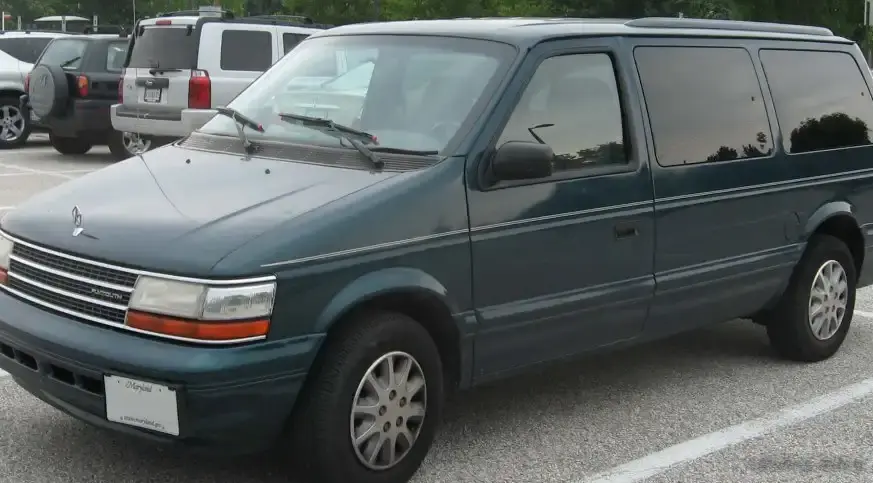
The Plymouth Grand Voyager 3.8i V6 LE, produced from 1990 to 1995, represented a significant offering in the burgeoning minivan segment. Part of the first generation of the Grand Voyager (and closely related to the Dodge Caravan and Chrysler Town & Country), this variant occupied a mid-range position within the lineup, offering a balance of power, space, and features aimed at families. It was a key player in Plymouth’s attempt to capture market share in a segment increasingly dominated by Chrysler’s own offerings. The 3.8i V6 LE trim was designed to appeal to buyers seeking a comfortable and capable vehicle for both daily commuting and longer road trips.
Technical Specifications
| Brand | Plymouth |
| Model | Grand Voyager |
| Type (Engine) | 3.8 i V6 LE (165 Hp) |
| Start of production | 1990 year |
| End of production | 1995 year |
| Powertrain Architecture | Internal Combustion engine |
| Body type | Minivan |
| Seats | 7 |
| Doors | 4 |
| Fuel consumption (combined) | 12.4 l/100 km (19 US mpg, 22.8 UK mpg, 8.1 km/l) |
| Fuel Type | Petrol (Gasoline) |
| Weight-to-power ratio | 10.4 kg/Hp, 96 Hp/tonne |
| Weight-to-torque ratio | 5.9 kg/Nm, 168.2 Nm/tonne |
| Power | 165 Hp @ 4000 rpm |
| Power per litre | 43.7 Hp/l |
| Torque | 289 Nm @ 3600 rpm (213.16 lb.-ft. @ 3600 rpm) |
| Engine layout | Front, Transverse |
| Engine Model/Code | EGH |
| Engine displacement | 3778 cm3 (230.55 cu. in.) |
| Number of cylinders | 6 |
| Engine configuration | V-engine |
| Cylinder Bore | 96 mm (3.78 in.) |
| Piston Stroke | 87 mm (3.43 in.) |
| Compression ratio | 9:1 |
| Number of valves per cylinder | 2 |
| Fuel injection system | Multi-port manifold injection |
| Engine aspiration | Naturally aspirated engine |
| Engine oil capacity | 4.3 l (4.54 US qt | 3.78 UK qt) |
| Coolant | 9.5 l (10.04 US qt | 8.36 UK qt) |
| Kerb Weight | 1718 kg (3787.54 lbs.) |
| Trunk (boot) space – minimum | 1020 l (36.02 cu. ft.) |
| Fuel tank capacity | 75 l (19.81 US gal | 16.5 UK gal) |
| Length | 4896 mm (192.76 in.) |
| Width | 1830 mm (72.05 in.) |
| Height | 1646 mm (64.8 in.) |
| Wheelbase | 3030 mm (119.29 in.) |
| Front track | 1522 mm (59.92 in.) |
| Rear (Back) track | 1578 mm (62.13 in.) |
| Drivetrain Architecture | The Internal combustion engine (ICE) drives the front wheels of the vehicle. |
| Drive wheel | Front wheel drive |
| Number of gears and type of gearbox | 4 gears, automatic transmission |
| Front suspension | Coil spring |
| Rear suspension | Coil spring |
| Front brakes | Ventilated discs |
| Rear brakes | Disc |
| Assisting systems | ABS (Anti-lock braking system) |
| Steering type | Steering rack and pinion |
| Power steering | Hydraulic Steering |
| Tires size | 205/70 R15 S |
Powertrain & Engine Architecture
The heart of the Grand Voyager 3.8i LE was the 3.8-liter (3778 cc) EGH V6 engine. This engine, a member of Chrysler’s second-generation 3.8L family, featured a 90-degree V-angle and a cast iron block with aluminum cylinder heads. It utilized a multi-port fuel injection system, delivering fuel directly to each intake port for improved efficiency and power delivery. The engine produced 165 horsepower at 4000 rpm and 289 Nm (213.16 lb-ft) of torque at 3600 rpm. The automatic transmission was a 4-speed unit, designed for smooth operation and ease of use. This transmission, while not known for its sporty performance, was reliable and well-suited to the Grand Voyager’s intended purpose as a family hauler.
Driving Characteristics
The 3.8L V6 paired with the 4-speed automatic provided adequate, though not exhilarating, performance. Acceleration was reasonable for everyday driving, but passing maneuvers required planning. The automatic transmission’s gear ratios were optimized for fuel economy and comfortable cruising rather than quick acceleration. Compared to the available manual transmission or the higher-output engine options (though not commonly offered in the Grand Voyager), this combination felt less responsive. However, the automatic transmission made the Grand Voyager significantly easier to drive in stop-and-go traffic, a key consideration for its target audience.
Equipment & Trim Levels
The “LE” designation indicated a mid-level trim package. Standard features typically included air conditioning, power windows and locks, an upgraded sound system, and cloth upholstery. Optional extras could include a rear entertainment system, leather upholstery, and upgraded wheels. The interior was designed with practicality in mind, offering ample space for passengers and cargo. The dashboard layout was straightforward and functional, prioritizing ease of use over stylistic flair.
Chassis & Braking
The Grand Voyager utilized a front-wheel-drive layout with coil spring suspension at both the front and rear. The front brakes were ventilated discs, providing good stopping power, while the rear brakes were solid discs. An anti-lock braking system (ABS) was included as standard equipment, enhancing safety. The suspension was tuned for a comfortable ride, prioritizing smoothness over sporty handling. Stabilizer bars were present, but the overall handling characteristics were typical of a large minivan.
Market Reception & Comparison
The Grand Voyager 3.8i V6 LE was generally well-received by critics as a practical and comfortable family vehicle. Fuel economy, at 19 US mpg combined, was considered average for its class. Reliability was generally good, although some owners reported minor issues with the automatic transmission over the long term. Compared to the base model with a smaller engine, the 3.8i LE offered a noticeable improvement in performance. However, it lacked the sporty appeal of some competitors, such as the Ford Windstar.
Legacy
The Plymouth Grand Voyager 3.8i V6 LE remains a relatively common sight on used car lots today. The 3.8L V6 engine is known for its durability, and with proper maintenance, can last for many years. While not a collector’s item, these vans offer a practical and affordable transportation option for families. The automatic transmission, while not the most advanced, is generally reliable. Parts availability is good, making maintenance relatively straightforward. The Grand Voyager, in this configuration, represents a solid example of American minivan design from the early 1990s, prioritizing space, comfort, and practicality over outright performance.