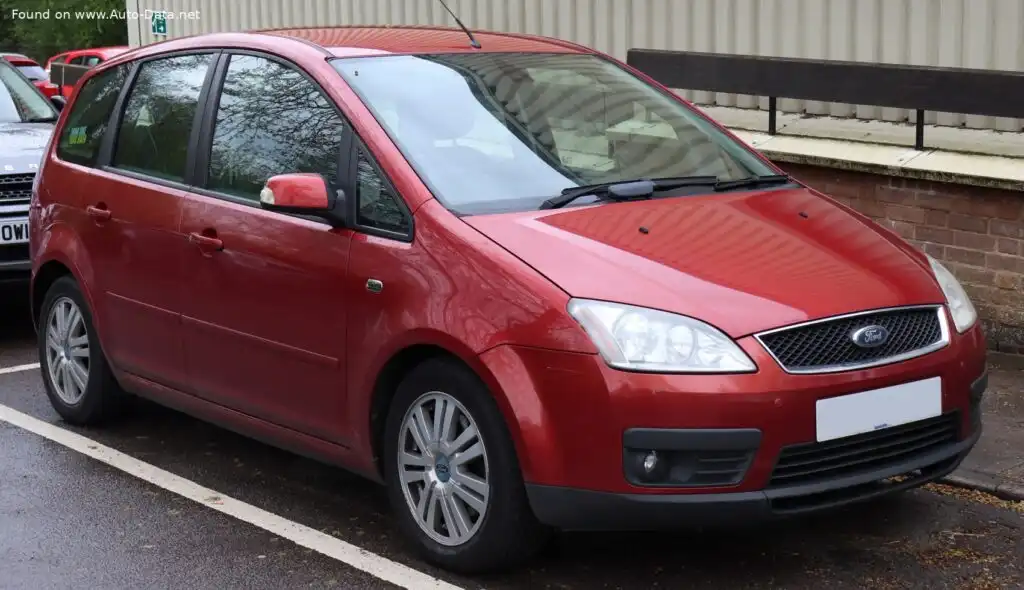
The Ford C-MAX, specifically the facelifted version introduced in 2007, represented Ford’s entry into the compact multi-purpose vehicle (MPV) segment in Europe. Positioned as a practical and versatile family car, the C-MAX aimed to offer a blend of space, comfort, and driving dynamics. The 1.8 TDCi variant, producing 115 horsepower, was a key engine option within the range, offering a balance between fuel efficiency and acceptable performance for everyday use. Production of this specific configuration ran throughout the 2007 model year, forming part of the broader C-MAX (Facelift) generation which utilized the Ford C170 platform.
Technical Specifications
| Brand | Ford |
| Model | C-MAX |
| Generation | C-MAX (Facelift 2007) |
| Type (Engine) | 1.8 TDCi (115 Hp) |
| Start of production | 2007 |
| End of production | 2007 |
| Powertrain Architecture | Internal Combustion engine |
| Body type | MPV |
| Seats | 5 |
| Doors | 5 |
| Fuel Type | Diesel |
| Power | 115 Hp @ 3700 rpm |
| Power per litre | 65.6 Hp/l |
| Torque | 280 Nm @ 1900 rpm / 206.52 lb.-ft. @ 1900 rpm |
| Engine layout | Front, Transverse |
| Engine Model/Code | BHPA |
| Engine displacement | 1753 cm3 / 106.97 cu. in. |
| Number of cylinders | 4 |
| Engine configuration | Inline |
| Fuel injection system | Diesel Commonrail |
| Engine aspiration | Turbocharger, Intercooler |
| Engine oil capacity | 5.6 l / 5.92 US qt | 4.93 UK qt |
| Coolant | 8.1 l / 8.56 US qt | 7.13 UK qt |
| Max. weight | 1995 kg / 4398.22 lbs |
| Trunk (boot) space – minimum | 460 l / 16.24 cu. ft |
| Trunk (boot) space – maximum | 1620 l / 57.21 cu. ft |
| Fuel tank capacity | 55 l / 14.53 US gal | 12.1 UK gal |
| Permitted trailer load with brakes (12%) | 1500 kg / 3306.93 lbs |
| Permitted trailer load without brakes | 730 kg / 1609.37 lbs |
| Width | 1825 mm / 71.85 in |
| Height | 1595-1601 mm / 62.8 – 63.03 in |
| Wheelbase | 2640 mm / 103.94 in |
| Front track | 1535 mm / 60.43 in |
| Rear (Back) track | 1531 mm / 60.28 in |
| Drivetrain Architecture | The Internal combustion engine (ICE) drives the front wheels of the vehicle. |
| Drive wheel | Front wheel drive |
| Number of gears and type of gearbox | 5 gears, manual transmission |
| Front brakes | Disc |
| Rear brakes | Disc |
| Assisting systems | ABS (Anti-lock braking system) |
Powertrain & Engine Architecture
The heart of the C-MAX 1.8 TDCi was the BHPA engine, a 1.8-liter inline-four cylinder diesel engine. This engine was part of Ford’s Duratorq family, known for its robust construction and relatively simple design. The BHPA utilized a common rail direct injection system, delivering fuel at extremely high pressure for improved combustion efficiency and reduced emissions. A turbocharger with an intercooler was employed to boost power output, providing increased torque across a wider rev range. The engine featured a single overhead camshaft (SOHC) valvetrain, operating four valves per cylinder. The 5-speed manual transmission was the standard gearbox for this variant, chosen for its balance of cost-effectiveness and fuel economy. The transmission’s gear ratios were tuned to prioritize mid-range acceleration and cruising efficiency, rather than outright performance.
Driving Characteristics
The 115 horsepower and 280 Nm (206 lb-ft) of torque provided by the 1.8 TDCi engine delivered adequate, but not exhilarating, performance in the C-MAX. Acceleration from 0 to 60 mph was typically in the 11-12 second range. The engine felt strongest in the mid-range, making it well-suited for overtaking maneuvers on the highway. Compared to the higher-output 2.0-liter TDCi versions, the 1.8 felt noticeably less powerful, particularly when fully loaded with passengers and luggage. However, the 1.8 TDCi offered a smoother and more refined driving experience than the smaller 1.6-liter diesel, and its fuel economy was a significant advantage. The 5-speed manual transmission provided a reasonably precise shift feel, although it lacked the sporty engagement of some competitors.
Equipment & Trim Levels
The 1.8 TDCi C-MAX typically came equipped with a respectable level of standard features. These generally included air conditioning, power windows, power door locks, a CD player with auxiliary input, and ABS brakes. Higher trim levels, such as the Titanium, added features like alloy wheels, upgraded interior trim, automatic headlights, rain-sensing wipers, and a multi-function steering wheel. Optional extras included a panoramic sunroof, parking sensors, and a navigation system. Interior upholstery was typically cloth, with the option of leather on higher-spec models. The dashboard layout was functional and user-friendly, with logically placed controls.
Chassis & Braking
The C-MAX utilized a MacPherson strut front suspension and a multi-link rear suspension, providing a comfortable ride and decent handling characteristics. The suspension was tuned to prioritize comfort over outright sportiness, but the C-MAX still offered a reasonably stable and predictable driving experience. Brakes were disc brakes all around, providing adequate stopping power for the vehicle’s weight. ABS (Anti-lock Braking System) was standard, enhancing safety in emergency braking situations. Stabilizer bars were fitted to both the front and rear axles to reduce body roll during cornering.
Market Reception & Comparison
The Ford C-MAX 1.8 TDCi was generally well-received by automotive critics as a practical and economical family car. It was praised for its spacious interior, comfortable ride, and good fuel economy. However, some critics noted that the 1.8 TDCi engine lacked the punch of its larger counterparts. Compared to rivals like the Renault Scenic and Volkswagen Touran, the C-MAX offered a competitive package in terms of price, features, and practicality. The 1.8 TDCi variant was particularly appealing to buyers who prioritized fuel efficiency and low running costs over outright performance.
Legacy
The Ford C-MAX 1.8 TDCi, while not the most powerful version of the model, proved to be a reliable and durable powertrain. The Duratorq engine is known for its longevity, and with regular maintenance, these engines can accumulate high mileage without major issues. In the used car market, the 1.8 TDCi C-MAX remains a popular choice for budget-conscious buyers seeking a practical and economical MPV. Common issues are typically related to wear and tear on components such as the turbocharger, fuel injectors, and clutch. However, these are generally straightforward to repair, and parts are readily available. The C-MAX 1.8 TDCi represents a solid and dependable option for those needing a versatile and affordable family vehicle.