Technical Specifications
| Brand | Ford |
| Model | C-MAX |
| Generation | C-MAX (Facelift 2007) |
| Type (Engine) | 2.0 TDCI (136 Hp) |
| Start of production | 2007 |
| End of production | 2010 |
| Powertrain Architecture | Internal Combustion engine |
| Body type | MPV |
| Seats | 5 |
| Doors | 5 |
| Fuel consumption (urban) | 7.6 l/100 km (30.9 US mpg) |
| Fuel consumption (extra urban) | 4.8 l/100 km (49 US mpg) |
| Fuel consumption (combined) | 5.8 l/100 km (40.6 US mpg) |
| Fuel Type | Diesel |
| Acceleration 0 – 100 km/h | 9.6 sec |
| Acceleration 0 – 62 mph | 9.6 sec |
| Acceleration 0 – 60 mph | 9.1 sec |
| Maximum speed | 200 km/h (124.27 mph) |
| Emission standard | Euro 4 |
| Weight-to-power ratio | 11.1 kg/Hp |
| Weight-to-torque ratio | 4.7 kg/Nm |
| Power | 136 Hp @ 4000 rpm |
| Torque | 320 Nm @ 2000 rpm (236.02 lb.-ft. @ 2000 rpm) |
| Engine layout | Front, Transverse |
| Engine Model/Code | G6DA |
| Engine displacement | 1997 cm3 (121.86 cu. in.) |
| Number of cylinders | 4 |
| Engine configuration | Inline |
| Cylinder Bore | 85 mm (3.35 in.) |
| Piston Stroke | 88 mm (3.46 in.) |
| Compression ratio | 18:1 |
| Number of valves per cylinder | 4 |
| Fuel injection system | Diesel Commonrail |
| Engine aspiration | Turbocharger, Intercooler |
| Engine oil capacity | 5.5 l (5.81 US qt | 4.84 UK qt) |
| Coolant capacity | 8.4 l (8.88 US qt | 7.39 UK qt) |
| Kerb Weight | 1506 kg (3320.16 lbs.) |
| Max. weight | 1990 kg (4387.2 lbs.) |
| Max load | 484 kg (1067.04 lbs.) |
| Trunk (boot) space – minimum | 550 l (19.42 cu. ft.) |
| Trunk (boot) space – maximum | 1620 l (57.21 cu. ft.) |
| Fuel tank capacity | 55 l (14.53 US gal | 12.1 UK gal) |
| Length | 4372 mm (172.13 in.) |
| Width | 1825 mm (71.85 in.) |
| Height | 1595 mm (62.8 in.) |
| Wheelbase | 2640 mm (103.94 in.) |
| Drivetrain Architecture | Front wheel drive |
| Number of gears | 5 |
| Gearbox type | Manual transmission |
| Front suspension | Independent, McPherson with coil spring and anti-roll bar |
| Rear suspension | Independent multi-link spring suspension with stabilizer |
| Front brakes | Ventilated discs |
| Rear brakes | Disc |
| Assisting systems | ABS (Anti-lock braking system) |
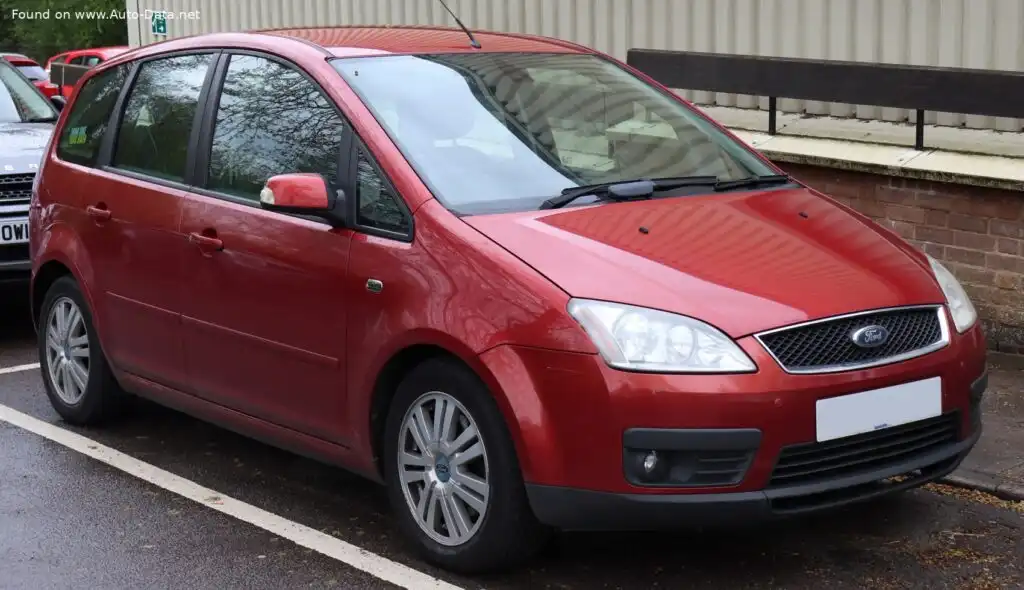
The Ford C-MAX, specifically the facelifted version produced from 2007 to 2010, was Ford’s offering in the increasingly popular compact multi-purpose vehicle (MPV) segment in Europe. Designed as a practical and versatile family car, the C-MAX aimed to deliver a blend of interior space, comfort, and reasonable driving dynamics. The 2.0 TDCI variant, producing 136 horsepower, was a key model within the C-MAX range, appealing to buyers who needed the efficiency and range of a diesel engine for longer trips and occasional towing, without sacrificing everyday usability. This model occupied a mid-range position in the C-MAX lineup, positioned above the lower-powered 1.6-liter gasoline and diesel options, and below the more performance-focused trims.
Powertrain & Engine Architecture
The 2.0 TDCI C-MAX was powered by the G6DA engine, a four-cylinder, inline diesel. This engine was widely used across both Ford and PSA (Peugeot-Citroën) vehicles during this period, benefiting from a collaborative development effort. The 2.0-liter displacement struck a balance between fuel economy and usable power. The engine employed a common rail direct injection system, injecting fuel directly into the cylinders at very high pressure for optimized combustion efficiency. A turbocharger, coupled with an intercooler, boosted power output by forcing more air into the engine. The engine featured four valves per cylinder, improving airflow and enhancing performance. The 136 horsepower peak was reached at 4000 rpm, while the substantial 320 Nm (236 lb-ft) of torque was available from a low 2000 rpm, providing strong pulling power for everyday driving and overtaking maneuvers. The engine was typically paired with a five-speed manual transmission, offering a conventional driving experience.
Driving Characteristics
The 2.0 TDCI C-MAX provided a comfortable and capable driving experience. The readily available torque meant the car felt responsive in most situations, minimizing the need for frequent downshifts. While not designed for outright performance, the C-MAX offered adequate acceleration, achieving 60 mph in approximately 9.1 seconds. The five-speed manual transmission was well-matched to the engine’s characteristics, providing smooth and precise gear changes. Compared to the less powerful 1.6-liter diesel, the 2.0 TDCI offered a noticeable improvement in performance, especially when carrying passengers or navigating inclines. However, it didn’t quite match the brisk acceleration of the higher-output gasoline variants. The suspension was tuned for comfort, effectively absorbing bumps and road imperfections, making it a pleasant vehicle for longer journeys.
Equipment & Trim Levels
The 2.0 TDCI C-MAX generally came with a reasonable level of standard equipment. This typically included air conditioning, power windows, power mirrors, and a basic audio system. Higher trim levels, such as the Titanium, added features like alloy wheels, upgraded interior upholstery, automatic climate control, and a more advanced audio system with steering wheel-mounted controls. Optional extras included a panoramic sunroof, parking sensors, and a navigation system. Interior upholstery was usually cloth, with leather options available on the higher-spec trims. The dashboard layout was functional and user-friendly, with logically arranged controls.
Chassis & Braking
The C-MAX utilized an independent suspension system on both the front and rear axles. The front suspension employed McPherson struts with a coil spring and anti-roll bar, while the rear featured a multi-link setup, also incorporating a stabilizer bar. This configuration aimed to balance ride comfort with handling stability. Braking was provided by ventilated discs on the front wheels and solid discs on the rear. An Anti-lock Braking System (ABS) was standard, enhancing safety by preventing wheel lockup during hard braking. The chassis was engineered to deliver a stable and predictable driving experience, with reduced body roll during cornering.
Market Reception & Comparison
The Ford C-MAX 2.0 TDCI was generally well-regarded by automotive reviewers. It was praised for its spacious interior, comfortable ride quality, and the fuel efficiency of its diesel engine. The 2.0 TDCI engine was considered a good compromise between performance and economy. Compared to the 1.6-liter diesel, the 2.0 TDCI offered a significant performance increase, making it a more suitable choice for drivers who frequently transported passengers or luggage, or who regularly undertook longer trips. However, the 1.6-liter diesel was more affordable and offered even better fuel economy. The gasoline variants provided a more refined driving experience but lacked the torque and fuel efficiency of the diesel engines.
Legacy
The Ford C-MAX 2.0 TDCI has proven to be a relatively reliable vehicle, with the G6DA engine generally considered durable. However, like all diesel engines, it can be susceptible to issues related to the fuel injection system and turbocharger if not properly maintained. Regular servicing, including oil changes and filter replacements, is essential for ensuring long-term reliability. In the used car market, the C-MAX 2.0 TDCI remains a popular choice for buyers seeking a practical and fuel-efficient family vehicle. Its combination of space, comfort, and economy continues to make it a competitive option, even with the introduction of newer MPV models. Parts availability is generally good, and repair costs are reasonable, contributing to its continued appeal.