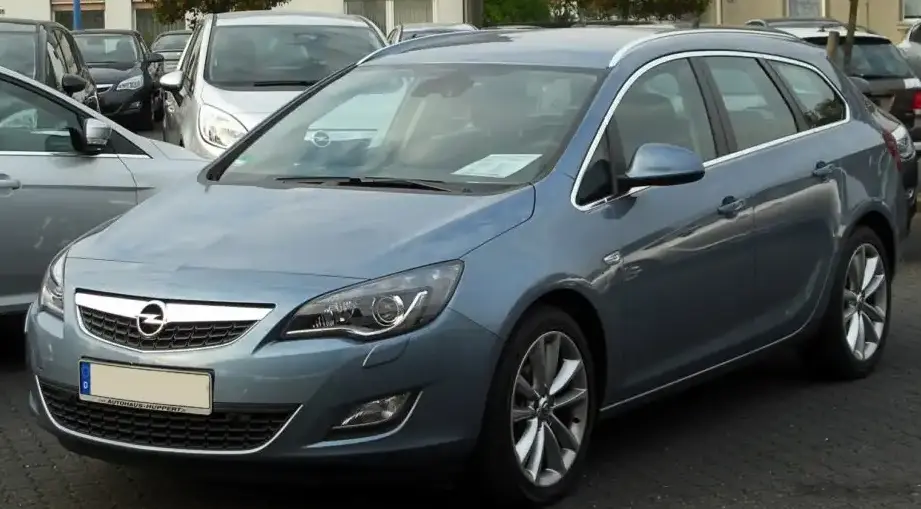
The Opel Astra J Sports Tourer 1.7 CDTI, producing 110 horsepower, was a popular variant of Opel’s Astra J series, specifically the station wagon (estate) body style. Produced from 2010 to 2012, it occupied a key position in the Astra J lineup as an efficient and practical option for families and drivers prioritizing fuel economy. This model was primarily marketed in Europe, where the station wagon format remains highly favored, offering a balance between cargo capacity and manageable dimensions. It was positioned as a mid-range offering, slotting below the more powerful petrol and diesel variants while offering more features than the base-level trims.
Technical Specifications
| Brand | Opel |
| Model | Astra |
| Generation | Astra J Sports Tourer |
| Type (Engine) | 1.7 CDTI (110 Hp) |
| Start of production | 2010 |
| End of production | 2012 |
| Powertrain Architecture | Internal Combustion engine |
| Body type | Station wagon (estate) |
| Seats | 5 |
| Doors | 5 |
| Fuel consumption (urban) | 5.5 l/100 km (42.8 US mpg) |
| Fuel consumption (extra urban) | 3.9 l/100 km (60.3 US mpg) |
| Fuel consumption (combined) | 3.9 l/100 km (60.3 US mpg) |
| CO2 emissions | 119 g/km |
| Fuel Type | Diesel |
| Acceleration 0 – 100 km/h | 13 sec |
| Acceleration 0 – 62 mph | 13 sec |
| Acceleration 0 – 60 mph | 12.4 sec |
| Maximum speed | 180 km/h (111.85 mph) |
| Emission standard | Euro 5 |
| Weight-to-power ratio | 12.7 kg/Hp |
| Weight-to-torque ratio | 5.4 kg/Nm |
| Power | 110 Hp @ 3800 rpm |
| Torque | 260 Nm @ 2550 rpm (191.77 lb.-ft. @ 2550 rpm) |
| Engine layout | Front, Transverse |
| Engine Model/Code | A17DTJ |
| Engine displacement | 1686 cm3 (102.89 cu. in.) |
| Number of cylinders | 4 |
| Engine configuration | Inline |
| Cylinder Bore | 79 mm (3.11 in.) |
| Piston Stroke | 86 mm (3.39 in.) |
| Compression ratio | 18.4:1 |
| Number of valves per cylinder | 4 |
| Fuel injection system | Diesel Commonrail |
| Engine aspiration | Turbocharger, Intercooler |
| Valvetrain | DOHC |
| Engine oil capacity | 5.4 l (5.71 US qt | 4.75 UK qt) |
| Coolant capacity | 7.1 l (7.5 US qt | 6.25 UK qt) |
| Kerb Weight | 1393 kg (3071.04 lbs.) |
| Max. weight | 1960 kg (4321.06 lbs.) |
| Max load | 567 kg (1250.02 lbs.) |
| Trunk (boot) space – minimum | 550 l (19.42 cu. ft.) |
| Trunk (boot) space – maximum | 1550 l (54.74 cu. ft.) |
| Fuel tank capacity | 56 l (14.79 US gal | 12.32 UK gal) |
| Length | 4698 mm (184.96 in.) |
| Width | 1814 mm (71.42 in.) |
| Width including mirrors | 2013 mm (79.25 in.) |
| Height | 1535 mm (60.43 in.) |
| Wheelbase | 2685 mm (105.71 in.) |
| Front track | 1544 mm (60.79 in.) |
| Rear track | 1558 mm (61.34 in.) |
| Front overhang | 974 mm (38.35 in.) |
| Rear overhang | 1039 mm (40.91 in.) |
| Ride height (ground clearance) | 109 mm (4.29 in.) |
| Drag coefficient (Cd) | 0.33 |
| Drivetrain Architecture | Front wheel drive |
| Number of gears | 6 |
| Gearbox type | Manual transmission |
| Front brakes | Ventilated discs |
| Rear brakes | Disc |
| Tires size | 215/50 R17 |
| Wheel rims size | 17 |
Powertrain & Engine Architecture
The heart of the Astra J Sports Tourer 1.7 CDTI is the A17DTJ engine, a 1.7-liter inline-four cylinder diesel. This engine is part of Opel/Vauxhall’s family of small-displacement diesel engines, known for their efficiency and relatively low emissions. The A17DTJ utilizes a common rail direct injection system, delivering fuel directly into the combustion chamber at extremely high pressure. This, combined with a turbocharger and intercooler, allows for a good balance of power and fuel economy. The engine features a Double Overhead Camshaft (DOHC) valvetrain with four valves per cylinder, optimizing airflow for improved performance. The 6-speed manual transmission was the standard offering for this variant, providing a good spread of gears for both urban and highway driving. The transmission was chosen to maximize fuel efficiency and provide adequate acceleration.
Driving Characteristics
The 110 horsepower and 191 lb-ft of torque produced by the 1.7 CDTI engine provided adequate, though not exhilarating, performance. Acceleration from 0-60 mph took around 12.4 seconds, and top speed was limited to 111.85 mph. In real-world driving, the engine felt most comfortable in the mid-range, with readily available torque for overtaking and merging. Compared to the more powerful 1.4 Turbo petrol or 2.0 CDTI diesel variants, the 1.7 CDTI felt noticeably slower, particularly when fully loaded. However, the manual transmission allowed drivers to maintain control and extract the most from the engine’s power band. The gear ratios were well-matched for everyday driving, providing smooth shifts and reasonable fuel economy.
Equipment & Trim Levels
The Astra J Sports Tourer 1.7 CDTI typically came equipped with a reasonable level of standard features. These included air conditioning, electric front windows, a CD/radio system, and basic safety equipment like ABS and airbags. Higher trim levels, such as ‘Enjoy’ or ‘Cosmo’, added features like alloy wheels, cruise control, parking sensors, and upgraded interior trim. Interior upholstery was typically cloth, with options for leather upgrades on higher trims. The dashboard layout was functional and well-designed, with a clear instrument cluster and intuitive controls. Optional extras included a panoramic sunroof, navigation system, and premium audio system.
Chassis & Braking
The Astra J Sports Tourer featured a MacPherson strut front suspension and a torsion beam rear suspension. This setup provided a good balance between ride comfort and handling. The torsion beam rear suspension was a cost-effective solution, but it didn’t offer the same level of sophistication as a multi-link setup found on some higher-end trims. Braking was handled by ventilated discs on the front wheels and solid discs on the rear. ABS (Anti-lock Braking System) was standard, providing enhanced braking performance and stability. The steering was electrically assisted, offering a light and precise feel.
Market Reception & Comparison
The Astra J Sports Tourer 1.7 CDTI was generally well-received by critics for its fuel efficiency and practicality. It was praised for its spacious interior and large cargo area, making it a suitable choice for families. However, some reviewers noted that the engine lacked outright power, particularly when compared to its petrol counterparts. Fuel economy was a major selling point, with combined figures around 60.3 US mpg. In terms of reliability, the A17DTJ engine proved to be generally robust, although some owners reported issues with the diesel particulate filter (DPF) and turbocharger. Compared to the 1.4 Turbo petrol, the 1.7 CDTI offered significantly better fuel economy but less performance. The 2.0 CDTI diesel provided more power but at a higher price point.
Legacy
The Opel Astra J Sports Tourer 1.7 CDTI remains a popular choice in the used car market, particularly for buyers seeking an affordable and fuel-efficient station wagon. The A17DTJ engine, while not the most powerful, has proven to be relatively reliable with proper maintenance. Common issues, such as DPF blockages, can be mitigated with regular servicing and occasional long-distance drives. The Astra J Sports Tourer’s spacious interior and practical design continue to appeal to families and drivers who prioritize functionality over outright performance. Its enduring popularity is a testament to its well-rounded design and efficient powertrain.