
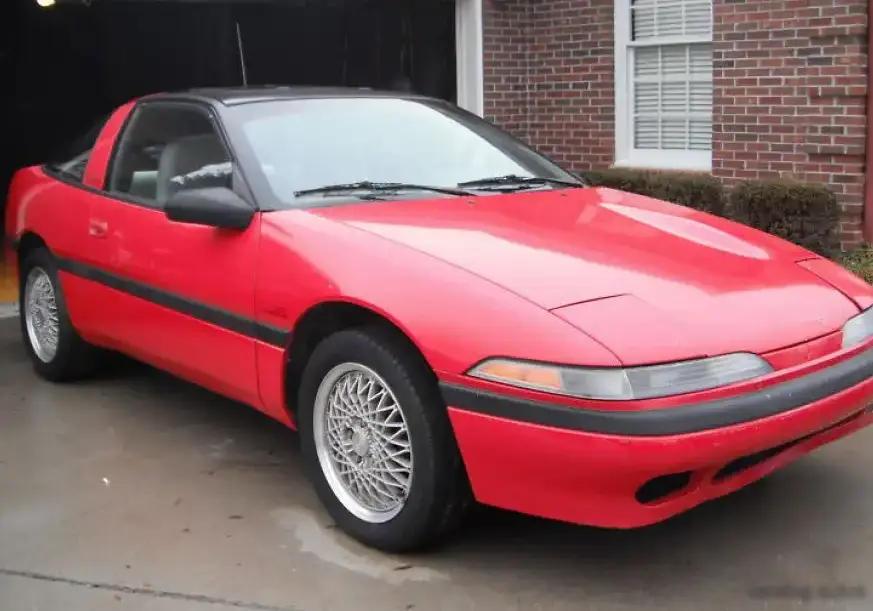
The Plymouth Laser 2.0i Automatic, produced between 1989 and 1994, represented a key offering within the first generation of the Laser, a sport compact coupe. Built in partnership with Mitsubishi – and mechanically identical to the Mitsubishi Eclipse and Eagle Talon – the Laser aimed to capture a segment of the burgeoning American market for affordable, stylish, and performance-oriented vehicles. The 2.0i Automatic trim occupied a middle ground in the Laser lineup, offering a balance between the base model’s affordability and the more potent turbocharged variants. It was positioned as a comfortable and practical daily driver with a respectable level of performance.
Technical Specifications
| Brand | Plymouth |
| Model | Laser |
| Generation | Laser |
| Type (Engine) | 2.0i (137 Hp) Automatic |
| Start of production | 1989 |
| End of production | 1994 |
| Powertrain Architecture | Internal Combustion engine |
| Body type | Coupe |
| Seats | 4 |
| Doors | 3 |
| Fuel consumption (urban) | 13 l/100 km (18.1 US mpg, 21.7 UK mpg, 7.7 km/l) |
| Fuel consumption (extra urban) | 8 l/100 km (29.4 US mpg, 35.3 UK mpg, 12.5 km/l) |
| Fuel Type | Petrol (Gasoline) |
| Acceleration 0 – 100 km/h | 11.4 sec |
| Acceleration 0 – 62 mph | 11.4 sec |
| Acceleration 0 – 60 mph | 10.8 sec |
| Maximum speed | 182 km/h (113.09 mph) |
| Weight-to-power ratio | 8.9 kg/Hp, 112.8 Hp/tonne |
| Weight-to-torque ratio | 7.2 kg/Nm, 139.1 Nm/tonne |
| Power | 137 Hp @ 6000 rpm |
| Power per litre | 68.6 Hp/l |
| Torque | 169 Nm @ 5000 rpm (124.65 lb.-ft. @ 5000 rpm) |
| Engine layout | Front, Transverse |
| Engine Model/Code | 4G63 |
| Engine displacement | 1997 cm3 (121.86 cu. in.) |
| Number of cylinders | 4 |
| Engine configuration | Inline |
| Cylinder Bore | 85 mm (3.35 in.) |
| Piston Stroke | 88 mm (3.46 in.) |
| Compression ratio | 9:1 |
| Number of valves per cylinder | 4 |
| Fuel injection system | Multi-port manifold injection |
| Engine aspiration | Naturally aspirated engine |
| Valvetrain | DOHC |
| Engine oil capacity | 4.4 l (4.65 US qt | 3.87 UK qt) |
| Coolant | 7 l (7.4 US qt | 6.16 UK qt) |
| Kerb Weight | 1215 kg (2678.62 lbs.) |
| Trunk (boot) space – minimum | 290 l (10.24 cu. ft.) |
| Trunk (boot) space – maximum | 730 l (25.78 cu. ft.) |
| Fuel tank capacity | 60 l (15.85 US gal | 13.2 UK gal) |
| Length | 4330 mm (170.47 in.) |
| Width | 1690 mm (66.54 in.) |
| Height | 1310 mm (51.57 in.) |
| Wheelbase | 2470 mm (97.24 in.) |
| Front track | 1465 mm (57.68 in.) |
| Rear (Back) track | 1450 mm (57.09 in.) |
| Drivetrain Architecture | The Internal combustion engine (ICE) drives the front wheels of the vehicle. |
| Drive wheel | Front wheel drive |
| Number of gears and type of gearbox | 4 gears, automatic transmission |
| Front suspension | Coil spring |
| Rear suspension | Coil spring |
| Front brakes | Ventilated discs |
| Rear brakes | Disc |
| Assisting systems | ABS (Anti-lock braking system) |
| Steering type | Steering rack and pinion |
| Power steering | Hydraulic Steering |
| Tires size | 205/55 R16 |
| Wheel rims size | 6J x 16 |
INTRODUCTION
The Plymouth Laser, along with its Mitsubishi Eclipse and Eagle Talon siblings, was a product of the Diamond-Star Motors joint venture between Chrysler and Mitsubishi. This partnership aimed to produce competitive, high-quality vehicles for the North American market. The first-generation Laser (1990-1994) was based on the Mitsubishi Mirage platform, and the 2.0i Automatic variant was a popular choice for buyers seeking a blend of affordability, comfort, and reasonable performance. It represented a step up from the base model, offering a larger engine and the convenience of an automatic transmission.
Powertrain & Engine Architecture
The heart of the Laser 2.0i Automatic is the Mitsubishi 4G63 2.0-liter inline-four cylinder engine. This engine, known for its durability and potential for modification, featured a cast iron block and an aluminum cylinder head. The 4G63 in this application utilized multi-port fuel injection, delivering fuel directly into each intake port for improved efficiency and power delivery. The engine employed a double overhead camshaft (DOHC) valvetrain with four valves per cylinder, enhancing breathing and contributing to its 137 horsepower output at 6000 rpm and 169 Nm (124.65 lb-ft) of torque at 5000 rpm. The engine’s 9:1 compression ratio was a compromise between performance and the use of readily available 87 octane gasoline. The automatic transmission was a four-speed unit, providing smooth shifts but sacrificing some of the responsiveness found in the available five-speed manual transmission.
Driving Characteristics
The 2.0i Automatic Laser offered a comfortable and predictable driving experience. While not as quick as the turbocharged variants, the 137 hp engine provided adequate power for everyday driving and highway merging. The automatic transmission, while convenient, did result in some power loss compared to the manual version. Gear ratios were tuned for fuel efficiency and smooth cruising, rather than outright acceleration. The 0-60 mph time of around 10.8 seconds and a top speed of 113 mph reflected this focus. The front-wheel-drive configuration provided decent handling, but lacked the balance and grip of all-wheel-drive models. Overall, the driving experience was geared towards practicality and ease of use.
Equipment & Trim Levels
The Laser 2.0i Automatic typically came standard with features such as air conditioning, power steering, a basic audio system, and cloth upholstery. Optional extras included a sunroof, upgraded audio systems (often with a cassette player), and alloy wheels. Interior trim was relatively basic, reflecting the car’s price point, but offered a functional and comfortable cabin. The dashboard layout was straightforward, with easy-to-read gauges and logically placed controls. The 2.0i trim generally lacked the more luxurious features found in higher-end models, such as leather seats or premium sound systems.
Chassis & Braking
The Laser 2.0i Automatic utilized a MacPherson strut front suspension and a coil spring rear suspension. This setup provided a comfortable ride quality, although it wasn’t particularly sporty. The front brakes were ventilated discs, offering good stopping power, while the rear brakes were solid discs. An anti-lock braking system (ABS) was often included as standard equipment, enhancing safety. The Laser’s curb weight of 1215 kg (2678.62 lbs) contributed to its handling characteristics and braking performance. Stabilizer bars were present at both the front and rear, helping to reduce body roll during cornering.
Market Reception & Comparison
The Plymouth Laser 2.0i Automatic was generally well-received by critics as an affordable and reliable sport coupe. It offered a good value proposition compared to other vehicles in its class. However, it was often criticized for its lack of outright performance compared to the turbocharged models. Fuel economy was respectable, averaging around 24 mpg in combined driving. Compared to the Laser RS Turbo, the 2.0i Automatic offered significantly less power and acceleration, but it was also more affordable to purchase and maintain. The 2.0i Automatic was also a more sensible choice for buyers who prioritized comfort and convenience over performance.
Legacy
The Plymouth Laser, and particularly the 2.0i Automatic variant, has developed a modest following among enthusiasts. The 4G63 engine is renowned for its durability and tunability, making it a popular choice for engine swaps and modifications. While not as collectible as the turbocharged models, the 2.0i Automatic remains a relatively affordable and reliable option in the used car market. Common issues include wear and tear on the automatic transmission and potential oil leaks from the engine. However, with proper maintenance, these vehicles can provide many years of reliable service. The Laser’s legacy lies in its contribution to the growing popularity of sport compact cars in the United States and its role in establishing the Diamond-Star Motors joint venture as a successful automotive partnership.
