
Technical Specifications
| Brand | Plymouth |
| Model | Laser |
| Generation | Laser |
| Type (Engine) | 2.0i Turbo (195 Hp) Automatic |
| Start of production | 1991 |
| End of production | 1994 |
| Powertrain Architecture | Internal Combustion engine |
| Body type | Coupe |
| Seats | 4 |
| Doors | 3 |
| Fuel consumption (urban) | 18 l/100 km (13.1 US mpg, 15.7 UK mpg, 5.6 km/l) |
| Fuel consumption (extra urban) | 9 l/100 km (26.1 US mpg, 31.4 UK mpg, 11.1 km/l) |
| Fuel Type | Petrol (Gasoline) |
| Maximum speed | 230 km/h (142.92 mph) |
| Weight-to-power ratio | 6.4 kg/Hp, 156.6 Hp/tonne |
| Weight-to-torque ratio | 4.5 kg/Nm, 221.7 Nm/tonne |
| Power | 195 Hp @ 6000 rpm |
| Power per litre | 97.6 Hp/l |
| Torque | 276 Nm @ 3000 rpm (203.57 lb.-ft. @ 3000 rpm) |
| Engine layout | Front, Transverse |
| Engine Model/Code | 4G63T |
| Engine displacement | 1997 cm3 (121.86 cu. in.) |
| Number of cylinders | 4 |
| Engine configuration | Inline |
| Cylinder Bore | 85 mm (3.35 in.) |
| Piston Stroke | 88 mm (3.46 in.) |
| Compression ratio | 7.8:1 |
| Number of valves per cylinder | 4 |
| Fuel injection system | Multi-port manifold injection |
| Engine aspiration | Turbocharger |
| Valvetrain | DOHC |
| Engine oil capacity | 4.5 l (4.76 US qt | 3.96 UK qt) |
| Coolant | 7 l (7.4 US qt | 6.16 UK qt) |
| Kerb Weight | 1245 kg (2744.76 lbs.) |
| Trunk (boot) space – minimum | 290 l (10.24 cu. ft.) |
| Trunk (boot) space – maximum | 730 l (25.78 cu. ft.) |
| Fuel tank capacity | 60 l (15.85 US gal | 13.2 UK gal) |
| Length | 4330 mm (170.47 in.) |
| Width | 1690 mm (66.54 in.) |
| Height | 1310 mm (51.57 in.) |
| Wheelbase | 2470 mm (97.24 in.) |
| Front track | 1465 mm (57.68 in.) |
| Rear (Back) track | 1450 mm (57.09 in.) |
| Drivetrain Architecture | The Internal combustion engine (ICE) drives the front wheels of the vehicle. |
| Drive wheel | Front wheel drive |
| Number of gears and type of gearbox | 4 gears, automatic transmission |
| Front suspension | Coil spring |
| Rear suspension | Coil spring |
| Front brakes | Ventilated discs |
| Rear brakes | Disc |
| Assisting systems | ABS (Anti-lock braking system) |
| Steering type | Steering rack and pinion |
| Power steering | Hydraulic Steering |
| Tires size | 185/70 R14 |
| Wheel rims size | 14 |
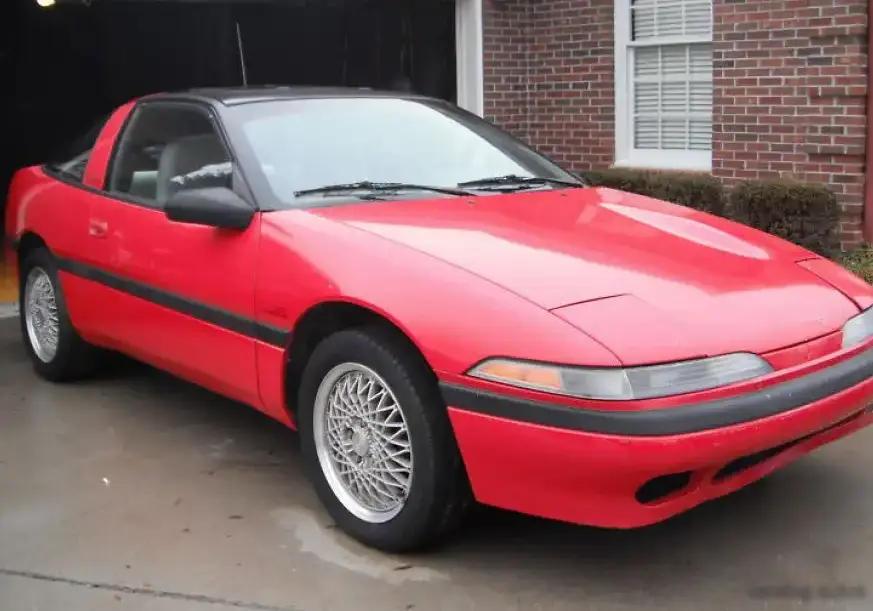
The Plymouth Laser 2.0i Turbo, produced between 1991 and 1994, was a performance-oriented variant within the compact coupe segment. Built as part of the Diamond-Star Motors (DSM) joint venture between Chrysler and Mitsubishi, the Laser shared its 1HX0 platform with the Mitsubishi Eclipse and Eagle Talon. The 2.0i Turbo, equipped with a turbocharged 2.0-liter inline-four engine and a four-speed automatic transmission, occupied a middle ground in the Laser lineup, aiming to attract buyers who desired a sporty coupe without the complexity of a manual gearbox. It represented a compromise between performance and convenience, offering a more accessible entry point into the turbocharged DSM offerings.
Powertrain & Engine Architecture
The heart of the Laser 2.0i Turbo was the 4G63T engine, a 2.0-liter (1997 cc) inline-four cylinder powerplant developed by Mitsubishi. This engine was known for its robust construction and significant tuning potential. The ‘T’ designation indicated the presence of a turbocharger, substantially increasing power output. The engine employed a multi-port fuel injection system, precisely delivering fuel to each cylinder for optimized combustion efficiency. A double overhead camshaft (DOHC) valvetrain, featuring four valves per cylinder, further enhanced engine breathing and overall performance. The 7.8:1 compression ratio was a deliberate choice to accommodate the turbocharging system and mitigate the risk of pre-ignition. The four-speed automatic transmission, while offering ease of use, was a conventional torque-converter type and didn’t provide the same level of responsiveness or direct feel as the five-speed manual transmissions available on other Laser models.
Driving Characteristics
The 195 horsepower and 276 Nm (203.57 lb-ft) of torque generated by the 2.0i Turbo automatic powertrain delivered respectable acceleration for the early 1990s. However, the automatic transmission inevitably diminished the engine’s full potential. Compared to the five-speed manual transmission offered on other Laser variants, the automatic resulted in some power loss through the torque converter and reduced driver control over gear selection. Gear ratios were tuned to strike a balance between acceleration and fuel economy, but the automatic transmission lacked the immediacy and responsiveness of a manual gearbox. In real-world driving, the experience was comfortable, though not overtly sporty. The turbocharger provided a noticeable surge of power during acceleration, but some degree of turbo lag was present, particularly at lower engine speeds. The front-wheel-drive configuration, common for vehicles in this segment, could induce torque steer under hard acceleration, requiring careful throttle modulation.
Equipment & Trim Levels
The 2.0i Turbo Automatic trim typically included standard features such as power windows, power door locks, and an upgraded sound system. Interior upholstery generally consisted of cloth seats, with leather available as an optional upgrade. The dashboard layout was functional and driver-focused, featuring easily readable gauges. Optional extras included a sunroof, air conditioning, and enhanced audio systems. The Laser, even in its turbocharged automatic configuration, was positioned as a relatively affordable performance coupe, meaning luxury features weren’t as abundant as in some competing models. The focus remained on providing a sporty driving experience at a reasonable price point.
Chassis & Braking
The Plymouth Laser utilized a front-engine, front-wheel-drive layout. Suspension consisted of coil springs at all four corners, providing a comfortable ride quality. The front suspension incorporated stabilizer bars to minimize body roll during cornering maneuvers. Braking duties were handled by ventilated discs at the front and solid discs at the rear. An anti-lock braking system (ABS) was standard equipment, enhancing safety and control during emergency braking situations. The chassis was engineered to balance handling with ride comfort, leaning slightly towards the former to reflect the car’s performance aspirations.
Market Reception & Comparison
The Laser 2.0i Turbo Automatic received a mixed reception from automotive critics. While the engine’s power and potential were generally praised, the automatic transmission was often criticized for detracting from the overall driving experience. Compared to the manual transmission versions, the automatic was perceived as less engaging and slightly slower. Fuel economy was also a concern, as the turbocharged engine consumed more fuel than the naturally aspirated models. However, the automatic transmission appealed to buyers who prioritized convenience and ease of use over outright performance. When compared to rivals like the Honda Prelude and Nissan NX, the Laser offered more aggressive styling and a more powerful engine, but often lacked the refinement and overall build quality of the Japanese competitors.
Legacy
The Plymouth Laser, and particularly the 2.0i Turbo Automatic variant, has cultivated a dedicated following among automotive enthusiasts. The 4G63T engine is widely recognized for its durability and substantial potential for modification. While the automatic transmission isn’t as highly regarded as the manual, it remains a viable option for those seeking a comfortable and relatively powerful coupe. Today, well-maintained examples of the Laser 2.0i Turbo Automatic are becoming increasingly collectible. Common issues include turbocharger wear, oil leaks, and age-related deterioration of rubber components. However, the availability of aftermarket parts and a passionate enthusiast community ensures that these cars can be maintained and enjoyed for years to come. The 4G63T engine’s reputation for robustness has cemented its place in the aftermarket performance scene, with many examples still being used in modified vehicles today.
