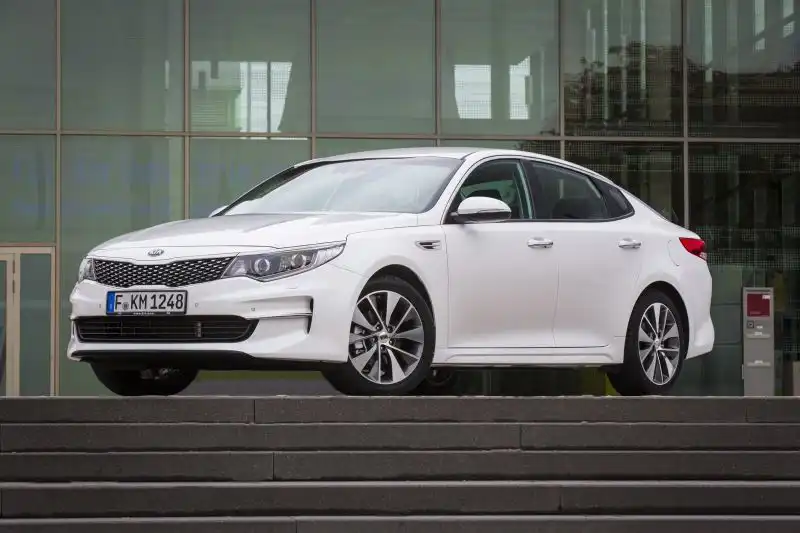
The Kia Optima IV, produced from 2015 to 2018, represented a significant step forward for the Korean automaker in the mid-size sedan segment. The 2.0 CVVL (Continuously Variable Valve Lift) engine paired with a 6-speed automatic transmission was a core offering within the Optima IV lineup, positioned as a balance between affordability, fuel efficiency, and acceptable performance. This variant aimed to appeal to a broad customer base seeking a comfortable and well-equipped family sedan. It served as a stepping stone between the base 1.6L engine and the more powerful 2.4L and turbocharged options.
Technical Specifications
| Brand | Kia |
| Model | Optima |
| Generation | Optima IV |
| Type (Engine) | 2.0 CVVL (163 Hp) Automatic |
| Start of production | 2015 |
| End of production | 2018 |
| Powertrain Architecture | Internal Combustion engine |
| Body type | Sedan |
| Seats | 5 |
| Doors | 4 |
| Fuel consumption (urban) | 10.6 l/100 km (22.2 US mpg) |
| Fuel consumption (extra urban) | 5.7 l/100 km (41.3 US mpg) |
| Fuel consumption (combined) | 7.5 l/100 km (31.4 US mpg) |
| CO2 emissions | 175 g/km |
| Fuel Type | Petrol (Gasoline) |
| Acceleration 0 – 100 km/h | 10.5 sec |
| Acceleration 0 – 62 mph | 10.5 sec |
| Acceleration 0 – 60 mph | 10 sec |
| Maximum speed | 208 km/h (129.25 mph) |
| Emission standard | Euro 6 b |
| Weight-to-power ratio | 9 kg/Hp |
| Weight-to-torque ratio | 7.5 kg/Nm |
| Power | 163 Hp @ 6500 rpm |
| Torque | 196 Nm @ 4800 rpm (144.56 lb.-ft. @ 4800 rpm) |
| Engine layout | Front, Transverse |
| Engine Model/Code | G4ND |
| Engine displacement | 1999 cm3 (121.99 cu. in.) |
| Number of cylinders | 4 |
| Engine configuration | Inline |
| Cylinder Bore | 81 mm (3.19 in.) |
| Piston Stroke | 97 mm (3.82 in.) |
| Compression ratio | 10.3:1 |
| Number of valves per cylinder | 4 |
| Fuel injection system | Multi-port manifold injection |
| Engine aspiration | Naturally aspirated engine |
| Engine oil capacity | 4.3 l (4.54 US qt | 3.78 UK qt) |
| Coolant capacity | 5.8 l (6.13 US qt | 5.1 UK qt) |
| Kerb Weight | 1470 kg (3240.8 lbs.) |
| Max. weight | 2020 kg (4453.34 lbs.) |
| Max load | 550 kg (1212.54 lbs.) |
| Trunk (boot) space – minimum | 510 l (18.01 cu. ft.) |
| Fuel tank capacity | 70 l (18.49 US gal | 15.4 UK gal) |
| Permitted trailer load with brakes (12%) | 1300 kg (2866.01 lbs.) |
| Permitted trailer load without brakes | 650 kg (1433 lbs.) |
| Length | 4855 mm (191.14 in.) |
| Width | 1860 mm (73.23 in.) |
| Height | 1465 mm (57.68 in.) |
| Wheelbase | 2805 mm (110.43 in.) |
| Front track | 1607 mm (63.27 in.) |
| Rear (Back) track | 1614 mm (63.54 in.) |
| Ride height (ground clearance) | 135 mm (5.31 in.) |
| Minimum turning circle (turning diameter) | 10.9 m (35.76 ft.) |
| Drivetrain Architecture | Front wheel drive |
| Number of gears and type of gearbox | 6 gears, automatic transmission |
| Front suspension | Independent, type McPherson with coil spring and anti-roll bar |
| Rear suspension | Double wishbone |
| Front brakes | Ventilated discs |
| Rear brakes | Disc |
| Assisting systems | ABS (Anti-lock braking system) |
| Steering type | Steering rack and pinion |
| Power steering | Electric Steering |
| Tires size | 215/60 R16; 215/55 R17; 235/45 R18 |
| Wheel rims size | 16; 17; 18 |
Powertrain & Engine Architecture
The heart of this Optima variant is the G4ND 2.0-liter inline-four cylinder engine. This engine utilizes Kia’s CVVL technology, which allows for variable valve lift, optimizing engine performance and fuel efficiency across a wider range of engine speeds. The multi-point fuel injection system delivers fuel directly to the intake ports, while the dual overhead camshafts (DOHC) operate 16 valves. The engine is transversely mounted in the front of the vehicle. Paired with the engine is a conventional 6-speed automatic transmission. This transmission, while not offering the lightning-fast shifts of a dual-clutch unit, provides smooth and predictable gear changes suitable for everyday driving. The transmission’s gear ratios are tuned for fuel economy and comfortable cruising, rather than outright acceleration.
Driving Characteristics
The 163 horsepower and 196 Nm (144.56 lb-ft) of torque delivered by the 2.0L engine and automatic transmission combination resulted in a respectable, but not exhilarating, driving experience. Acceleration from 0-60 mph took around 10 seconds. The automatic transmission, while smooth, could sometimes feel hesitant during quick overtaking maneuvers. Compared to the available turbocharged 1.6L engine, the 2.0L offered a more linear power delivery, making it easier to modulate. However, it lacked the turbo engine’s punch. Against the 2.4L naturally aspirated engine, the 2.0L offered better fuel economy but significantly less power. The suspension tuning prioritized comfort over sporty handling, providing a smooth ride on most road surfaces.
Equipment & Trim Levels
The 2.0 CVVL Automatic Optima typically came standard with features like air conditioning, power windows and locks, a touchscreen infotainment system with Bluetooth connectivity, and a rearview camera. Higher trim levels, such as the EX, added features like leather upholstery, a sunroof, upgraded audio system, and advanced safety technologies like blind-spot monitoring and rear cross-traffic alert. Interior upholstery was typically cloth on the base models, with leather options available on higher trims. Dashboard configurations were consistent across the range, featuring a straightforward layout with easy-to-use controls.
Chassis & Braking
The Optima IV utilized a front-wheel-drive layout with an independent McPherson strut suspension in the front and a multi-link double wishbone suspension in the rear. This setup provided a good balance of ride comfort and handling. Braking duties were handled by ventilated discs in the front and solid discs in the rear. Anti-lock Braking System (ABS) was standard. Steering was provided by an electric power steering system, offering light and easy steering feel.
Market Reception & Comparison
The 2.0L Optima was generally well-received by critics as a practical and well-rounded mid-size sedan. It offered a good value proposition, providing a comfortable and well-equipped vehicle at a competitive price point. Fuel economy was a strong point, with combined fuel consumption averaging around 31.4 US mpg. However, some reviewers noted that the engine lacked the power and refinement of some of its competitors. Compared to the Honda Accord and Toyota Camry, the Optima offered a more stylish design and a longer warranty, but its overall driving experience was not quite as polished.
Legacy
The G4ND 2.0L engine and 6-speed automatic transmission pairing proved to be relatively reliable in the Optima IV. While not without its share of minor issues, such as occasional oil consumption and sensor failures, the powertrain generally held up well over time. In the used car market, the 2.0L Optima remains a popular choice for buyers seeking an affordable and dependable mid-size sedan. Its combination of fuel efficiency, comfort, and features makes it a practical option for families and commuters.