Technical Specifications
| Brand | Opel |
| Model | Astra |
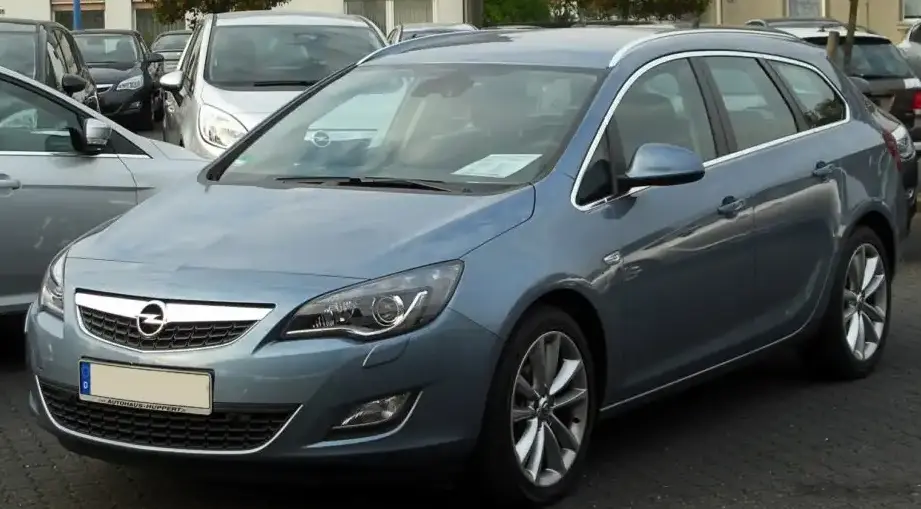
| Generation | Astra J Sports Tourer |
| Type (Engine) | 2.0 CDTI (160 Hp) Automatic |
| Start of production | 2010 |
| End of production | 2012 |
| Powertrain Architecture | Internal Combustion engine |
| Body type | Station wagon (estate) |
| Seats | 5 |
| Doors | 5 |
| Fuel consumption (urban) | 7.9 l/100 km (29.8 US mpg) |
| Fuel consumption (extra urban) | 4.7 l/100 km (50 US mpg) |
| Fuel consumption (combined) | 5.9 l/100 km (39.9 US mpg) |
| Fuel Type | Diesel |
| Acceleration 0 – 100 km/h | 9.7 sec |
| Acceleration 0 – 62 mph | 9.7 sec |
| Acceleration 0 – 60 mph | 9.2 sec |
| Maximum speed | 207 km/h (128.62 mph) |
| Emission standard | Euro 5 |
| Power | 160 Hp @ 4000 rpm |
| Torque | 350 Nm @ 1750 rpm (258.15 lb.-ft. @ 1750 rpm) |
| Engine layout | Front, Transverse |
| Engine Model/Code | A20DTH |
| Engine displacement | 1956 cm3 (119.36 cu. in.) |
| Number of cylinders | 4 |
| Engine configuration | Inline |
| Cylinder Bore | 83 mm (3.27 in.) |
| Piston Stroke | 90.4 mm (3.56 in.) |
| Compression ratio | 18:1 |
| Number of valves per cylinder | 4 |
| Fuel injection system | Diesel Commonrail |
| Engine aspiration | Turbocharger, Intercooler |
| Valvetrain | OHC |
| Engine oil capacity | 4.5 l (4.76 US qt | 3.96 UK qt) |
| Coolant capacity | 6.9 l (7.29 US qt | 6.07 UK qt) |
| Max. weight | 1960 kg (4321.06 lbs.) |
| Trunk (boot) space – minimum | 550 l (19.42 cu. ft.) |
| Trunk (boot) space – maximum | 1550 l (54.74 cu. ft.) |
| Fuel tank capacity | 56 l (14.79 US gal | 12.32 UK gal) |
| Length | 4698 mm (184.96 in.) |
| Width | 1814 mm (71.42 in.) |
| Width including mirrors | 2013 mm (79.25 in.) |
| Height | 1535 mm (60.43 in.) |
| Wheelbase | 2685 mm (105.71 in.) |
| Front track | 1544 mm (60.79 in.) |
| Rear track | 1558 mm (61.34 in.) |
| Front overhang | 974 mm (38.35 in.) |
| Rear overhang | 1039 mm (40.91 in.) |
| Ride height (ground clearance) | 109 mm (4.29 in.) |
| Drag coefficient (Cd) | 0.33 |
| Drivetrain Architecture | Front wheel drive |
| Number of gears | 6 |
| Gearbox type | Automatic transmission |
| Front brakes | Ventilated discs |
| Rear brakes | Disc |
| Tires size | 215/50 R17 |
| Wheel rims size | 17 |
The Opel Astra J Sports Tourer 2.0 CDTI Automatic, produced between 2010 and 2012, was a practical and efficient offering within the broader Astra J range (2009-2015). Positioned as a mid-range trim, it catered to buyers seeking the versatility of a station wagon (estate) combined with the convenience of an automatic transmission and the fuel economy of a modern diesel engine. This variant was primarily marketed in Europe, where station wagons maintain significant popularity, offering a compelling alternative to hatchback models. It was a key component of Opel’s strategy to provide a diverse lineup appealing to various customer needs.
Powertrain & Engine Architecture
At the heart of this Astra J variant lies the A20DTH engine, a 1956cc inline-four cylinder diesel. This engine utilizes a common rail direct injection system, delivering fuel at extremely high pressure for optimized combustion. The A20DTH is equipped with a turbocharger and intercooler, enhancing power output and efficiency. The engine features an overhead camshaft (OHC) valvetrain with four valves per cylinder, contributing to its relatively high specific output. The six-speed automatic transmission, sourced from Aisin, was chosen for its smoothness and reliability. It features adaptive shift patterns, adjusting to driving style and conditions. Unlike some dual-clutch transmissions of the era, this unit prioritized comfort over outright speed, offering seamless gear changes.
Driving Characteristics
The 2.0 CDTI Automatic Sports Tourer offered a comfortable and capable driving experience. While not a performance-oriented vehicle, the 160 horsepower and 350 Nm (258 lb-ft) of torque provided adequate acceleration for everyday driving and highway cruising. The automatic transmission, while smooth, did slightly diminish the overall responsiveness compared to the six-speed manual version. Gear ratios were tuned for fuel efficiency, with taller gearing in higher gears. The engine delivered strong low-end torque, making it easy to navigate city traffic and maintain speed on inclines. However, the automatic transmission could sometimes feel hesitant during quick overtaking maneuvers, requiring a deliberate kickdown. The added weight of the station wagon body style, combined with the automatic transmission, resulted in a slightly slower 0-60 mph time (around 9.2 seconds) compared to the manual counterpart.
Equipment & Trim Levels
The 2.0 CDTI Automatic typically came with a generous level of standard equipment. Interior features included comfortable cloth upholstery, a leather-wrapped steering wheel, and air conditioning. Infotainment systems varied depending on the specific market and optional packages, but generally included a CD player, radio, and auxiliary input. Higher trim levels offered upgrades such as leather seats, a touchscreen infotainment system with navigation, and automatic climate control. Safety features included ABS, electronic stability control, and multiple airbags. Optional extras included parking sensors, a panoramic sunroof, and upgraded alloy wheels.
Chassis & Braking
The Astra J Sports Tourer utilized a MacPherson strut front suspension and a multi-link rear suspension, providing a good balance of ride comfort and handling. The suspension was tuned to prioritize comfort, resulting in a relatively soft ride quality. Front brakes consisted of ventilated discs, while rear brakes were solid discs. The braking system was equipped with ABS and electronic brakeforce distribution (EBD). Stabilizer bars were fitted to both the front and rear axles to reduce body roll during cornering. The suspension setup was generally well-suited to the vehicle’s weight and intended use, providing a stable and predictable driving experience.
Market Reception & Comparison
The Astra J Sports Tourer 2.0 CDTI Automatic received generally positive reviews from automotive critics. It was praised for its spacious interior, comfortable ride, and fuel efficiency. However, some critics noted that the automatic transmission could feel sluggish at times and that the interior materials were not as premium as those found in some competitors. Compared to the 1.3 CDTI and 1.7 CDTI variants, the 2.0 CDTI offered significantly more power and torque, resulting in improved acceleration and overall performance. It also provided a more refined driving experience. Compared to the petrol-powered Astra J models, the 2.0 CDTI offered superior fuel economy, making it a more practical choice for drivers who covered long distances.
Legacy
The A20DTH engine, in general, has proven to be a relatively reliable powertrain, although like any diesel engine, it is susceptible to issues related to the diesel particulate filter (DPF) if not properly maintained. Regular oil changes and the use of high-quality diesel fuel are crucial for ensuring long-term reliability. On the used car market, the Astra J Sports Tourer 2.0 CDTI Automatic remains a popular choice, offering a good balance of practicality, fuel efficiency, and affordability. Its reputation for reliability and relatively low running costs contribute to its continued appeal. Parts availability is generally good, and maintenance costs are reasonable, making it a sensible option for budget-conscious buyers seeking a versatile and dependable station wagon.