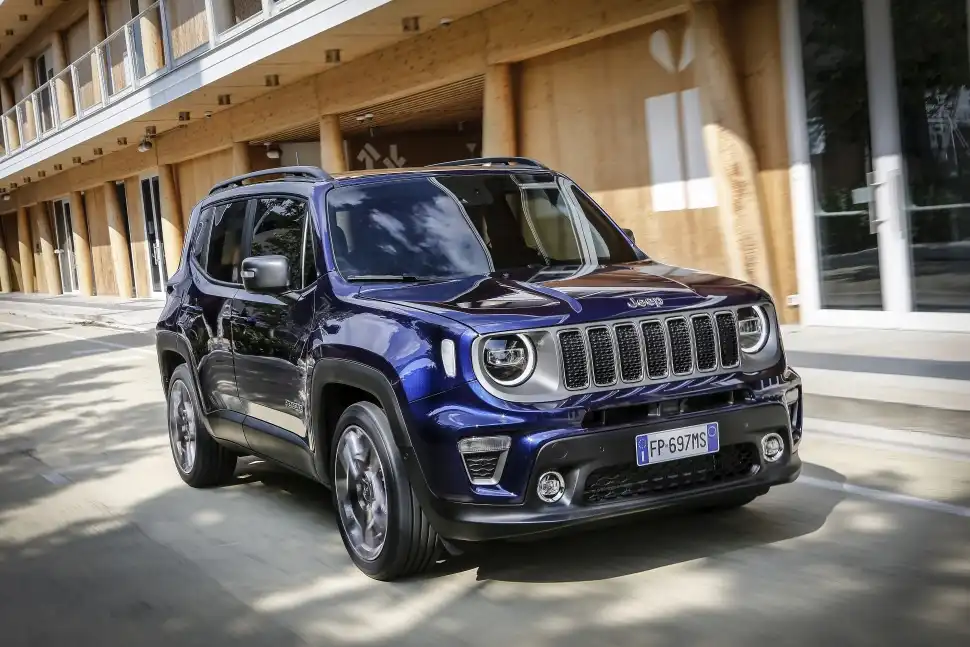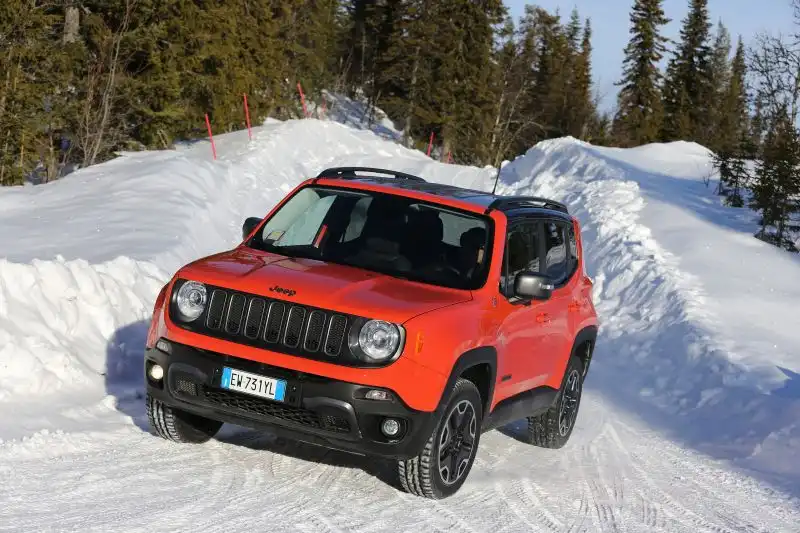
The Jeep Renegade 1.4 MultiAir2 (140 hp) DDCT Start&Stop was a key variant of the first-generation Renegade (BU/MK) produced between 2014 and 2018. Introduced as a more fuel-efficient and accessible entry point into the Renegade lineup, this model aimed to broaden the vehicle’s appeal, particularly in European and other markets where smaller displacement engines were favored. It represented Jeep’s attempt to capture a segment of the growing subcompact SUV market with a blend of Jeep’s off-road heritage and modern efficiency. This specific configuration occupied a mid-range position within the broader Renegade offerings, slotting below the more powerful engine options like the 1.6 and 2.4-liter variants, and above the base-level trims.
Technical Specifications
| Brand | Jeep |
| Model | Renegade |
| Type (Engine) | 1.4 MultiAir2 (140 Hp) DDCT start&stop |
| Start of production | 2014 |
| End of production | 2018 |
| Powertrain Architecture | Internal Combustion engine |
| Body type | SUV, Crossover |
| Seats | 5 |
| Doors | 5 |
| Fuel consumption (urban) | 7.5 l/100 km (31.4 US mpg) |
| Fuel consumption (extra urban) | 5 l/100 km (47 US mpg) |
| Fuel consumption (combined) | 5.9 l/100 km (39.9 US mpg) |
| CO2 emissions | 137 g/km |
| Fuel Type | Petrol (Gasoline) |
| Acceleration 0 – 100 km/h | 11 sec |
| Acceleration 0 – 62 mph | 11 sec |
| Acceleration 0 – 60 mph | 10.5 sec |
| Maximum speed | 181 km/h (112.47 mph) |
| Emission standard | Euro 6 |
| Power | 140 Hp @ 5500 rpm |
| Torque | 230 Nm @ 1750 rpm (169.64 lb.-ft. @ 1750 rpm) |
| Engine layout | Front, Transverse |
| Engine Model/Code | 55263624 |
| Engine displacement | 1368 cm3 (83.48 cu. in.) |
| Number of cylinders | 4 |
| Engine configuration | Inline |
| Cylinder Bore | 72 mm (2.83 in.) |
| Piston Stroke | 84 mm (3.31 in.) |
| Compression ratio | 9.8:1 |
| Number of valves per cylinder | 4 |
| Fuel injection system | Multi-port manifold injection |
| Engine aspiration | Turbocharger, Intercooler |
| Valvetrain | SOHC |
| Engine oil capacity | 3.8 l (4.02 US qt | 3.34 UK qt) |
| Coolant | 5.2 l (5.49 US qt | 4.58 UK qt) |
| Trunk (boot) space – minimum | 351 l (12.4 cu. ft.) |
| Trunk (boot) space – maximum | 1297 l (45.8 cu. ft.) |
| Fuel tank capacity | 48 l (12.68 US gal | 10.56 UK gal) |
| Permitted trailer load without brakes | 1000 kg (2204.62 lbs.) |
| Length | 4236 mm (166.77 in.) |
| Width | 1805 mm (71.06 in.) |
| Height | 1667 mm (65.63 in.) |
| Wheelbase | 2570 mm (101.18 in.) |
| Front track | 1541 mm (60.67 in.) |
| Rear track | 1541 mm (60.67 in.) |
| Ride height (ground clearance) | 175 mm (6.89 in.) |
| Drag coefficient (Cd) | 0.34 |
| Minimum turning circle | 11.07 m (36.32 ft.) |
| Approach angle | 17.9° |
| Departure angle | 29.7° |
| Drivetrain Architecture | Front wheel drive |
| Number of gears | 6 |
| Gearbox type | Automatic transmission DDCT |
| Front suspension | Independent type McPherson |
| Rear suspension | McPherson |
| Front brakes | Ventilated discs |
| Rear brakes | Disc |
INTRODUCTION
The Jeep Renegade 1.4 MultiAir2 (140 hp) DDCT Start&Stop, launched in 2014, was a significant addition to the Renegade lineup. Built on the 1HX0/A3 platform shared with the Fiat 500X, it aimed to provide a more economical and accessible option for buyers seeking the Jeep brand’s rugged image and capability in a smaller package. This variant was particularly important in European markets, where fuel efficiency and lower running costs are highly valued. The “MultiAir2” designation refers to the second generation of Fiat’s MultiAir electro-hydraulic valve actuation technology, designed to improve engine efficiency and reduce emissions. The DDCT (Dual Dry Clutch Transmission) was a six-speed automatic transmission intended to provide smooth and responsive shifting.
Powertrain & Engine Architecture
At the heart of this Renegade variant lies the 1.4-liter turbocharged four-cylinder engine, specifically the 55263624 engine code. This engine utilizes Fiat’s MultiAir2 technology, which allows for independent control of intake valve timing and lift. This system optimizes combustion, resulting in improved fuel economy and reduced emissions. The engine employs a single scroll turbocharger with an intercooler to boost power output. Fuel delivery is managed by a multi-port fuel injection system. The engine produces 140 horsepower at 5500 rpm and 230 Nm (169.64 lb.-ft.) of torque at 1750 rpm. The DDCT six-speed dual-clutch transmission offers quicker shifts compared to a traditional automatic, contributing to a more engaging driving experience. The transmission’s gear ratios are tuned for a balance between fuel efficiency and acceleration.
Driving Characteristics
The 140 hp 1.4 MultiAir2 with the DDCT transmission delivers adequate performance for everyday driving. Acceleration from 0 to 60 mph takes approximately 10.5 seconds, and the top speed is around 112.47 mph. While not particularly sporty, the engine provides sufficient power for merging onto highways and navigating city streets. The DDCT transmission generally shifts smoothly, although some drivers have reported occasional hesitation at low speeds. Compared to the higher-output 1.6 and 2.4-liter versions, this variant feels less powerful, especially when fully loaded or tackling steep inclines. However, it offers a more refined and fuel-efficient driving experience. The gear ratios are optimized for fuel economy, meaning the engine can feel slightly strained when demanding quick acceleration.
Equipment & Trim Levels
The Renegade 1.4 MultiAir2 (140 hp) DDCT Start&Stop was typically offered in several trim levels, varying by market. Standard equipment generally included air conditioning, power windows and locks, a touchscreen infotainment system with Bluetooth connectivity, and a suite of safety features like ABS, electronic stability control, and multiple airbags. Higher trim levels added features such as alloy wheels, a rearview camera, parking sensors, a premium audio system, and leather upholstery. Optional extras included a panoramic sunroof, navigation system, and advanced driver-assistance systems like lane departure warning and adaptive cruise control. Interior upholstery was typically cloth on base models, with leather options available on higher trims. The dashboard layout was consistent across the Renegade range, featuring a modern and functional design.
Chassis & Braking
The Renegade’s chassis features an independent McPherson strut suspension at the front and a McPherson strut rear suspension. This setup provides a comfortable ride quality, although it’s not as sporty as some competitors. The front brakes are ventilated discs, while the rear brakes are solid discs. The steering is a rack and pinion system with electric power assistance. The Renegade’s relatively compact size and lightweight construction contribute to its nimble handling. Stabilizer bars are fitted to both the front and rear axles to reduce body roll during cornering. The ride height of 175 mm (6.89 in.) provides adequate ground clearance for light off-road use.
Market Reception & Comparison
The Jeep Renegade 1.4 MultiAir2 (140 hp) DDCT Start&Stop received mixed reviews from automotive critics. While praised for its fuel efficiency and stylish design, some reviewers criticized its performance and the occasional quirks of the DDCT transmission. Compared to the more powerful Renegade variants, this model offered lower running costs but sacrificed some performance. Against competitors like the Nissan Juke, Peugeot 2008, and Renault Captur, the Renegade offered a unique blend of Jeep’s off-road heritage and a more refined driving experience. Fuel economy figures of around 39.9 US mpg combined were competitive within its class. Reliability reports suggest that the 1.4 MultiAir engine can be prone to issues with the MultiAir system, requiring careful maintenance.
Legacy
The Jeep Renegade 1.4 MultiAir2 (140 hp) DDCT Start&Stop remains a relatively common sight on the used car market. While the MultiAir engine requires diligent maintenance to prevent potential issues, the Renegade’s overall build quality and Jeep brand appeal contribute to its continued desirability. Owners often appreciate its fuel efficiency, comfortable ride, and distinctive styling. However, prospective buyers should be aware of the potential for MultiAir system problems and factor in the cost of preventative maintenance. This variant played a crucial role in establishing the Renegade as a successful model for Jeep, broadening its customer base and appealing to those seeking a stylish and efficient subcompact SUV.