
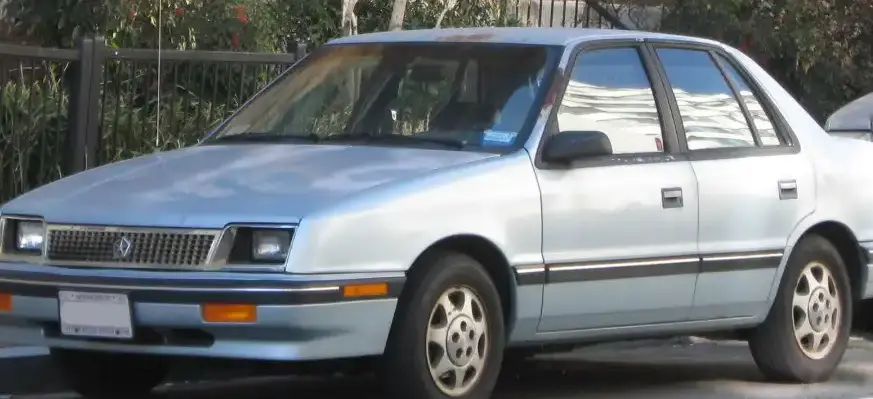
The Plymouth Sundance 2.2i Automatic, produced between 1986 and 1992, represented Plymouth’s entry into the compact, front-wheel-drive market. Part of the first generation of the Sundance (and its Dodge Shadow sibling), this variant was positioned as an affordable and practical transportation option for families and commuters. It utilized Chrysler’s “TC” platform, a design that would underpin several models throughout the late 1980s and early 1990s. The 2.2i Automatic trim offered a balance between fuel efficiency and usability, making it a popular choice despite not being the performance-oriented version of the lineup.
Technical Specifications
| Brand | Plymouth |
| Model | Sundance |
| Type (Engine) | 2.2i (94 Hp) Automatic |
| Start of production | 1986 |
| End of production | 1992 |
| Powertrain Architecture | Internal Combustion engine |
| Body type | Hatchback |
| Seats | 5 |
| Doors | 3/5 |
| Fuel consumption (urban) | 12 l/100 km (19.6 US mpg) |
| Fuel consumption (extra urban) | 7 l/100 km (33.6 US mpg) |
| Fuel Type | Petrol (Gasoline) |
| Maximum speed | 170 km/h (105.63 mph) |
| Weight-to-power ratio | 12.8 kg/Hp |
| Weight-to-torque ratio | 7.3 kg/Nm |
| Power | 94 Hp @ 4800 rpm |
| Power per litre | 42.5 Hp/l |
| Torque | 165 Nm @ 3200 rpm (121.7 lb.-ft. @ 3200 rpm) |
| Engine layout | Front, Transverse |
| Engine displacement | 2213 cm3 (135.05 cu. in.) |
| Number of cylinders | 4 |
| Engine configuration | Inline |
| Cylinder Bore | 87.5 mm (3.44 in.) |
| Piston Stroke | 92 mm (3.62 in.) |
| Compression ratio | 9.5:1 |
| Number of valves per cylinder | 2 |
| Fuel injection system | Single-point injection |
| Engine aspiration | Naturally aspirated |
| Valvetrain | OHC |
| Engine oil capacity | 4.3 l (4.54 US qt | 3.78 UK qt) |
| Coolant | 8.5 l (8.98 US qt | 7.48 UK qt) |
| Kerb Weight | 1205 kg (2656.57 lbs.) |
| Trunk (boot) space – minimum | 375 l (13.24 cu. ft.) |
| Trunk (boot) space – maximum | 945 l (33.37 cu. ft.) |
| Fuel tank capacity | 53 l (14 US gal | 11.66 UK gal) |
| Length | 4360 mm (171.65 in.) |
| Width | 1710 mm (67.32 in.) |
| Height | 1350 mm (53.15 in.) |
| Wheelbase | 2470 mm (97.24 in.) |
| Front track | 1460 mm (57.48 in.) |
| Rear track | 1455 mm (57.28 in.) |
| Drivetrain Architecture | Front wheel drive |
| Number of gears | 3 |
| Gearbox type | Automatic transmission |
| Front suspension | Coil spring |
| Rear suspension | Coil spring |
| Front brakes | Ventilated discs |
| Rear brakes | Disc |
| Assisting systems | ABS (Anti-lock braking system) |
| Steering type | Steering rack and pinion |
| Power steering | Hydraulic |
| Tires size | 185/70 R14 |
| Wheel rims size | 14 |
Powertrain & Engine Architecture
The heart of the Sundance 2.2i Automatic was the Chrysler 2.2L inline-four cylinder engine. This engine, internally designated as the P-code, utilized a single-point fuel injection system, a relatively common setup for the era. The engine featured an overhead camshaft (OHC) valvetrain with two valves per cylinder. While not a particularly powerful engine, it was known for its relative durability and ease of maintenance. The 94 horsepower output at 4800 rpm and 165 Nm (121.7 lb-ft) of torque at 3200 rpm were adequate for everyday driving. The engine was transversely mounted, driving the front wheels. The automatic transmission was a Chrysler-built three-speed unit, chosen for its simplicity and cost-effectiveness. It wasn’t known for particularly quick shifts, but it provided smooth operation for typical commuting and highway cruising.
Driving Characteristics
The 2.2i Automatic Sundance offered a comfortable, if not particularly exciting, driving experience. Acceleration was modest, with the 0-60 mph time estimated to be around 12-14 seconds. The three-speed automatic transmission had relatively wide gear ratios, prioritizing fuel economy over performance. This meant that the engine often felt strained during quick acceleration or when climbing hills. Compared to the available five-speed manual transmission, the automatic version noticeably reduced responsiveness. However, the automatic was favored by drivers seeking ease of use, especially in urban environments. The suspension, tuned for comfort, provided a reasonably smooth ride, absorbing most road imperfections without excessive body roll.
Equipment & Trim Levels
The Sundance 2.2i Automatic typically came standard with features considered essential for the time, including air conditioning, an AM/FM radio, cloth upholstery, and power steering. Optional extras included upgraded sound systems, cruise control, and power windows and locks. Interior trim levels varied, with higher trims offering more comfortable seating materials and additional convenience features. The dashboard layout was functional and straightforward, with clearly marked gauges and controls. The hatchback body style provided a good amount of cargo space, enhanced by the folding rear seats.
Chassis & Braking
The Sundance utilized a front-wheel-drive chassis with independent front suspension and a semi-independent twist-beam rear suspension. The front suspension employed coil springs and MacPherson struts, while the rear suspension used coil springs and trailing arms. Braking duties were handled by ventilated discs at the front and solid discs at the rear. An anti-lock braking system (ABS) was available as an option, enhancing safety by preventing wheel lockup during hard braking. The steering system was a rack-and-pinion setup with hydraulic power assistance, providing relatively light and precise steering feel.
Market Reception & Comparison
The Plymouth Sundance 2.2i Automatic was generally well-received as an affordable and practical compact car. Critics praised its comfortable ride and spacious interior, but noted its lack of performance. Compared to the higher-output versions of the Sundance, such as those equipped with the turbocharged 2.5L engine, the 2.2i Automatic was significantly slower. However, it offered better fuel economy and lower maintenance costs. The 2.2i Automatic also competed with other compact cars of the era, such as the Ford Escort and Chevrolet Cavalier, offering a similar level of value and practicality. Its fuel economy, averaging around 19.6 mpg in the city and 33.6 mpg on the highway, was competitive for its time.
Legacy
The Plymouth Sundance, and specifically the 2.2i Automatic variant, remains a relatively common sight in the used car market, though finding well-maintained examples is becoming increasingly difficult. The 2.2L engine is generally considered reliable, although age and mileage can lead to issues such as oil leaks and sensor failures. The automatic transmission, while durable, can experience problems with the torque converter or valve body. Despite its age, the Sundance 2.2i Automatic continues to appeal to those seeking a simple, affordable, and nostalgic vehicle. It represents a significant era in American automotive history, showcasing the shift towards front-wheel-drive compact cars and the increasing importance of fuel efficiency.
