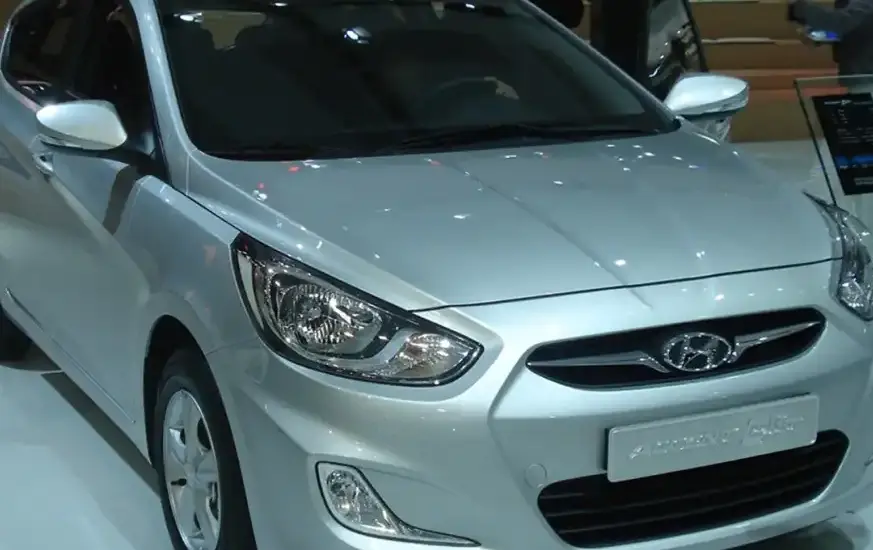
The Hyundai Solaris I 1.4 MPI (107 hp) Automatic, produced between 2011 and 2014, represented an entry-level offering within the first generation of the Solaris compact sedan and hatchback. Designed primarily for the Russian and developing markets, the Solaris aimed to provide affordable and reliable transportation. This particular variant, combining a 1.4-liter naturally aspirated engine with a four-speed automatic transmission, was positioned as a convenient and accessible option for buyers prioritizing ease of use over outright performance. It was a key model in Hyundai’s strategy to gain market share in regions where fuel efficiency and low running costs were paramount.
Technical Specifications
| Brand | Hyundai |
| Model | Solaris |
| Generation | Solaris I |
| Type (Engine) | 1.4 MPI (107 Hp) Automatic |
| Start of production | 2011 |
| End of production | 2014 |
| Powertrain Architecture | Internal Combustion engine |
| Body type | Hatchback |
| Seats | 5 |
| Doors | 5 |
| Fuel consumption (urban) | 8.5 l/100 km (27.7 US mpg) |
| Fuel consumption (extra urban) | 5.2 l/100 km (45.2 US mpg) |
| Fuel consumption (combined) | 6.4 l/100 km (36.8 US mpg) |
| Fuel Type | Petrol (Gasoline) |
| Acceleration 0 – 100 km/h | 13.2 sec |
| Acceleration 0 – 62 mph | 13.2 sec |
| Acceleration 0 – 60 mph | 12.5 sec |
| Maximum speed | 170 km/h (105.63 mph) |
| Emission standard | Euro 4 |
| Weight-to-power ratio | 10.6 kg/Hp |
| Weight-to-torque ratio | 8.4 kg/Nm |
| Power | 107 Hp @ 6300 rpm |
| Torque | 135 Nm @ 5000 rpm (99.57 lb.-ft. @ 5000 rpm) |
| Engine layout | Front, Transverse |
| Engine displacement | 1396 cm3 (85.19 cu. in.) |
| Number of cylinders | 4 |
| Engine configuration | Inline |
| Number of valves per cylinder | 4 |
| Fuel injection system | Multi-port manifold injection |
| Engine aspiration | Naturally aspirated |
| Engine oil capacity | 3.3 l (3.49 US qt | 2.9 UK qt) |
| Coolant capacity | 5.3 l (5.6 US qt | 4.66 UK qt) |
| Kerb Weight | 1135 kg (2502.25 lbs.) |
| Max. weight | 1565 kg (3450.23 lbs.) |
| Max load | 430 kg (947.99 lbs.) |
| Trunk (boot) space – minimum | 370 l (13.07 cu. ft.) |
| Fuel tank capacity | 43 l (11.36 US gal | 9.46 UK gal) |
| Permitted trailer load with brakes (12%) | 800 kg (1763.7 lbs.) |
| Permitted trailer load without brakes | 450 kg (992.08 lbs.) |
| Length | 4115 mm (162.01 in.) |
| Width | 1700 mm (66.93 in.) |
| Height | 1470 mm (57.87 in.) |
| Wheelbase | 2570 mm (101.18 in.) |
| Front track | 1490 mm (58.66 in.) |
| Rear track | 1502 mm (59.13 in.) |
| Front overhang | 820 mm (32.28 in.) |
| Rear overhang | 725 mm (28.54 in.) |
| Ride height (ground clearance) | 160 mm (6.3 in.) |
| Minimum turning circle | 10.4 m (34.12 ft.) |
| Drivetrain Architecture | Front wheel drive |
| Number of gears | 4 |
| Gearbox type | Automatic transmission |
| Front suspension | Independent, McPherson with coil spring and anti-roll bar |
| Rear suspension | Semi-independent, coil spring |
| Front brakes | Ventilated discs |
| Rear brakes | Disc |
| Assisting systems | ABS (Anti-lock braking system) |
| Steering type | Steering rack and pinion |
| Tires size | 185/65 R15; 195/55 R16 |
| Wheel rims size | 15; 16 |
Powertrain & Engine Architecture
The Solaris 1.4 MPI utilized the Hyundai G4FA engine, a 1.4-liter inline-four cylinder powerplant. This engine featured a multi-point fuel injection system and a single overhead camshaft (SOHC) valvetrain with four valves per cylinder. The engine was designed for reliability and fuel economy rather than high performance. The 107 horsepower output at 6300 rpm and 135 Nm (99.57 lb-ft) of torque at 5000 rpm were typical figures for an engine of this displacement in this class. The four-speed automatic transmission, while providing convenience, was a relatively older design. It featured traditional hydraulic control and lacked the efficiency of more modern transmissions with more gears. The transmission’s gear ratios were tuned for smooth operation and acceptable acceleration, but it wasn’t particularly sporty or optimized for highway cruising.
Driving Characteristics
The 1.4 MPI Automatic Solaris offered a comfortable, if uninspiring, driving experience. Acceleration was adequate for city driving and merging onto highways, but the 13.2-second 0-100 km/h time reflected its modest power output. The automatic transmission contributed to a smooth ride, but it could sometimes feel sluggish during quick overtaking maneuvers. Compared to the manual transmission version, the automatic suffered a slight performance penalty. The higher-output 1.6-liter engine options offered significantly more power and a more engaging driving experience, but at a higher price point. The four-speed automatic’s limited gear selection meant the engine often operated at higher RPMs during highway driving, impacting fuel economy compared to the manual or more modern automatic transmissions.
Equipment & Trim Levels
The 1.4 MPI Automatic Solaris typically came with a base level of equipment. Standard features generally included air conditioning, power windows, central locking, and a basic audio system. Safety features such as ABS and dual airbags were also standard. Higher trim levels, available at an additional cost, added features like alloy wheels, a more advanced audio system, and fog lights. Interior upholstery was typically cloth, and the dashboard design was functional but not particularly luxurious. Optional extras included a sunroof, upgraded sound system, and parking sensors.
Chassis & Braking
The Solaris I featured a front-wheel-drive layout with an independent McPherson strut suspension in the front and a semi-independent coil spring suspension in the rear. This suspension setup provided a comfortable ride, but it wasn’t particularly sporty. The front brakes were ventilated discs, while the rear brakes were solid discs. The ABS system helped to improve braking performance and stability, especially on slippery surfaces. The steering was a rack-and-pinion system, providing adequate precision and feel. The relatively lightweight construction of the Solaris helped to offset the modest engine power.
Market Reception & Comparison
The Hyundai Solaris I 1.4 MPI Automatic was generally well-received in its target markets. Critics praised its affordability, reliability, and fuel efficiency. However, the automatic transmission was often criticized for its dated design and lack of responsiveness. Compared to other trims in the Solaris lineup, the 1.4 MPI Automatic offered the lowest price of entry but also the least amount of performance. The 1.6-liter engine options were more popular among buyers who prioritized driving enjoyment, while the diesel variants (where available) offered superior fuel economy. The Solaris competed with other subcompact cars such as the Renault Logan, Skoda Rapid, and Volkswagen Polo.
Legacy
The Hyundai Solaris I 1.4 MPI Automatic has proven to be a relatively reliable powertrain in the used car market. The G4FA engine is known for its durability, and the four-speed automatic transmission, while not the most sophisticated, is generally robust. However, as with any used car, regular maintenance is crucial. Common issues include wear and tear on suspension components and potential oil leaks. Today, the Solaris I 1.4 MPI Automatic remains an affordable and practical option for budget-conscious buyers seeking a reliable and fuel-efficient compact car. Its simplicity and relatively low maintenance costs make it a popular choice in regions where affordability is a key consideration.