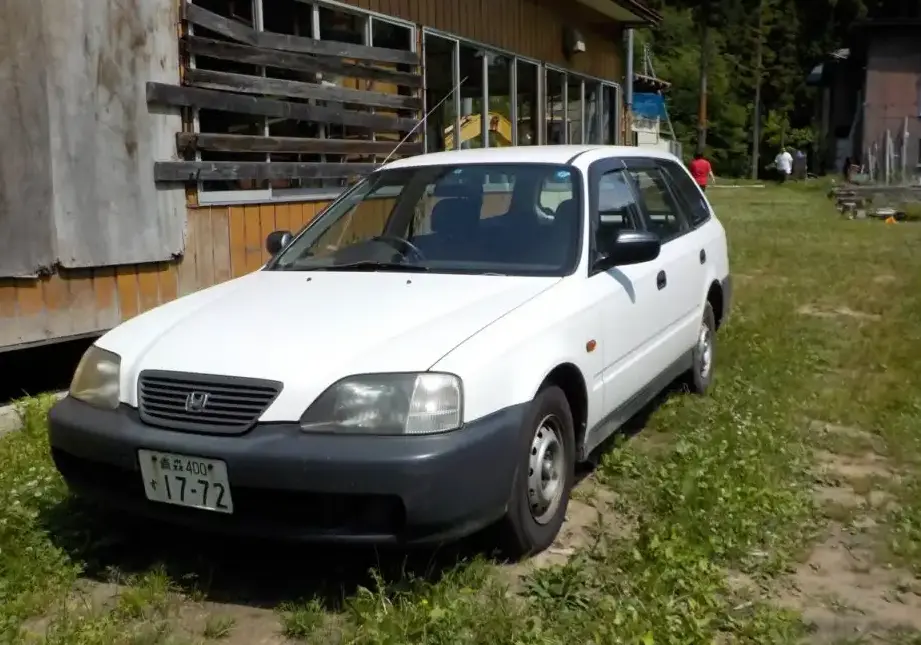
The Honda Partner 1.5 i 16V, produced between 1996 and 2004, was a compact station wagon primarily aimed at the Japanese domestic market (JDM). Positioned as a practical and affordable family vehicle, the Partner served as Honda’s entry into the increasingly popular kei car-inspired, small-wagon segment. While not officially sold in the United States, the Partner represents a significant example of Honda’s engineering focus on maximizing interior space and fuel efficiency within a small footprint. This particular variant, equipped with the 1.5-liter 16-valve engine and a four-speed automatic transmission, represented a balance between usability and cost, making it a popular choice for families and businesses needing a versatile vehicle.
Technical Specifications
| Brand | Honda |
| Model | Partner |
| Generation | Partner |
| Type (Engine) | 1.5 i 16V (105 Hp) |
| Start of production | 1996 |
| End of production | 2004 |
| Powertrain Architecture | Internal Combustion engine |
| Body type | Station wagon (estate) |
| Seats | 5 |
| Doors | 5 |
| Fuel consumption (urban) | 9.5 l/100 km (24.8 US mpg) |
| Fuel consumption (extra urban) | 6.5 l/100 km (36.2 US mpg) |
| Fuel consumption (combined) | 8.9 l/100 km (26.4 US mpg) |
| Fuel Type | Petrol (Gasoline) |
| Acceleration 0 – 100 km/h | 11.3 sec |
| Acceleration 0 – 62 mph | 11.3 sec |
| Acceleration 0 – 60 mph | 10.7 sec |
| Maximum speed | 195 km/h (121.17 mph) |
| Weight-to-power ratio | 10.2 kg/Hp |
| Weight-to-torque ratio | 7.6 kg/Nm |
| Power | 105 Hp @ 6500 rpm |
| Torque | 140 Nm @ 4600 rpm (103.26 lb.-ft. @ 4600 rpm) |
| Engine layout | Front, Transverse |
| Engine displacement | 1493 cm3 (91.11 cu. in.) |
| Number of cylinders | 4 |
| Engine configuration | Inline |
| Cylinder Bore | 75 mm (2.95 in.) |
| Piston Stroke | 84.5 mm (3.33 in.) |
| Compression ratio | 9:1 |
| Number of valves per cylinder | 4 |
| Fuel injection system | Multi-port manifold injection |
| Engine aspiration | Naturally aspirated engine |
| Valvetrain | SOHC |
| Kerb Weight | 1070 kg (2358.95 lbs.) |
| Max. weight | 1495 kg (3295.91 lbs.) |
| Max load | 425 kg (936.96 lbs.) |
| Trunk (boot) space – minimum | 820 l (28.96 cu. ft.) |
| Fuel tank capacity | 60 l (15.85 US gal | 13.2 UK gal) |
| Length | 4570 mm (179.92 in.) |
| Width | 1695 mm (66.73 in.) |
| Height | 1465 mm (57.68 in.) |
| Wheelbase | 2620 mm (103.15 in.) |
| Front track | 1475 mm (58.07 in.) |
| Rear (Back) track | 1470 mm (57.87 in.) |
| Drivetrain Architecture | The Internal combustion engine (ICE) drives the front wheels of the vehicle. |
| Drive wheel | Front wheel drive |
| Number of gears and type of gearbox | 4 gears, automatic transmission |
| Front suspension | Coil spring |
| Rear suspension | Coil spring |
| Front brakes | Disc |
| Rear brakes | Drum |
| Steering type | Steering rack and pinion |
| Power steering | Hydraulic Steering |
| Tires size | 175/70 R13 |
| Wheel rims size | 13 |
Powertrain & Engine Architecture
The heart of the Partner 1.5 i 16V is the Honda D15B engine, a 1.5-liter inline-four cylinder powerplant. This engine, part of Honda’s D-series, utilizes a single overhead camshaft (SOHC) valvetrain and multi-point fuel injection. The 16 valves (four per cylinder) contribute to improved breathing and a relatively high output for its displacement. The engine’s 9:1 compression ratio was a common specification for Honda engines of this era, balancing performance and fuel efficiency. Paired with this engine is a four-speed automatic transmission, designed for smooth and convenient operation. This transmission, while not offering the sporty engagement of a manual, was well-suited to the Partner’s intended role as a practical family vehicle. The automatic transmission featured typical torque converter technology for the time, prioritizing smooth shifts over outright performance.
Driving Characteristics
The 105 horsepower and 103 lb-ft of torque produced by the 1.5-liter engine provided adequate, though not exhilarating, performance. Acceleration from 0-60 mph took approximately 10.7 seconds, and top speed was around 121 mph. The automatic transmission’s gear ratios were geared towards fuel economy and everyday drivability. Compared to the manual transmission versions of the Partner, the automatic offered less direct control and slightly slower acceleration. However, it provided a more relaxed driving experience, particularly in urban environments. The engine felt responsive enough for typical commuting and highway cruising, but lacked the punch of higher-output Honda engines available in other models.
Equipment & Trim Levels
The Honda Partner 1.5 i 16V typically came with a fairly basic level of equipment, reflecting its position as an affordable vehicle. Standard features generally included power steering, air conditioning (often optional), and a basic audio system. Interior upholstery was typically cloth, with a functional and durable design. Higher trim levels, if available, might have included features like alloy wheels, upgraded audio systems, and power windows. The dashboard layout was simple and straightforward, prioritizing ease of use over aesthetic flair. Optional extras often included a sunroof and upgraded seat materials.
Chassis & Braking
The Partner utilized a relatively simple chassis design, featuring coil spring suspension at all four wheels. The front suspension employed MacPherson struts, while the rear used a torsion beam setup. This configuration provided a comfortable ride, though handling was not particularly sporty. Braking was accomplished via disc brakes at the front and drum brakes at the rear. The braking system was adequate for the vehicle’s weight and performance, but lacked the stopping power of more advanced systems. Stabilizer bars were typically fitted to reduce body roll during cornering, but were not particularly substantial.
Market Reception & Comparison
The Honda Partner was generally well-received in Japan as a practical and reliable family vehicle. Critics praised its spacious interior, fuel efficiency, and ease of use. However, some noted its relatively modest performance and basic interior appointments. Compared to other trims in the Partner lineup, the 1.5 i 16V automatic offered a balance between cost and convenience. It was more affordable than higher-powered versions, but provided the ease of use of an automatic transmission. Fuel economy was comparable to other vehicles in its class, and reliability was generally excellent, as expected from a Honda product.
Legacy
The Honda Partner, particularly the 1.5 i 16V variant, has proven to be a durable and reliable vehicle. Many examples are still on the road today, testament to Honda’s engineering quality. In the used car market, these vehicles are often sought after for their affordability and practicality. The D15B engine is known for its longevity and relatively simple maintenance requirements. While parts availability may be a concern in some regions, the engine’s widespread use in other Honda models ensures that components are generally accessible. The Partner represents a significant chapter in Honda’s history, demonstrating the company’s commitment to providing affordable and reliable transportation to a wide range of customers.