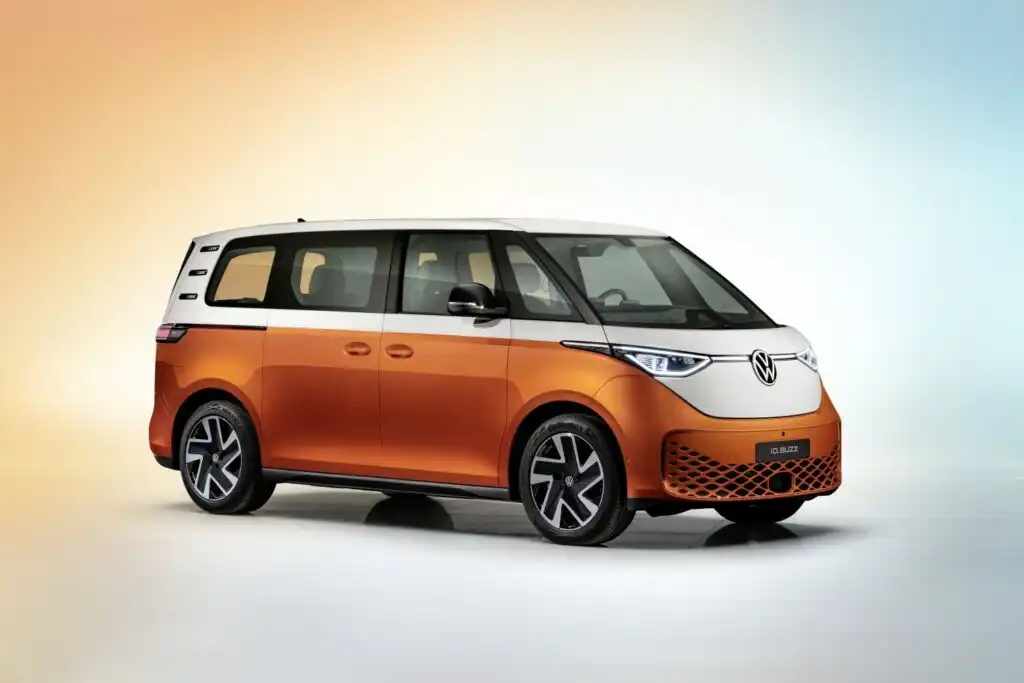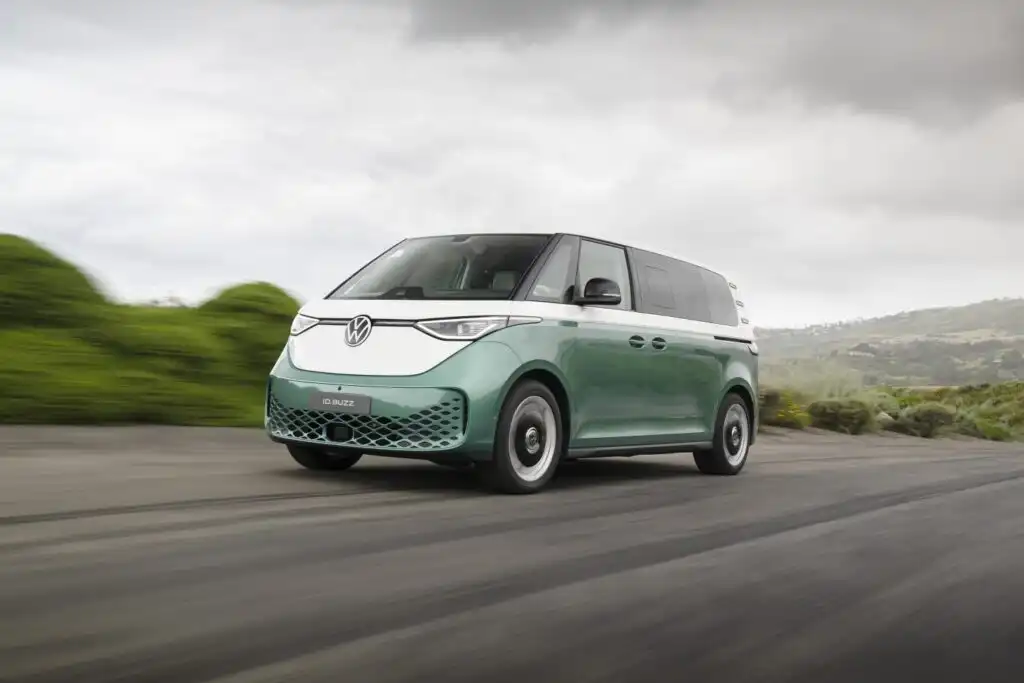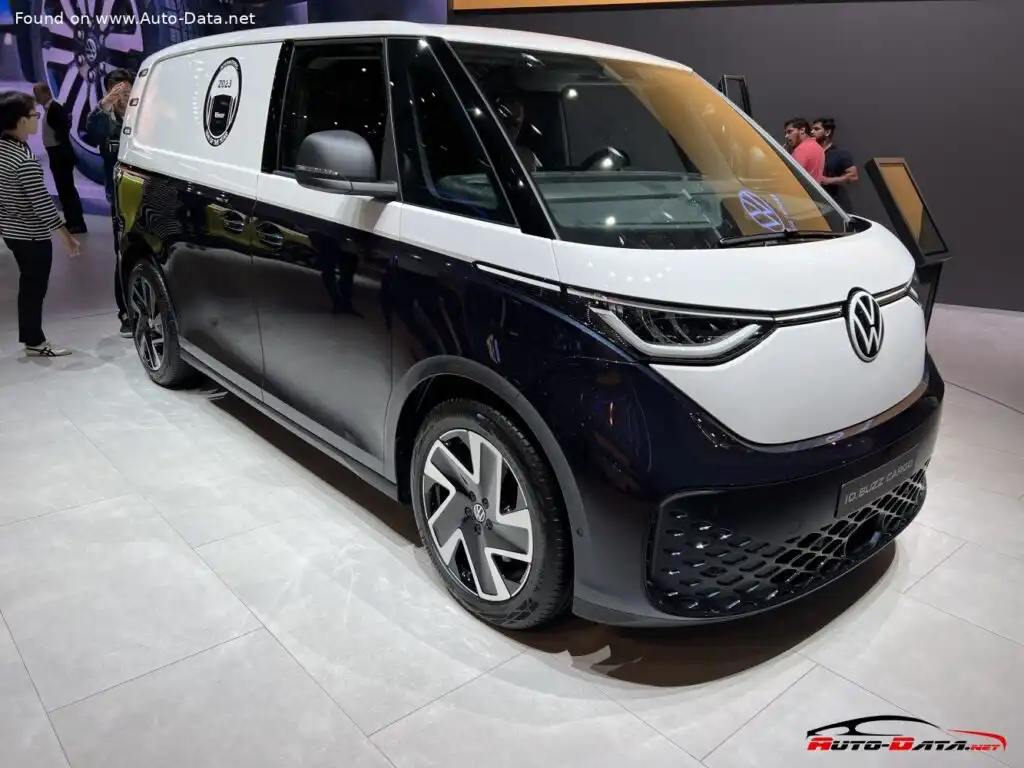
The Volkswagen ID. Buzz Cargo 84 kWh (340 Hp) 4MOTION is an all-electric, all-wheel-drive commercial vehicle introduced in August 2024. Representing Volkswagen’s entry into the electric van segment, the ID. Buzz Cargo is based on the MEB platform – the same architecture underpinning other Volkswagen Group electric vehicles like the ID.4. It’s positioned as a modern, zero-emission alternative to traditional internal combustion engine vans, aimed at businesses and tradespeople requiring a practical and environmentally conscious transport solution. The “Cargo” designation signifies its focus on commercial use, differing from the passenger-oriented ID. Buzz.
Technical Specifications
| Brand | Volkswagen |
| Model | ID. Buzz |
| Generation | ID. Buzz Cargo |
| Type (Engine) | 84 kWh (340 Hp) 4MOTION |
| Start of production | August, 2024 |
| Powertrain Architecture | BEV (Electric Vehicle) |
| Body type | MPV |
| Seats | 3 |
| Doors | 4-5 |
| Fuel Type | Electricity |
| Maximum speed | 160 km/h (99.42 mph) |
| Weight-to-power ratio | 7.2 kg/Hp, 139.6 Hp/tonne |
| Gross battery capacity | 84 kWh |
| Net (usable) battery capacity | 79 kWh |
| Battery technology | Lithium-ion (Li-Ion) |
| Battery location | Below the floor |
| All-electric range (WLTP) | 404-432 km (251.03 – 268.43 mi) |
| Average Energy consumption (WLTP) | 20-21.4 kWh/100 km (32.19 – 34.44 kWh/100 mi) |
| Average Energy consumption (MPGe) | 105 – 98 |
| Average Energy consumption (km/kWh) | 5 – 4.7 |
| Average Energy consumption (mi/kWh) | 3.1 – 2.9 |
| Electric motor 1 power | 286 Hp |
| Electric motor 1 Torque | 560 Nm (413.03 lb.-ft.) |
| Electric motor 1 model/code | APP550 |
| Electric motor 1 location | Rear axle, Transverse |
| Electric motor 1 type | Synchronous |
| Electric motor 2 power | 109 Hp |
| Electric motor 2 Torque | 134 Nm (98.83 lb.-ft.) |
| Electric motor 2 model/code | AKA150 |
| Electric motor 2 location | Front axle, Transverse |
| Electric motor 2 type | Asynchronous |
| System power | 340 Hp |
| Kerb Weight | 2435 kg (5368.26 lbs.) |
| Max. weight | 3150 kg (6944.56 lbs.) |
| Max load | 715 kg (1576.31 lbs.) |
| Trunk (boot) space – maximum | 3900 l (137.73 cu. ft.) |
| Permitted trailer load with brakes (12%) | 1800 kg (3968.32 lbs.) |
| Permitted trailer load without brakes | 750 kg (1653.47 lbs.) |
| Permitted towbar download | 75 kg (165.35 lbs.) |
| Length | 4712 mm (185.51 in.) |
| Width | 1985 mm (78.15 in.) |
| Width including mirrors | 2212 mm (87.09 in.) |
| Height | 1932 mm (76.06 in.) |
| Wheelbase | 2989 mm (117.68 in.) |
| Front track | 1673 mm (65.87 in.) |
| Rear (Back) track | 1666-1670 mm (65.59 – 65.75 in.) |
| Front overhang | 819 mm (32.24 in.) |
| Rear overhang | 904 mm (35.59 in.) |
| Ride height (ground clearance) | 159 mm (6.26 in.) |
| Minimum turning circle (turning diameter) | 11.1 m (36.42 ft.) |
| Front brakes | Ventilated discs |
| Rear brakes | Drum |
| Front tires | 235/55 R19 |
| Rear tires | 255/50 R19 |
| Front wheel rims | 8J x 19 |
| Rear wheel rims | 9J x 19 |
| Gears | 1, automatic transmission |
Powertrain & Engine Architecture
The ID. Buzz Cargo utilizes a dual-motor, all-wheel-drive (4MOTION) powertrain. The rear motor (APP550) is a synchronous electric motor producing 286 horsepower, while the front motor (AKA150) is an asynchronous motor generating 109 horsepower. Combined, these motors deliver a system output of 340 horsepower. The 84 kWh (gross) / 79 kWh (net) lithium-ion battery pack is located under the floor, contributing to a low center of gravity and maximizing interior space. The vehicle employs a single-speed automatic transmission, typical of electric vehicles, providing seamless acceleration. The battery supports DC fast charging, allowing for a significant range boost in a relatively short period. The MEB platform’s architecture allows for over-the-air software updates, potentially improving performance and adding features over time.
Driving Characteristics
The dual-motor setup of the ID. Buzz Cargo 4MOTION provides strong acceleration and confident handling in various conditions. The instant torque characteristic of electric motors delivers brisk off-the-line performance. While not designed for outright speed, the 340 hp system provides ample power for loaded cargo runs and highway driving. The all-wheel-drive system enhances traction, particularly beneficial in inclement weather or when carrying heavy loads. The single-speed transmission simplifies the driving experience, and regenerative braking helps to recapture energy and extend range. Compared to a potential rear-wheel-drive version (not currently offered), the 4MOTION system offers superior stability and control.
Equipment & Trim Levels
As a cargo-focused vehicle, the ID. Buzz Cargo prioritizes practicality and functionality. Standard equipment includes a driver’s seat, a double passenger seat, and a comprehensive suite of safety features such as ABS, electronic stability control, and multiple airbags. The interior is designed for durability and ease of cleaning. While specific trim levels are still evolving with the 2024 launch, options are expected to include upgraded infotainment systems, parking assist features, and various cargo area configurations. The focus remains on providing a robust and adaptable workspace for commercial users.
Chassis & Braking
The ID. Buzz Cargo features an independent suspension system – McPherson struts at the front and a multi-link setup at the rear – designed to balance ride comfort with load-carrying capability. Stabilizer bars are included on both axles to minimize body roll during cornering. The braking system utilizes ventilated discs at the front and drum brakes at the rear, a cost-saving measure common in commercial vehicles. Electric power steering provides precise and responsive handling. The tires are sized 235/55 R19 at the front and 255/50 R19 at the rear, offering a good balance of grip and rolling resistance.
Market Reception & Comparison
The ID. Buzz Cargo is entering a competitive market segment, facing rivals such as the Ford E-Transit, Mercedes-Benz eSprinter, and Renault Kangoo E-Tech. Initial reviews have praised its spacious interior, comfortable ride, and zero-emission operation. The 4MOTION all-wheel-drive system is a key differentiator, providing an advantage in regions with challenging weather conditions. Fuel economy, expressed as energy consumption, is competitive with other electric vans, ranging from 20-21.4 kWh/100 km. Long-term reliability remains to be seen, but Volkswagen’s reputation for build quality is expected to contribute to a positive ownership experience.
Legacy
The ID. Buzz Cargo represents a significant step forward in Volkswagen’s commitment to electric mobility. Its innovative design, spacious interior, and practical features position it as a compelling alternative to traditional combustion engine vans. The longevity of the MEB platform and the potential for future battery technology advancements suggest that the ID. Buzz Cargo will remain a relevant and competitive vehicle in the electric commercial vehicle market for years to come. The success of this model will likely influence Volkswagen’s future electric vehicle offerings and accelerate the transition towards sustainable transportation solutions.