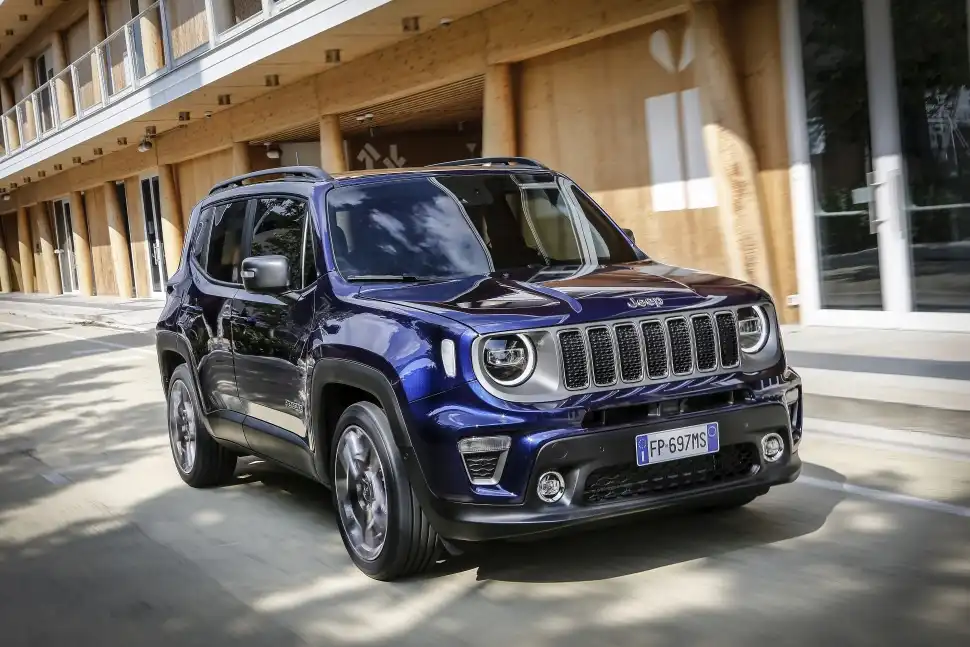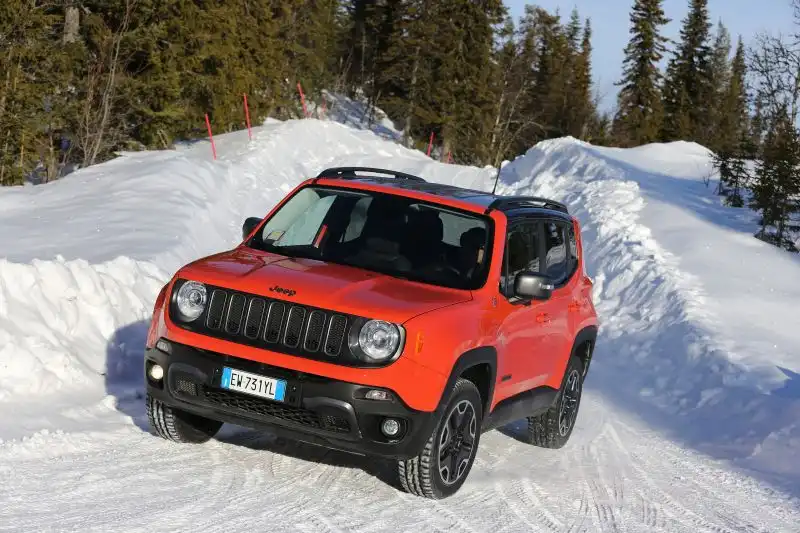
The Jeep Renegade 2.0 MultiJet 4×4 Automatic, produced from 2014 to 2018, represents a significant entry for Jeep into the burgeoning subcompact SUV/crossover market. This variant, powered by a 2.0-liter turbocharged diesel engine producing 170 horsepower, was primarily aimed at the European market, where diesel engines held a substantial share. It occupied a mid-range position within the Renegade lineup, offering a balance between fuel efficiency, all-wheel-drive capability, and a more refined driving experience compared to the base engine options. The Renegade itself was a landmark vehicle for Jeep, being the first Jeep model to be produced outside of North America, with production taking place in Melfi, Italy, alongside the Fiat 500X with which it shares a platform.
Technical Specifications
| Brand | Jeep |
| Model | Renegade |
| Type (Engine) | 2.0 MultiJet (170 Hp) 4×4 Automatic start&stop |
| Start of production | 2014 |
| End of production | 2018 |
| Powertrain Architecture | Internal Combustion engine |
| Body type | SUV, Crossover |
| Seats | 5 |
| Doors | 5 |
| Fuel consumption (urban) | 6.9 l/100 km (34.1 US mpg) |
| Fuel consumption (extra urban) | 5.1 l/100 km (46.1 US mpg) |
| Fuel consumption (combined) | 5.8 l/100 km (40.6 US mpg) |
| CO2 emissions | 155 g/km |
| Fuel Type | Diesel |
| Acceleration 0 – 100 km/h | 8.9 sec |
| Acceleration 0 – 62 mph | 8.9 sec |
| Acceleration 0 – 60 mph | 8.5 sec |
| Maximum speed | 196 km/h (121.79 mph) |
| Emission standard | Euro 6 |
| Power | 170 Hp @ 3750 rpm |
| Torque | 350 Nm @ 1750 rpm (258.15 lb.-ft. @ 1750 rpm) |
| Engine layout | Front, Transverse |
| Engine Model/Code | 55283099 |
| Engine displacement | 1956 cm3 (119.36 cu. in.) |
| Number of cylinders | 4 |
| Engine configuration | Inline |
| Cylinder Bore | 83 mm (3.27 in.) |
| Piston Stroke | 90.4 mm (3.56 in.) |
| Compression ratio | 16.5:1 |
| Number of valves per cylinder | 4 |
| Fuel injection system | Diesel Commonrail |
| Engine aspiration | Turbocharger, Intercooler |
| Valvetrain | DOHC |
| Engine oil capacity | 4.3 l (4.54 US qt | 3.78 UK qt) |
| Coolant capacity | 6.5 l (6.87 US qt | 5.72 UK qt) |
| Trunk (boot) space – minimum | 351 l (12.4 cu. ft.) |
| Trunk (boot) space – maximum | 1297 l (45.8 cu. ft.) |
| Fuel tank capacity | 48 l (12.68 US gal | 10.56 UK gal) |
| Permitted trailer load with brakes (12%) | 1500 kg (3306.93 lbs.) |
| Length | 4236 mm (166.77 in.) |
| Width | 1805 mm (71.06 in.) |
| Height | 1697 mm (66.81 in.) |
| Wheelbase | 2570 mm (101.18 in.) |
| Front track | 1541 mm (60.67 in.) |
| Rear track | 1541 mm (60.67 in.) |
| Ride height (ground clearance) | 198 mm (7.8 in.) |
| Drag coefficient (Cd) | 0.36 |
| Minimum turning circle | 11.07 m (36.32 ft.) |
| Approach angle | 21° |
| Departure angle | 32.1° |
| Drive wheel | All wheel drive (4×4) |
| Number of gears and type of gearbox | 9 gears, automatic transmission |
| Front suspension | Independent type McPherson |
| Rear suspension | McPherson |
| Front brakes | Ventilated discs |
| Rear brakes | Disc |
| Assisting systems | ABS (Anti-lock braking system) |
| Steering type | Steering rack and pinion |
Powertrain & Engine Architecture
The heart of the Renegade 2.0 MultiJet 4×4 is the Fiat-sourced 1.956-liter (2.0L) inline-four cylinder diesel engine, designated with engine code 55283099. This engine belongs to the Fiat Group’s family of turbocharged diesel engines, known for their efficiency and relatively robust construction. It utilizes a common-rail direct injection system, delivering fuel at extremely high pressures for optimized combustion. The engine features a single turbocharger with an intercooler to increase air density and boost power output. The double overhead camshaft (DOHC) valvetrain, with four valves per cylinder, contributes to efficient gas exchange. Paired with this engine is a ZF-sourced 9-speed automatic transmission. This transmission was a relatively new design at the time, offering a wide gear ratio spread for both fuel economy and performance. The 9-speed automatic was chosen to maximize the efficiency of the diesel engine, keeping it within its optimal torque band.
Driving Characteristics
The 170 horsepower and 350 Nm (258 lb-ft) of torque provided by the 2.0 MultiJet engine, coupled with the 9-speed automatic, resulted in a respectable, if not exhilarating, driving experience. Acceleration from 0-60 mph took approximately 8.5 to 8.9 seconds. The automatic transmission, while offering smooth shifts, could sometimes feel hesitant or ‘hunt’ for the right gear, particularly during quick acceleration. Compared to the 1.4-liter gasoline versions, the 2.0 MultiJet offered significantly more low-end torque, making it more comfortable for highway cruising and towing. The all-wheel-drive system, typically operating in front-wheel drive under normal conditions, seamlessly engaged the rear wheels when traction was needed, providing enhanced stability in slippery conditions. The gear ratios were tuned for fuel efficiency, with higher gears designed for relaxed highway driving.
Equipment & Trim Levels
The 2.0 MultiJet 4×4 Automatic typically came equipped with a reasonable level of standard features. These included air conditioning, power windows and locks, a touchscreen infotainment system (usually a 5 or 6.5-inch display), Bluetooth connectivity, and alloy wheels. Higher trim levels, such as the Limited or Trailhawk, added features like leather upholstery, heated seats, a larger touchscreen display with navigation, a rearview camera, and more advanced safety systems. Optional extras included a panoramic sunroof, premium audio systems, and various styling packages.
Chassis & Braking
The Renegade’s chassis utilized an independent McPherson strut suspension at the front and a McPherson strut rear suspension. This setup provided a comfortable ride, although it wasn’t particularly sporty. Stabilizer bars were fitted to both the front and rear axles to reduce body roll during cornering. Braking duties were handled by ventilated discs at the front and solid discs at the rear. Anti-lock braking system (ABS) was standard, providing enhanced stopping power and control. The Renegade’s relatively light weight helped to compensate for the modest braking performance.
Market Reception & Comparison
The Jeep Renegade 2.0 MultiJet 4×4 Automatic was generally well-received by automotive critics, particularly for its fuel efficiency and all-wheel-drive capability. However, some reviewers criticized the occasionally hesitant automatic transmission and the somewhat basic interior materials. Compared to other trims in the Renegade lineup, the 2.0 MultiJet offered a significant improvement in fuel economy and torque, making it a popular choice for drivers who frequently covered long distances or needed to tow. The 1.4-liter gasoline versions were more affordable but lacked the diesel’s low-end grunt. The Trailhawk trim, with its more aggressive styling and enhanced off-road capability, appealed to a different segment of buyers.
Legacy
The 2.0 MultiJet engine, while generally reliable, is known to require regular maintenance, particularly regarding the diesel particulate filter (DPF). Proper oil changes and the use of high-quality diesel fuel are crucial for preventing DPF issues. The 9-speed automatic transmission has also been known to experience occasional software glitches, but these can often be resolved with software updates. In the used car market, the Renegade 2.0 MultiJet 4×4 Automatic remains a relatively popular choice, offering a good balance of practicality, fuel efficiency, and all-weather capability. Its Italian-built heritage and Jeep branding contribute to its enduring appeal.