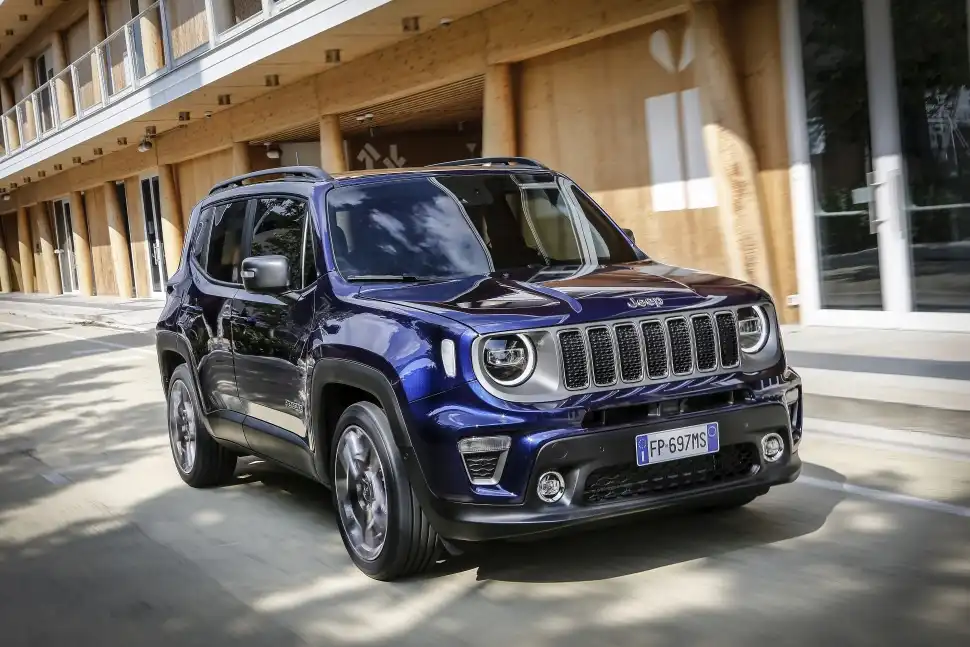
The Jeep Renegade 1.0 T-GDI (120 hp) served as a crucial entry point into the Renegade model range, primarily in European and international markets, following its introduction with the 2018 facelift in August of that year and continuing through February 2022. Built on the 1HX0/A3 platform – shared with other Stellantis vehicles – this variant was designed to offer a more fuel-efficient and accessible option within the burgeoning subcompact SUV segment. It was positioned as the base engine choice, appealing to buyers who prioritized economy and affordability over outright performance.
Technical Specifications
| Brand | Jeep |
| Model | Renegade |
| Generation | Renegade (facelift 2018) |
| Type (Engine) | 1.0 T-GDI (120 Hp) |
| Start of production | August, 2018 |
| End of production | February, 2022 |
| Powertrain Architecture | Internal Combustion engine |
| Body type | SUV, Crossover |
| Seats | 5 |
| Doors | 5 |
| Fuel consumption (urban) | 6.5-7.3 l/100 km (36.2 – 32.2 US mpg, 43.5 – 38.7 UK mpg, 15.4 – 13.7 km/l) |
| Fuel consumption (extra urban) | 5.3-5.5 l/100 km (44.4 – 42.8 US mpg, 53.3 – 51.4 UK mpg, 18.9 – 18.2 km/l) |
| Fuel consumption (combined) | 5.9-6.1 l/100 km (39.9 – 38.6 US mpg, 47.9 – 46.3 UK mpg, 16.9 – 16.4 km/l) |
| CO2 emissions | 132-136 g/km |
| Fuel Type | Petrol (Gasoline) |
| Acceleration 0 – 100 km/h | 11.2 sec |
| Acceleration 0 – 62 mph | 11.2 sec |
| Acceleration 0 – 60 mph | 10.6 sec |
| Maximum speed | 185 km/h (114.95 mph) |
| Emission standard | Euro 6d-Temp |
| Weight-to-power ratio | 11 kg/Hp, 90.9 Hp/tonne |
| Weight-to-torque ratio | 6.9 kg/Nm, 143.9 Nm/tonne |
| Power | 120 Hp @ 5750 rpm |
| Power per litre | 120.1 Hp/l |
| Torque | 190 Nm @ 1750 rpm (140.14 lb.-ft. @ 1750 rpm) |
| Engine layout | Front, Transverse |
| Engine Model/Code | 55282151 |
| Engine displacement | 999 cm3 (60.96 cu. in.) |
| Number of cylinders | 3 |
| Engine configuration | Inline |
| Cylinder Bore | 70 mm (2.76 in.) |
| Piston Stroke | 86.5 mm (3.41 in.) |
| Compression ratio | 10.5:1 |
| Number of valves per cylinder | 4 |
| Fuel injection system | Direct injection |
| Engine aspiration | Turbocharger, Intercooler |
| Engine oil capacity | 3.3 l (3.49 US qt | 2.9 UK qt) |
| Coolant | 6.94 l (7.33 US qt | 6.11 UK qt) |
| Kerb Weight | 1320 kg (2910.1 lbs.) |
| Max. weight | 1860 kg (4100.6 lbs.) |
| Max load | 540 kg (1190.5 lbs.) |
| Trunk (boot) space – minimum | 351 l (12.4 cu. ft.) |
| Trunk (boot) space – maximum | 1297 l (45.8 cu. ft.) |
| Fuel tank capacity | 48 l (12.68 US gal | 10.56 UK gal) |
| Permitted trailer load with brakes (12%) | 1250 kg (2755.78 lbs.) |
| Permitted trailer load without brakes | 600 kg (1322.77 lbs.) |
| Length | 4236 mm (166.77 in.) |
| Width | 1805 mm (71.06 in.) |
| Width with mirrors folded | 1885 mm (74.21 in.) |
| Width including mirrors | 2022 mm (79.61 in.) |
| Height | 1667 mm (65.63 in.) |
| Wheelbase | 2570 mm (101.18 in.) |
| Front track | 1539 mm (60.59 in.) |
| Rear (Back) track | 1539 mm (60.59 in.) |
| Ride height (ground clearance) | 134.2-166 mm (5.28 – 6.54 in.) |
| Minimum turning circle (turning diameter) | 11.07 m (36.32 ft.) |
| Approach angle | 18.6° |
| Departure angle | 21.2° |
| Ramp-over (brakeover) angle | 14.4° |
| Drivetrain Architecture | The Internal combustion engine (ICE) drives the front wheels of the vehicle. |
| Drive wheel | Front wheel drive |
| Number of gears and type of gearbox | 6 gears, manual transmission |
| Front suspension | Independent type McPherson |
| Rear suspension | McPherson, Independent coil spring |
| Front brakes | Ventilated discs |
| Rear brakes | Disc |
| Assisting systems | ABS (Anti-lock braking system) |
| Steering type | Steering rack and pinion |
| Power steering | Electric Steering |
| Tires size | 215/65 R16; 215/60 R17; 225/55 R18; 235/45 R19 |
| Wheel rims size | 16; 17; 18; 19 |
Powertrain & Engine Architecture
The 1.0-liter turbocharged three-cylinder engine, designated internally as the 55282151, is the core of this Renegade variant. This engine belongs to the Firefly family developed by Fiat Chrysler Automobiles (FCA), now Stellantis. It employs direct fuel injection and a single-scroll turbocharger with an intercooler to enhance both power output and fuel efficiency. The engine’s compact dimensions and lightweight construction contribute positively to the Renegade’s overall handling balance. It generates 120 horsepower at 5750 rpm and 190 Nm (140 lb-ft) of torque at 1750 rpm. The engine is mounted transversely at the front of the vehicle. A 6-speed manual transmission is standard, engineered to maximize fuel economy and provide sufficient performance for everyday driving needs.
Driving Characteristics
The 1.0 T-GDI Renegade delivers a comfortable, though not particularly sporty, driving experience. Acceleration from 0-60 mph takes approximately 10.6 seconds, with a top speed limited to 185 km/h (115 mph). The turbocharger provides a noticeable power boost during acceleration, but the engine can feel somewhat strained at higher speeds or when carrying a full load. The 6-speed manual transmission complements the engine’s characteristics well, offering smooth gear changes and a reasonable range of gear ratios. Compared to higher-output Renegade models, such as the 1.3 T-GDI or the Trailhawk versions, this variant prioritizes fuel economy over outright performance. The front-wheel-drive configuration contributes to lower fuel consumption but limits its off-road capabilities.
Equipment & Trim Levels
The 1.0 T-GDI Renegade typically came equipped with a base level of standard features, designed to attract budget-conscious buyers. Common standard equipment included air conditioning, a touchscreen infotainment system with Bluetooth connectivity, power windows and locks, and fundamental safety features like ABS and airbags. Higher trim levels, such as the Limited or Trailhawk, offered additional features like alloy wheels, a larger touchscreen display, navigation, and advanced driver-assistance systems. Interior upholstery was generally cloth, with leather options available on higher trim levels.
Chassis & Braking
The Renegade’s chassis utilizes an independent McPherson strut suspension at the front and a twist-beam suspension at the rear. This configuration provides a comfortable ride quality, although it doesn’t prioritize sporty handling. The front brakes are ventilated discs, while the rear brakes are solid discs. ABS (Anti-lock Braking System) is a standard safety feature. The Renegade’s relatively light weight helps to offset the modest power output of the 1.0 T-GDI engine. Steering is handled by an electric power steering system, offering light and precise control.
Market Reception & Comparison
The 1.0 T-GDI Renegade was generally well-received by automotive critics as an affordable and fuel-efficient option within the subcompact SUV segment. However, some reviewers pointed out that the engine could feel underpowered, particularly when fully loaded or navigating hilly terrain. Compared to other Renegade trims, the 1.0 T-GDI offered the best fuel economy, but at the cost of performance. It competed with other small SUVs like the Nissan Juke, Peugeot 2008, and Renault Captur.
Legacy
The 1.0 T-GDI Renegade has proven to be a relatively reliable powertrain, with few significant issues reported. The Firefly engine family has earned a reputation for durability and efficiency. In the used car market, this variant represents a good value proposition for buyers seeking an affordable and economical subcompact SUV. Consistent maintenance, including regular oil changes and timing belt replacements, is crucial for ensuring long-term reliability. The 1.0 T-GDI Renegade continues to be a popular choice for urban commuters and first-time car buyers.