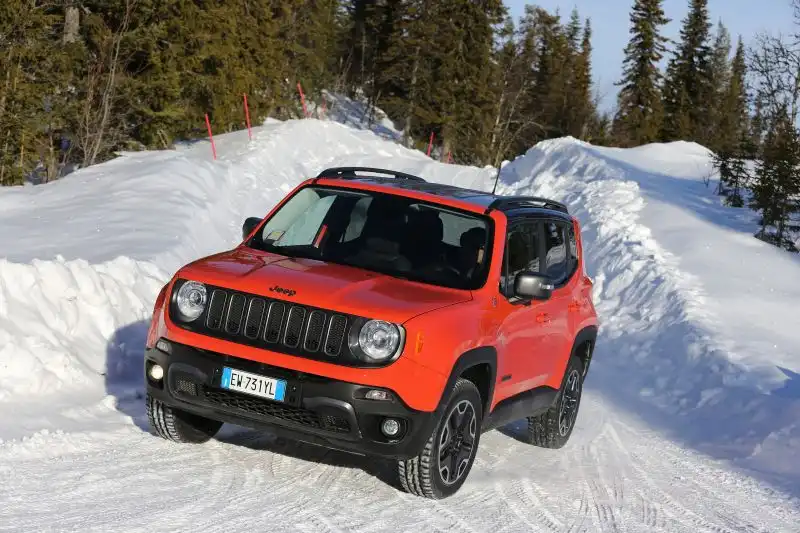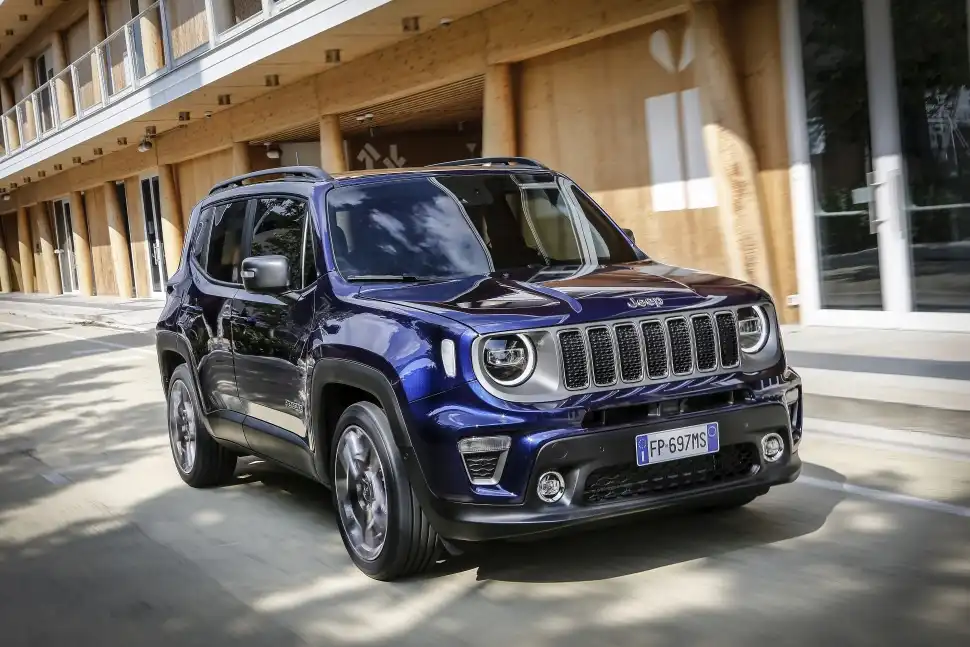
The Jeep Renegade, particularly the facelifted version introduced in August 2018, represented a significant step for the American brand into the increasingly popular subcompact SUV segment. This iteration, produced through November 2021, aimed to broaden the Renegade’s appeal with a range of engine options and trim levels. The 1.3 Turbo (150 Hp) DDCT variant occupied a key position in the lineup, offering a balance between fuel efficiency, performance, and affordability. It was primarily marketed in Europe and other international markets, as Jeep focused on different powertrain strategies for the North American market.
Technical Specifications
| Brand | Jeep |
| Model | Renegade |
| Generation | Renegade (facelift 2018) |
| Type (Engine) | 1.3 Turbo (150 Hp) DDCT |
| Start of production | August, 2018 |
| End of production | November, 2021 |
| Powertrain Architecture | Internal Combustion engine |
| Body type | SUV, Crossover |
| Seats | 5 |
| Doors | 5 |
| Fuel consumption (urban) | 6.9-7.3 l/100 km (34.1 – 32.2 US mpg) |
| Fuel consumption (extra urban) | 5.6-5.7 l/100 km (42 – 41.3 US mpg) |
| Fuel consumption (combined) | 6.2-6.3 l/100 km (37.9 – 37.3 US mpg) |
| CO2 emissions | 140-143 g/km |
| Fuel Type | Petrol (Gasoline) |
| Acceleration 0 – 100 km/h | 9.4 sec |
| Acceleration 0 – 62 mph | 9.4 sec |
| Acceleration 0 – 60 mph | 8.9 sec |
| Maximum speed | 196 km/h (121.79 mph) |
| Emission standard | Euro 6d-TEMP |
| Weight-to-power ratio | 8.8 kg/Hp |
| Weight-to-torque ratio | 4.9 kg/Nm |
| Power | 150 Hp @ 5500 rpm |
| Torque | 270 Nm @ 1850 rpm (199.14 lb.-ft. @ 1850 rpm) |
| Engine Model/Code | 55282328 |
| Engine displacement | 1332 cm3 (81.28 cu. in.) |
| Number of cylinders | 4 |
| Engine configuration | Inline |
| Cylinder Bore | 70 mm (2.76 in.) |
| Piston Stroke | 86.5 mm (3.41 in.) |
| Compression ratio | 10.5:1 |
| Number of valves per cylinder | 4 |
| Fuel injection system | Direct injection |
| Engine aspiration | Turbocharger, Intercooler |
| Engine oil capacity | 4.7 l (4.97 US qt | 4.14 UK qt) |
| Coolant | 8.3 l (8.77 US qt | 7.3 UK qt) |
| Kerb Weight | 1320 kg (2910.1 lbs.) |
| Trunk (boot) space – minimum | 351 l (12.4 cu. ft.) |
| Trunk (boot) space – maximum | 1297 l (45.8 cu. ft.) |
| Fuel tank capacity | 48 l (12.68 US gal | 10.56 UK gal) |
| Length | 4236 mm (166.77 in.) |
| Width | 1805 mm (71.06 in.) |
| Height | 1667 mm (65.63 in.) |
| Wheelbase | 2570 mm (101.18 in.) |
| Ride height (ground clearance) | 131 mm (5.16 in.) |
| Minimum turning circle | 11.1 m (36.42 ft.) |
| Drivetrain Architecture | Front wheel drive |
| Number of gears | 6 |
| Gearbox type | Automatic transmission DDCT |
INTRODUCTION
The 2018 facelift of the Jeep Renegade brought with it a revised engine lineup, including the 1.3-liter turbocharged four-cylinder engine producing 150 horsepower. This engine, paired with a six-speed Dual Dry Clutch Transmission (DDCT), was positioned as a mainstream offering within the Renegade range, appealing to buyers seeking a balance of efficiency and usability. The Renegade itself, built on the 1HX0/A3 platform shared with other Stellantis vehicles, was a crucial model for Jeep, representing an attempt to capture a younger, more urban demographic. The facelift addressed some initial criticisms of the pre-2018 models, improving interior quality and refining the exterior styling.
Powertrain & Engine Architecture
The 1.3-liter turbocharged engine, internally designated with engine code 55282328, is a key component of this Renegade variant. It’s a direct-injection gasoline engine featuring a single-scroll turbocharger and intercooler. This configuration allows for a relatively small displacement engine to produce a respectable 150 hp at 5500 rpm and 270 Nm (199 lb-ft) of torque from as low as 1850 rpm. The direct injection system optimizes fuel delivery and combustion efficiency. The DDCT six-speed automatic transmission is a dual-clutch unit designed for quick and smooth gear changes. Unlike traditional torque-converter automatics, the DDCT uses two separate clutches for odd and even gears, pre-selecting the next gear for faster shifts. This contributes to a more engaging driving experience and improved fuel economy.
Driving Characteristics
The 1.3 Turbo DDCT Renegade delivers a competent, if not particularly exhilarating, driving experience. The 150 hp output provides adequate power for everyday driving situations, including highway merging and overtaking. The DDCT transmission generally shifts smoothly, although some drivers have reported occasional hesitation at low speeds. Compared to the more powerful 1.6-liter Multijet diesel or the higher-output gasoline engines, this variant feels less urgent in its acceleration. However, it offers a more refined and quieter driving experience than the diesel. The gear ratios are tuned for a balance of fuel efficiency and responsiveness, with a focus on maximizing torque in the lower and mid-range. The front-wheel-drive configuration contributes to lower weight and improved fuel economy, but it lacks the all-weather capability of the available four-wheel-drive Renegade models.
Equipment & Trim Levels
The 1.3 Turbo DDCT Renegade was typically offered in mid-range trim levels, often designated as ‘Limited’ or similar depending on the specific market. Standard equipment generally included air conditioning, a touchscreen infotainment system with Bluetooth connectivity, alloy wheels, and a suite of safety features such as ABS, electronic stability control, and multiple airbags. Optional extras commonly included a panoramic sunroof, leather upholstery, navigation system, parking sensors, and advanced driver-assistance systems like lane departure warning and automatic emergency braking. Interior upholstery was typically cloth or a combination of cloth and vinyl, with higher trims offering full leather options. The dashboard layout was relatively straightforward, with a focus on usability and functionality.
Chassis & Braking
The Renegade’s chassis utilizes a MacPherson strut front suspension and a twist-beam rear suspension. This setup provides a comfortable ride quality, although it’s not particularly sporty. The front suspension is designed to absorb bumps and irregularities in the road, while the twist-beam rear suspension keeps the vehicle stable and predictable. Braking systems typically consisted of front disc brakes and rear drum brakes on the base models, with higher trims often upgrading to rear disc brakes. Electric power steering provides light and precise steering feel. Stabilizer bars are fitted to both the front and rear axles to reduce body roll during cornering.
Market Reception & Comparison
The 1.3 Turbo DDCT Renegade received generally positive reviews from automotive critics, who praised its fuel efficiency, comfortable ride, and user-friendly technology. However, some reviewers noted that the engine could feel strained when fully loaded or driving uphill. Compared to the 1.6-liter diesel, the 1.3 Turbo offered slightly less fuel economy but a more responsive driving experience. Against the higher-output gasoline engines, it provided a more affordable entry point into the Renegade range, albeit with reduced performance. Reliability reports have been mixed, with some owners reporting issues with the DDCT transmission, while others have experienced no major problems.
Legacy
The 1.3 Turbo DDCT Renegade represents a significant step in Jeep’s efforts to expand its appeal beyond traditional off-road enthusiasts. While not the most powerful or capable Renegade variant, it offered a compelling combination of fuel efficiency, practicality, and affordability. On the used car market, these models are generally well-regarded, but potential buyers should be aware of the potential for DDCT transmission issues and ensure that the vehicle has been properly maintained. The Renegade, in general, helped to establish Jeep as a player in the competitive subcompact SUV segment, paving the way for future models like the Jeep Compass and the redesigned Renegade.