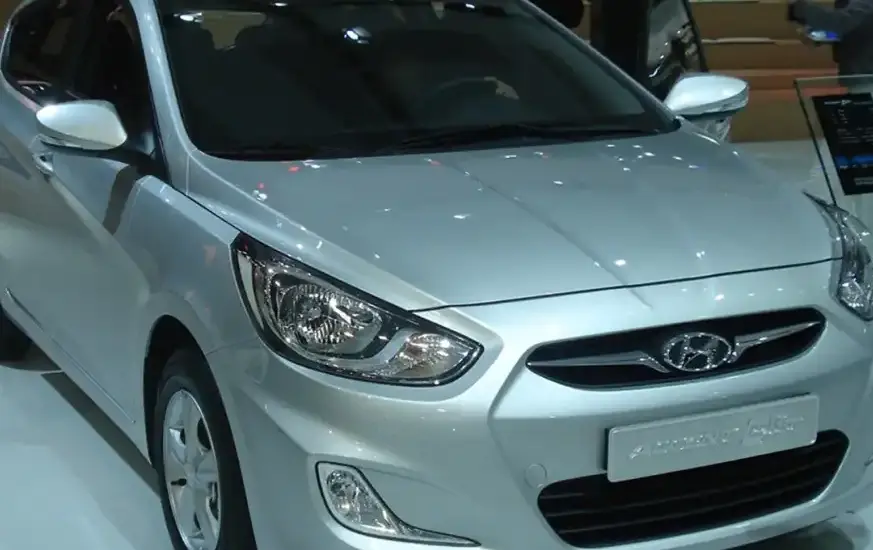
The Hyundai Solaris I Sedan 1.6 MPI (123 hp) was a key model in Hyundai’s expansion into the compact sedan market, particularly targeting emerging economies. Introduced in 2011 and continuing through 2014, this variant represented a significant step for Hyundai in offering a modern, affordable, and relatively well-equipped vehicle. It was primarily designed and sold for markets like Russia, Ukraine, and other parts of Eastern Europe, as well as some regions in the Middle East. The Solaris I Sedan was built on the Hyundai-Kia PB platform, shared with the Kia Rio of the same generation. This specific 1.6L engine and transmission combination occupied a central position in the Solaris lineup, offering a balance between performance, fuel economy, and price.
Technical Specifications
| Brand | Hyundai |
| Model | Solaris |
| Generation | Solaris I Sedan |
| Type (Engine) | 1.6 MPI (123 Hp) |
| Start of production | 2011 |
| End of production | 2014 |
| Powertrain Architecture | Internal Combustion engine |
| Body type | Sedan |
| Seats | 5 |
| Doors | 4 |
| Fuel consumption (urban) | 7.9 l/100 km (29.8 US mpg) |
| Fuel consumption (extra urban) | 4.9 l/100 km (48 US mpg) |
| Fuel consumption (combined) | 6 l/100 km (39.2 US mpg) |
| Fuel Type | Petrol (Gasoline) |
| Acceleration 0 – 100 km/h | 10.2 sec |
| Acceleration 0 – 62 mph | 10.2 sec |
| Acceleration 0 – 60 mph | 9.7 sec |
| Maximum speed | 190 km/h (118.06 mph) |
| Emission standard | Euro 4 |
| Weight-to-power ratio | 9 kg/Hp |
| Weight-to-torque ratio | 7.2 kg/Nm |
| Power | 123 Hp @ 6300 rpm |
| Torque | 155 Nm @ 4200 rpm (114.32 lb.-ft. @ 4200 rpm) |
| Engine layout | Front, Transverse |
| Engine displacement | 1591 cm3 (97.09 cu. in.) |
| Number of cylinders | 4 |
| Engine configuration | Inline |
| Number of valves per cylinder | 4 |
| Fuel injection system | Multi-port manifold injection |
| Engine aspiration | Naturally aspirated engine |
| Engine oil capacity | 3.3 l (3.49 US qt | 2.9 UK qt) |
| Coolant capacity | 5.3 l (5.6 US qt | 4.66 UK qt) |
| Kerb Weight | 1110 kg (2447.13 lbs.) |
| Max. weight | 1565 kg (3450.23 lbs.) |
| Max load | 455 kg (1003.1 lbs.) |
| Trunk (boot) space – minimum | 454 l (16.03 cu. ft.) |
| Fuel tank capacity | 43 l (11.36 US gal | 9.46 UK gal) |
| Permitted trailer load with brakes (12%) | 1000 kg (2204.62 lbs.) |
| Permitted trailer load without brakes | 450 kg (992.08 lbs.) |
| Length | 4370 mm (172.05 in.) |
| Width | 1700 mm (66.93 in.) |
| Height | 1470 mm (57.87 in.) |
| Wheelbase | 2570 mm (101.18 in.) |
| Front track | 1495 mm (58.86 in.) |
| Rear (Back) track | 1502 mm (59.13 in.) |
| Front overhang | 820 mm (32.28 in.) |
| Rear overhang | 980 mm (38.58 in.) |
| Ride height (ground clearance) | 160 mm (6.3 in.) |
| Minimum turning circle (turning diameter) | 10.4 m (34.12 ft.) |
| Drivetrain Architecture | Front wheel drive |
| Number of gears and type of gearbox | 5 gears, manual transmission |
| Front suspension | Independent, type McPherson with coil spring and anti-roll bar |
| Rear suspension | Semi-independent, coil spring |
| Front brakes | Ventilated discs |
| Rear brakes | Disc |
| Assisting systems | ABS (Anti-lock braking system) |
| Steering type | Steering rack and pinion |
| Tires size | 185/65 R15; 195/55 R16 |
| Wheel rims size | 15; 16 |
INTRODUCTION
The Hyundai Solaris I Sedan 1.6 MPI (123 hp) was produced from 2011 to 2014 and quickly became a popular choice in its target markets. Positioned as an entry-level to mid-range offering, it aimed to provide a modern and reliable sedan at a competitive price point. The Solaris was a crucial part of Hyundai’s strategy to gain market share in regions where affordability and practicality were paramount. It competed directly with vehicles like the Skoda Rapid, Volkswagen Polo Sedan, and Renault Logan. The 1.6L engine with 123 horsepower was the most common engine option, offering a good balance of performance and fuel efficiency for everyday driving.
Powertrain & Engine Architecture
The heart of the Solaris 1.6 MPI is the Hyundai Gamma engine, specifically the G4FG variant. This is a 1.6-liter (1591 cc) inline-four cylinder engine utilizing a multi-point fuel injection (MPI) system. The engine features a dual overhead camshaft (DOHC) design with four valves per cylinder, contributing to its relatively efficient operation. The engine code G4FG is a key identifier for this specific configuration. The engine’s design prioritizes reliability and ease of maintenance over outright performance. The 5-speed manual transmission was the standard offering, designed to provide smooth and efficient gear changes. The transmission’s gear ratios were tuned for fuel economy and everyday drivability, rather than sporty acceleration. The engine’s naturally aspirated design means it relies on atmospheric pressure to draw air into the cylinders, resulting in a predictable and linear power delivery.
Driving Characteristics
The Solaris 1.6 MPI with a manual transmission offered adequate performance for typical urban and highway driving. Acceleration from 0-60 mph took around 9.7 seconds, and the top speed was approximately 118 mph. While not a particularly sporty vehicle, the engine provided sufficient power for overtaking maneuvers and maintaining comfortable cruising speeds. The 5-speed manual transmission allowed drivers to maintain optimal engine RPMs for fuel efficiency or performance. Compared to higher-output versions (which weren’t widely available in many markets), this variant felt less strained during acceleration and offered better fuel economy. The suspension was tuned for comfort, absorbing bumps and imperfections in the road reasonably well. However, this also resulted in some body roll during cornering. The steering was light and easy to use, making it well-suited for city driving.
Equipment & Trim Levels
The Solaris 1.6 MPI typically came standard with features like air conditioning, power windows, central locking, and a basic audio system. Higher trim levels added features such as alloy wheels, fog lights, a more advanced audio system with Bluetooth connectivity, and sometimes even a sunroof. Interior upholstery was typically cloth, with options for different colors and patterns. The dashboard layout was functional and straightforward, prioritizing ease of use over aesthetic flair. Optional extras included a rear parking sensor, upgraded audio systems, and security alarms. The overall interior ambiance was practical and durable, reflecting the car’s target market.
Chassis & Braking
The Solaris I Sedan utilized a McPherson strut front suspension and a semi-independent coil spring rear suspension. This setup provided a good balance between ride comfort and handling. The front brakes were ventilated discs, offering good stopping power, while the rear brakes were solid discs. ABS (Anti-lock Braking System) was standard, enhancing safety during emergency braking situations. The chassis was designed to be lightweight yet rigid, contributing to the car’s overall stability. The steering system employed a rack and pinion setup, providing precise and responsive steering feel. Tire sizes typically ranged from 185/65 R15 to 195/55 R16, depending on the trim level.
Market Reception & Comparison
The Hyundai Solaris 1.6 MPI was generally well-received by critics and consumers alike. It was praised for its affordability, reliability, and relatively spacious interior. Fuel economy was also a strong point, with combined fuel consumption figures around 39.2 US mpg. Compared to other trims in the Solaris lineup, the 1.6 MPI offered the best balance of price and practicality. While more powerful engines were available in some markets, they came at a higher cost and often didn’t offer a significant performance advantage for everyday driving. The Solaris consistently outperformed competitors like the Renault Logan and Lada Priora in terms of build quality and features.
Legacy
The Hyundai Solaris I Sedan 1.6 MPI has proven to be a remarkably reliable vehicle, with many examples still on the road today. The Gamma engine is known for its durability and relatively low maintenance costs. Common issues are typically limited to wear-and-tear items such as brake pads, tires, and suspension components. In the used car market, the Solaris 1.6 MPI remains a popular choice for budget-conscious buyers seeking a dependable and affordable sedan. Its reputation for reliability and low running costs has ensured its continued relevance even after the introduction of newer models. The Solaris I Sedan laid the foundation for Hyundai’s success in the compact sedan segment, establishing the brand as a serious contender in emerging markets.