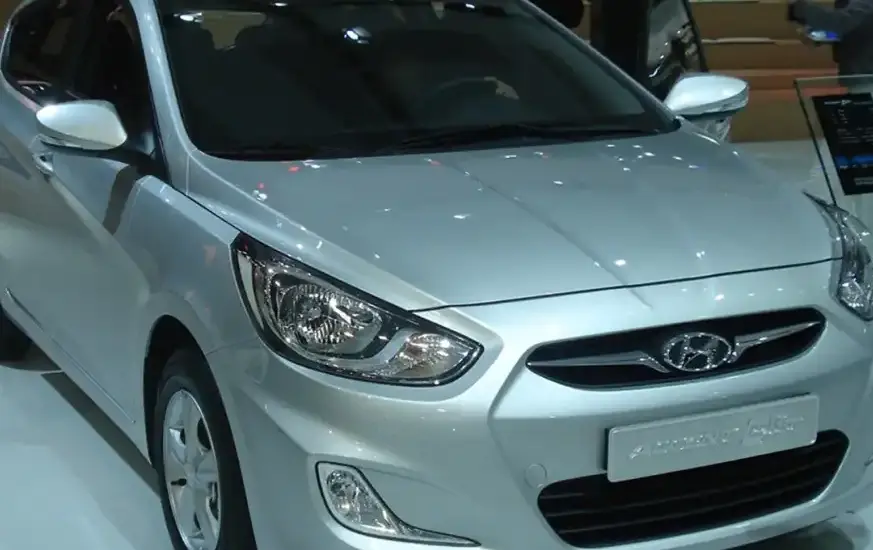
The Hyundai Solaris I Sedan (facelifted in 2014) with the 1.4-liter MPI engine producing 107 horsepower represents a significant entry point into the compact sedan market, particularly in regions like Russia and the Commonwealth of Independent States (CIS). Introduced as Hyundai’s offering in the budget-friendly sedan segment, the Solaris aimed to provide reliable transportation with a focus on value. This facelift, released in 2014, brought updated styling and minor mechanical refinements to the original Solaris, which debuted in 2010. The 1.4 MPI variant, paired with a five-speed manual transmission, was positioned as the base model, appealing to buyers prioritizing fuel efficiency and affordability over outright performance. Production of this specific configuration ran from 2014 to 2016.
Technical Specifications
| Brand | Hyundai |
| Model | Solaris |
| Generation | Solaris I Sedan (facelift 2014) |
| Type (Engine) | 1.4 MPI (107 Hp) |
| Start of production | 2014 |
| End of production | 2016 |
| Powertrain Architecture | Internal Combustion engine |
| Body type | Sedan |
| Seats | 5 |
| Doors | 4 |
| Fuel consumption (urban) | 7.6 l/100 km (30.9 US mpg) |
| Fuel consumption (extra urban) | 4.9 l/100 km (48 US mpg) |
| Fuel consumption (combined) | 5.9 l/100 km (39.9 US mpg) |
| Fuel Type | Petrol (Gasoline) |
| Acceleration 0 – 100 km/h | 11.5 sec |
| Acceleration 0 – 62 mph | 11.5 sec |
| Acceleration 0 – 60 mph | 10.9 sec |
| Maximum speed | 190 km/h (118.06 mph) |
| Emission standard | Euro 4 |
| Weight-to-power ratio | 11.4 kg/Hp |
| Weight-to-torque ratio | 9 kg/Nm |
| Power | 107 Hp @ 6300 rpm |
| Torque | 135 Nm @ 5000 rpm (99.57 lb.-ft. @ 5000 rpm) |
| Engine layout | Front, Transverse |
| Engine displacement | 1396 cm3 (85.19 cu. in.) |
| Number of cylinders | 4 |
| Engine configuration | Inline |
| Number of valves per cylinder | 4 |
| Fuel injection system | Multi-port manifold injection |
| Engine aspiration | Naturally aspirated |
| Engine oil capacity | 3.6 l (3.8 US qt | 3.17 UK qt) |
| Coolant capacity | 5.3 l (5.6 US qt | 4.66 UK qt) |
| Kerb Weight | 1220 kg (2689.64 lbs.) |
| Max. weight | 1565 kg (3450.23 lbs.) |
| Max load | 345 kg (760.59 lbs.) |
| Trunk (boot) space – minimum | 470 l (16.6 cu. ft.) |
| Fuel tank capacity | 43 l (11.36 US gal | 9.46 UK gal) |
| Permitted trailer load with brakes (12%) | 1000 kg (2204.62 lbs.) |
| Permitted trailer load without brakes | 450 kg (992.08 lbs.) |
| Length | 4375 mm (172.24 in.) |
| Width | 1700 mm (66.93 in.) |
| Height | 1470 mm (57.87 in.) |
| Wheelbase | 2570 mm (101.18 in.) |
| Front track | 1495 mm (58.86 in.) |
| Rear (Back) track | 1502 mm (59.13 in.) |
| Ride height (ground clearance) | 160 mm (6.3 in.) |
| Minimum turning circle | 10.4 m (34.12 ft.) |
| Drivetrain Architecture | Front wheel drive |
| Number of gears and type of gearbox | 5 gears, manual transmission |
| Front suspension | Independent, McPherson with coil spring and anti-roll bar |
| Rear suspension | Semi-independent, coil spring |
| Front brakes | Ventilated discs |
| Rear brakes | Disc |
| Assisting systems | ABS (Anti-lock braking system) |
| Steering type | Steering rack and pinion |
| Tires size | 185/65 R15; 195/55 R16 |
| Wheel rims size | 6.0J x 15; 6.0J x 16 |
Powertrain & Engine Architecture
The heart of this Solaris variant is the Hyundai G4FA 1.4-liter inline-four cylinder engine. This engine utilizes a multi-point fuel injection (MPI) system, a relatively simple and cost-effective technology. The G4FA engine features a single overhead camshaft (SOHC) design with four valves per cylinder. This configuration balances simplicity with reasonable performance. The engine’s 107 horsepower and 135 Nm (99.57 lb-ft) of torque are adequate for everyday driving, but it’s not designed for spirited acceleration. The five-speed manual transmission provides a straightforward driving experience, with gear ratios tuned for fuel economy rather than performance. The transmission is known for its durability and relatively low maintenance requirements.
Driving Characteristics
The 1.4L Solaris with a manual transmission delivers a predictable, if not particularly exciting, driving experience. Acceleration from 0-60 mph takes around 10.9 seconds, making it suitable for urban and highway driving, but not for quick overtaking maneuvers. The gear ratios are spaced to prioritize fuel efficiency, meaning the engine needs to be revved to access its peak power. Compared to the higher-output 1.6-liter engine option available in the Solaris lineup, the 1.4L feels noticeably less powerful. However, the lighter engine weight contributes to slightly better handling and fuel economy. The manual transmission provides a more engaging driving experience than the optional four-speed automatic, offering greater control over the engine’s power band.
Equipment & Trim Levels
The base-level 1.4 MPI Solaris typically came equipped with essential features such as air conditioning, power windows, central locking, and a basic audio system. Safety features included dual airbags, ABS, and electronic brake-force distribution (EBD). Higher trim levels added features like alloy wheels, a more advanced audio system, and fog lights. Interior upholstery was typically cloth, with a simple and functional dashboard layout. Optional extras included a rear parking sensor and upgraded audio systems.
Chassis & Braking
The Solaris I Sedan utilizes a McPherson strut front suspension and a semi-independent coil spring rear suspension. This setup provides a comfortable ride quality, although it’s not particularly sporty. The front brakes are ventilated discs, while the rear brakes are solid discs. The ABS system helps to maintain control during emergency braking situations. The steering is a rack-and-pinion system, providing adequate precision and feedback. The 1.4L models typically came with either 15-inch or 16-inch steel or alloy wheels, depending on the trim level.
Market Reception & Comparison
The Hyundai Solaris was well-received in its target markets, particularly for its affordability, reliability, and fuel efficiency. Critics praised its spacious interior and comfortable ride. However, the 1.4-liter engine was often criticized for its lack of power, especially when compared to competitors offering larger engines. In terms of fuel economy, the 1.4L Solaris outperformed many of its rivals. The 1.6L engine offered a significant performance boost but came at a higher price point. The 1.4L model was primarily aimed at budget-conscious buyers who prioritized practicality and fuel efficiency over performance.
Legacy
The Hyundai Solaris I Sedan, particularly the 1.4 MPI variant, established Hyundai as a major player in the affordable compact sedan segment. The G4FA engine proved to be a reliable and durable unit, with many examples still on the road today. While not known for its performance, the 1.4L Solaris remains a popular choice in the used car market due to its low running costs and relatively simple maintenance requirements. Its success paved the way for the second-generation Solaris, which further refined the formula and continued to build on Hyundai’s reputation for value and reliability.