Technical Specifications
| Brand | Kia |
| Model | Optima |
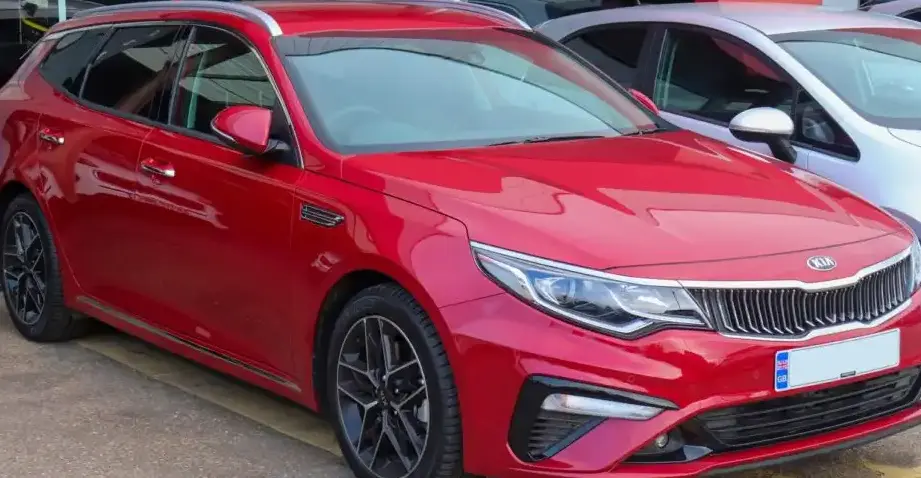
| Generation | Optima IV Sportswagon (facelift 2018) |
| Type (Engine) | 1.6 CRDi (136 Hp) |
| Start of production | 2018 |
| End of production | 2020 |
| Powertrain Architecture | Internal Combustion engine |
| Body type | Station wagon (estate) |
| Seats | 5 |
| Doors | 5 |
| Fuel consumption (urban) | 4.9-5.2 l/100 km (48 – 45.2 US mpg) |
| Fuel consumption (extra urban) | 4.0-4.3 l/100 km (58.8 – 54.7 US mpg) |
| Fuel consumption (combined) | 4.3-4.6 l/100 km (54.7 – 51.1 US mpg) |
| CO2 emissions | 114-122 g/km |
| Fuel Type | Diesel |
| Acceleration 0 – 100 km/h | 11.2 sec |
| Acceleration 0 – 62 mph | 11.2 sec |
| Acceleration 0 – 60 mph | 10.6 sec |
| Maximum speed | 195 km/h (121.17 mph) |
| Emission standard | Euro 6d – TEMP |
| Weight-to-power ratio | 11.4 kg/Hp |
| Weight-to-torque ratio | 4.8 kg/Nm |
| Power | 136 Hp @ 4000 rpm |
| Torque | 320 Nm @ 2000-2250 rpm (236.02 lb.-ft. @ 2000-2250 rpm) |
| Engine layout | Front, Transverse |
| Engine Model/Code | D4FE |
| Engine displacement | 1598 cm3 (97.52 cu. in.) |
| Number of cylinders | 4 |
| Engine configuration | Inline |
| Cylinder Bore | 77 mm (3.03 in.) |
| Piston Stroke | 85.8 mm (3.38 in.) |
| Compression ratio | 15.9:1 |
| Number of valves per cylinder | 4 |
| Fuel injection system | Diesel Commonrail |
| Engine aspiration | Turbocharger, Intercooler |
| Engine oil capacity | 4.4 l (4.65 US qt | 3.87 UK qt) |
| Coolant capacity | 6.9 l (7.29 US qt | 6.07 UK qt) |
| Kerb Weight | 1545-1675 kg (3406.14 – 3692.74 lbs.) |
| Max. weight | 2140 kg (4717.89 lbs.) |
| Max load | 465-595 kg (1025.15 – 1311.75 lbs.) |
| Trunk (boot) space – minimum | 552 l (19.49 cu. ft.) |
| Trunk (boot) space – maximum | 1686 l (59.54 cu. ft.) |
| Fuel tank capacity | 70 l (18.49 US gal | 15.4 UK gal) |
| Max. roof load | 100 kg (220.46 lbs.) |
| Permitted trailer load with brakes (12%) | 1800 kg (3968.32 lbs.) |
| Permitted trailer load without brakes | 750 kg (1653.47 lbs.) |
| Permitted towbar download | 80 kg (176.37 lbs.) |
| Length | 4855 mm (191.14 in.) |
| Width | 1860 mm (73.23 in.) |
| Width including mirrors | 2120 mm (83.46 in.) |
| Height | 1470 mm (57.87 in.) |
| Wheelbase | 2805 mm (110.43 in.) |
| Front track | 1597-1607 mm (62.87 – 63.27 in.) |
| Rear track | 1604-1614 mm (63.15 – 63.54 in.) |
| Front overhang | 965 mm (37.99 in.) |
| Rear overhang | 1085 mm (42.72 in.) |
| Ride height (ground clearance) | 135 mm (5.31 in.) |
| Minimum turning circle | 10.9 m (35.76 ft.) |
| Drivetrain | Front wheel drive |
| Number of gears and type of gearbox | 6 gears, manual transmission |
| Front suspension | Independent type McPherson |
| Rear suspension | Independent multi-link suspension |
| Front brakes | Ventilated discs |
| Rear brakes | Disc |
| Assisting systems | ABS (Anti-lock braking system) |
| Steering type | Steering rack and pinion |
| Power steering | Electric Steering |
| Tires size | 215/60 R16; 215/55 R17; 235/45 ZR18 |
| Wheel rims size | 6.5J x 16; 7.5J x 17; 7.5 x 18 |
The Kia Optima IV Sportswagon, launched in 2018 following a facelift, represented Kia’s commitment to offering practical and well-equipped vehicles in the European market. Built on the PF platform (shared with the Hyundai Sonata), the Sportswagon expanded the Optima range with a body style increasingly popular with European buyers. The 1.6 CRDi 136 hp variant was a significant offering, targeting customers who desired a balance between fuel economy, reasonable performance, and a comfortable driving experience. This engine was part of Kia’s efforts to meet increasingly stringent European emissions standards while still providing a viable diesel option.
Powertrain & Engine Architecture
The heart of this Optima variant is the D4FE 1.6-liter four-cylinder diesel engine. This engine utilizes a common-rail direct injection system, delivering fuel at extremely high pressure for optimized combustion. The engine benefits from a turbocharger with an intercooler, boosting power output to 136 horsepower at 4000 rpm and 320 Nm (236 lb-ft) of torque between 2000 and 2250 rpm. The engine features a cast iron block and aluminum cylinder head, contributing to its durability. The 6-speed manual transmission was standard, offering a good balance between fuel efficiency and driver engagement. The transmission’s gear ratios were tuned to maximize the engine’s torque output, providing adequate acceleration for everyday driving.
Driving Characteristics
The 1.6 CRDi Sportswagon offered a comfortable and refined driving experience. While not particularly sporty, the engine provided sufficient power for highway cruising and overtaking maneuvers. The 11.2-second 0-62 mph acceleration time reflects its focus on efficiency rather than outright speed. The manual transmission allowed for precise control, and the gear ratios were well-matched to the engine’s torque curve. Compared to the more powerful gasoline engines in the Optima lineup, the 1.6 CRDi prioritized fuel economy and lower running costs. It also offered a smoother and quieter ride than the higher-output diesel variants.
Equipment & Trim Levels
The 1.6 CRDi Sportswagon typically came equipped with a respectable level of standard features. These included air conditioning, a touchscreen infotainment system with Bluetooth connectivity, alloy wheels, and a suite of safety features such as ABS, ESC (Electronic Stability Control), and multiple airbags. Higher trim levels offered upgrades such as leather upholstery, a panoramic sunroof, heated seats, and advanced driver-assistance systems like lane departure warning and autonomous emergency braking. Interior materials were generally of good quality, providing a comfortable and well-appointed cabin.
Chassis & Braking
The Optima Sportswagon featured a McPherson strut front suspension and a multi-link rear suspension, providing a comfortable and controlled ride. The suspension was tuned to prioritize comfort over sporty handling. The braking system consisted of ventilated discs at the front and solid discs at the rear, providing adequate stopping power for the vehicle’s weight and performance. ABS (Anti-lock Braking System) was standard, enhancing safety during emergency braking situations. The steering was electrically assisted, offering a light and precise feel.
Market Reception & Comparison
The Kia Optima IV Sportswagon 1.6 CRDi was generally well-received by automotive critics. It was praised for its spacious interior, comfortable ride, and competitive fuel economy. However, some critics noted that the engine could feel strained when fully loaded or driving uphill. Compared to other diesel estate cars in its class, such as the Ford Mondeo Estate and the Volkswagen Passat Estate, the Optima offered a compelling value proposition with a generous level of standard equipment and a long warranty. Its fuel economy was comparable to its rivals, and its reliability proved to be good.
Legacy
The Kia Optima IV Sportswagon 1.6 CRDi has proven to be a reliable and durable vehicle in the used car market. The D4FE engine is known for its robustness, and with regular maintenance, it can provide many years of trouble-free service. The availability of spare parts is good, and maintenance costs are generally reasonable. The Sportswagon’s spacious interior and practical design continue to appeal to buyers looking for a versatile and affordable estate car. While no longer in production, the 1.6 CRDi variant remains a popular choice for those seeking a fuel-efficient and well-equipped family vehicle.