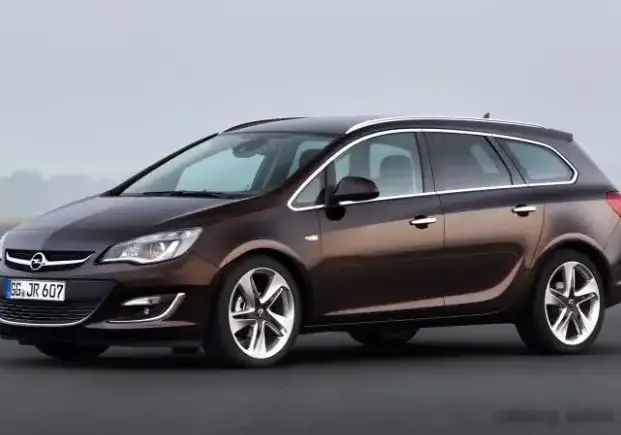
The Opel Astra J Sports Tourer (facelift, introduced in 2012) 1.7 CDTI Ecotec, producing 100 horsepower, represented an entry-level diesel option within the broader Astra J Sports Tourer range. Positioned as a fuel-efficient and practical choice, this variant catered to buyers prioritizing economy and space over outright performance. Production of this specific configuration ran from 2012 to 2014, falling within the lifecycle of the J series Astra, which utilized the General Motors Delta II platform (also known as the 1HX0 platform). The Sports Tourer body style, Opel’s designation for a station wagon, aimed to provide increased cargo capacity and versatility compared to the hatchback version.
Technical Specifications
| Brand | Opel |
| Model | Astra |
| Generation | Astra J Sports Tourer (facelift 2012) |
| Type (Engine) | 1.7 CDTI (100 Hp) Ecotec |
| Start of production | 2012 |
| End of production | 2014 |
| Powertrain Architecture | Internal Combustion engine |
| Body type | Station wagon (estate) |
| Seats | 5 |
| Doors | 5 |
| Fuel consumption (urban) | 5.4-5.6 l/100 km (43.6 – 42 US mpg) |
| Fuel consumption (extra urban) | 4.0-4.2 l/100 km (58.8 – 56 US mpg) |
| Fuel consumption (combined) | 4.5-4.7 l/100 km (52.3 – 50 US mpg) |
| CO2 emissions | 120-124 g/km |
| Fuel Type | Diesel |
| Acceleration 0 – 100 km/h | 12.7 sec |
| Acceleration 0 – 62 mph | 12.7 sec |
| Acceleration 0 – 60 mph | 12.1 sec |
| Maximum speed | 182 km/h (113.09 mph) |
| Emission standard | Euro 5 |
| Power | 100 Hp @ 4000 rpm |
| Torque | 260 Nm @ 1750-2500 rpm (191.77 lb.-ft. @ 1750-2500 rpm) |
| Engine layout | Front, Transverse |
| Engine Model/Code | A17DTL, A17DTN |
| Engine displacement | 1686 cm3 (102.89 cu. in.) |
| Number of cylinders | 4 |
| Engine configuration | Inline |
| Cylinder Bore | 79 mm (3.11 in.) |
| Piston Stroke | 86 mm (3.39 in.) |
| Number of valves per cylinder | 4 |
| Fuel injection system | Diesel Commonrail |
| Engine aspiration | Turbocharger, Intercooler |
| Engine oil capacity | 5.4 l (5.71 US qt | 4.75 UK qt) |
| Coolant capacity | 6.2 l (6.55 US qt | 5.46 UK qt) |
| Trunk (boot) space – minimum | 500 l (17.66 cu. ft.) |
| Trunk (boot) space – maximum | 1550 l (54.74 cu. ft.) |
| Fuel tank capacity | 56 l (14.79 US gal | 12.32 UK gal) |
| Length | 4698 mm (184.96 in.) |
| Width | 1814 mm (71.42 in.) |
| Width with mirrors folded | 1831 mm (72.09 in.) |
| Width including mirrors | 2013 mm (79.25 in.) |
| Height | 1535 mm (60.43 in.) |
| Wheelbase | 2685 mm (105.71 in.) |
| Front track | 1541 mm (60.67 in.) |
| Rear track | 1551 mm (61.06 in.) |
| Ride height (ground clearance) | 165 mm (6.5 in.) |
| Minimum turning circle | 11.4 m (37.4 ft.) |
| Drivetrain | Front wheel drive |
| Number of gears | 6 |
| Gearbox type | Manual transmission |
| Front brakes | Ventilated discs |
| Assisting systems | ABS (Anti-lock braking system) |
| Steering type | Steering rack and pinion |
| Power steering | Electric Steering |
Powertrain & Engine Architecture
The Astra J Sports Tourer 1.7 CDTI Ecotec utilized the A17DTL or A17DTN engine code, representing a member of Opel/Vauxhall’s family of small-displacement diesel engines. This 1.7-liter inline-four cylinder engine featured a common rail direct injection system, delivering fuel at high pressure directly into the combustion chamber for improved efficiency and reduced emissions. A turbocharger with an intercooler was employed to boost power output, mitigating the typical torque deficit of smaller displacement engines. The engine also incorporated four valves per cylinder, enhancing breathing and contributing to its power delivery. The 100 horsepower and 192 lb-ft of torque were respectable figures for this class of vehicle, though not exceptional. The engine was paired with a six-speed manual transmission, chosen for its fuel efficiency and lower cost compared to an automatic option.
Driving Characteristics
The 1.7 CDTI with the manual transmission offered a reasonably refined driving experience, prioritizing fuel economy over spirited acceleration. The 0-60 mph time of around 12.1 seconds reflects this focus. While adequate for everyday driving, overtaking maneuvers required careful planning. The engine’s torque peak, available from 1750-2500 rpm, provided sufficient pull for most situations, but the engine did feel strained when pushed hard. The six-speed gearbox was well-matched to the engine’s characteristics, allowing drivers to keep the engine within its optimal power band. Compared to the more powerful 1.4 Turbo petrol or 2.0 CDTI diesel variants, the 1.7 CDTI felt noticeably slower, but it offered a significant advantage in fuel efficiency.
Equipment & Trim Levels
The 1.7 CDTI Ecotec typically came equipped as a base or mid-range trim level, depending on the specific market and optional packages selected. Standard features generally included air conditioning, electric front windows, a basic audio system with USB connectivity, and stability control. Higher trim levels added features such as alloy wheels, cruise control, a more advanced infotainment system, and parking sensors. Interior upholstery was typically cloth, with options for upgraded materials available. The dashboard layout was functional and straightforward, prioritizing usability over luxury.
Chassis & Braking
The Astra J Sports Tourer’s chassis was tuned for comfort and stability. The front suspension utilized MacPherson struts, while the rear suspension employed a torsion beam setup. This configuration provided a good balance between ride quality and handling. The 1.7 CDTI variant typically featured ventilated disc brakes at the front and drum brakes at the rear, adequate for the vehicle’s weight and performance. Anti-lock Braking System (ABS) was standard, enhancing safety during emergency braking situations. Stabilizer bars were fitted to both the front and rear axles to reduce body roll during cornering.
Market Reception & Comparison
The Astra J Sports Tourer 1.7 CDTI Ecotec was generally well-received by automotive critics as a practical and economical choice. Its fuel efficiency was a major selling point, particularly in Europe where diesel fuel was often cheaper than gasoline. However, some reviewers criticized its lack of outright performance compared to more powerful variants. Compared to competitors like the Ford Focus Estate and Volkswagen Golf Estate, the Astra offered a competitive level of equipment and fuel economy. The 1.7 CDTI’s reliability was generally considered good, although diesel particulate filter (DPF) issues could occur with infrequent long-distance driving.
Legacy
The 1.7 CDTI engine, while not known for being particularly exciting, proved to be a durable and reliable powerplant. In the used car market, Astra J Sports Tourer models equipped with this engine are often sought after by buyers prioritizing fuel economy and low running costs. The engine’s relatively simple design and readily available parts contribute to its affordability and ease of maintenance. While modern vehicles offer more advanced technology and higher performance, the Astra J Sports Tourer 1.7 CDTI Ecotec remains a practical and economical option for those seeking a spacious and fuel-efficient station wagon.