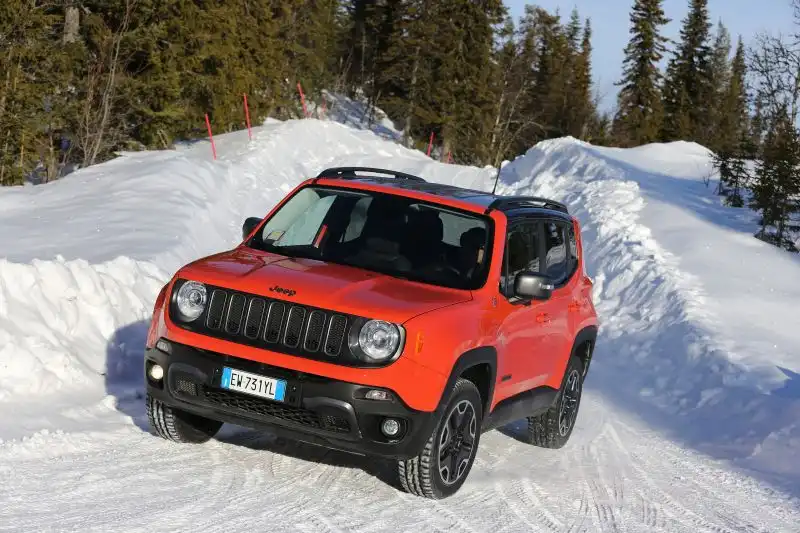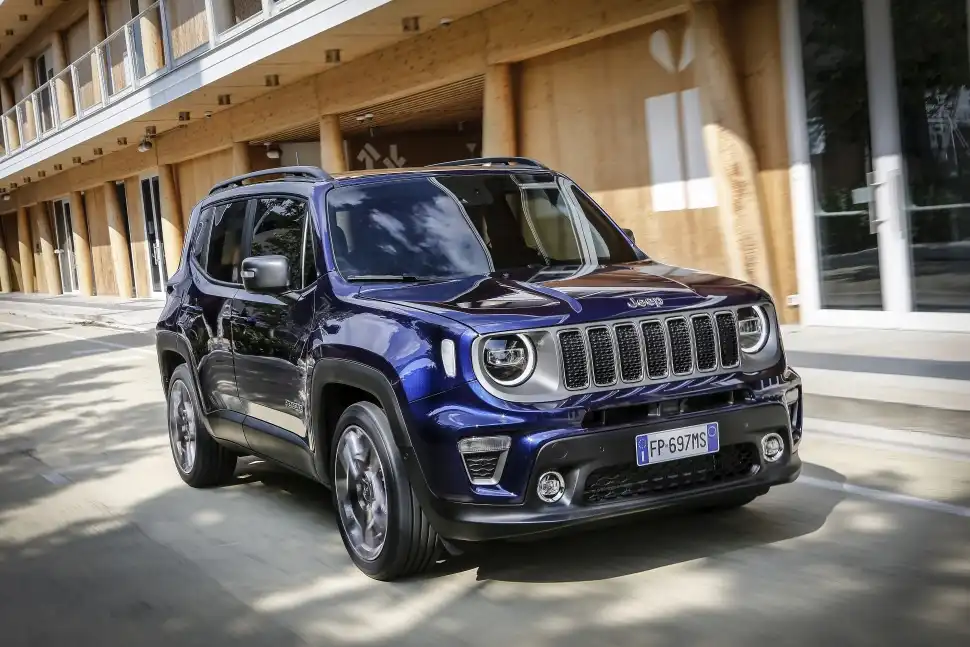
The Jeep Renegade 1.6 Multijet (120 hp) represents a significant entry point into the Renegade lineup, particularly in European and international markets following the 2018 facelift. Introduced in August 2018 and continuing through July 2020, this variant aimed to provide a balance of fuel efficiency and practicality within the subcompact SUV segment. Positioned as a more economical alternative to the higher-powered gasoline and diesel options, the 1.6 Multijet catered to buyers prioritizing lower running costs and everyday usability. It was a key component of Jeep’s strategy to broaden the Renegade’s appeal beyond the traditionally American focus on larger engines and off-road capability.
Technical Specifications
| Brand | Jeep |
| Model | Renegade |
| Generation | Renegade (facelift 2018) |
| Type (Engine) | 1.6 Multijet (120 Hp) |
| Start of production | August, 2018 |
| End of production | July, 2020 |
| Powertrain Architecture | Internal Combustion engine |
| Body type | SUV, Crossover |
| Seats | 5 |
| Doors | 5 |
| Fuel consumption (urban) | 5.8 l/100 km (40.6 US mpg, 48.7 UK mpg, 17.2 km/l) |
| Fuel consumption (extra urban) | 4.2 l/100 km (56 US mpg, 67.3 UK mpg, 23.8 km/l) |
| Fuel consumption (combined) | 4.8-4.9 l/100 km (49 – 48 US mpg, 58.9 – 57.6 UK mpg, 20.8 – 20.4 km/l) |
| CO2 emissions | 127-129 g/km |
| Fuel Type | Diesel |
| Acceleration 0 – 100 km/h | 10.2 sec |
| Acceleration 0 – 62 mph | 10.2 sec |
| Acceleration 0 – 60 mph | 9.7 sec |
| Maximum speed | 178 km/h (110.6 mph) |
| Emission standard | Euro 6 d |
| Weight-to-power ratio | 11.9 kg/Hp, 83.9 Hp/tonne |
| Weight-to-torque ratio | 4.5 kg/Nm, 223.8 Nm/tonne |
| Power | 120 Hp @ 3750 rpm |
| Power per litre | 75.1 Hp/l |
| Torque | 320 Nm @ 1750 rpm (236.02 lb.-ft. @ 1750 rpm) |
| Engine layout | Front, Transverse |
| Engine Model/Code | 55263113 |
| Engine displacement | 1598 cm3 (97.52 cu. in.) |
| Number of cylinders | 4 |
| Engine configuration | Inline |
| Cylinder Bore | 79.5 mm (3.13 in.) |
| Piston Stroke | 80.5 mm (3.17 in.) |
| Compression ratio | 16.5:1 |
| Number of valves per cylinder | 4 |
| Fuel injection system | Diesel Commonrail |
| Engine aspiration | Turbocharger, Intercooler |
| Engine oil capacity | 4.8 l (5.07 US qt | 4.22 UK qt) |
| Coolant | 6.1 l (6.45 US qt | 5.37 UK qt) |
| Kerb Weight | 1430 kg (3152.61 lbs.) |
| Trunk (boot) space – minimum | 351 l (12.4 cu. ft.) |
| Trunk (boot) space – maximum | 1297 l (45.8 cu. ft.) |
| Fuel tank capacity | 55 l (14.53 US gal | 12.1 UK gal) |
| Length | 4236 mm (166.77 in.) |
| Width | 1805 mm (71.06 in.) |
| Height | 1667 mm (65.63 in.) |
| Wheelbase | 2570 mm (101.18 in.) |
| Ride height (ground clearance) | 175 mm (6.89 in.) |
| Minimum turning circle | 11.0 m (36.09 ft.) |
| Drivetrain Architecture | The Internal combustion engine (ICE) drives the front wheels of the vehicle. |
| Drive wheel | Front wheel drive |
| Number of gears and type of gearbox | 6 gears, manual transmission |
| Front brakes | Ventilated discs |
| Rear brakes | Ventilated discs |
Powertrain & Engine Architecture
The heart of this Renegade variant is the 1.6-liter Multijet diesel engine, specifically the 55263113 engine code. This engine belongs to the Fiat Group’s family of turbocharged diesel engines, known for their efficiency and relatively compact size. It features a common rail direct injection system, delivering fuel directly into the cylinders at extremely high pressure for optimized combustion. The engine utilizes a variable geometry turbocharger (VGT) with an intercooler to enhance power output and reduce turbo lag. The 16.5:1 compression ratio is typical for diesel engines, contributing to their thermal efficiency. The engine is transversely mounted in the front of the vehicle. Paired with this engine is a 6-speed manual transmission, chosen for its fuel efficiency and driver engagement. While an automatic transmission was offered on other Renegade trims, it wasn’t available with this specific 1.6 Multijet engine.
Driving Characteristics
The 120 hp 1.6 Multijet, coupled with the manual transmission, delivers a practical, if not exhilarating, driving experience. Acceleration from 0-60 mph takes around 9.7 seconds, making it suitable for everyday commuting and highway driving, but not for rapid overtaking. The 320 Nm (236 lb-ft) of torque, available from 1750 rpm, provides adequate pulling power for most situations. The gear ratios are tuned for fuel economy, meaning the engine needs to be revved slightly to access its full potential. Compared to the 1.4-liter gasoline engine or the more powerful 2.0-liter diesel options, this variant prioritizes fuel efficiency over outright performance. The manual transmission allows for greater driver control, but requires more effort in stop-and-go traffic.
Equipment & Trim Levels
The 1.6 Multijet (120 hp) typically served as an entry-level or mid-range trim within the Renegade lineup. Standard equipment generally included air conditioning, a touchscreen infotainment system with Bluetooth connectivity, power windows and mirrors, and basic safety features like ABS and stability control. Higher trim levels added features such as alloy wheels, a rearview camera, parking sensors, and more advanced infotainment options. Interior upholstery was typically cloth, with options for upgraded materials on higher trims. Optional extras included a panoramic sunroof, navigation system, and various driver-assistance systems.
Chassis & Braking
The Renegade’s chassis is based on the Fiat Small Wide platform, shared with other compact Jeep and Fiat models. The suspension consists of MacPherson struts at the front and a twist-beam axle at the rear. The front brakes are ventilated discs, while the rear brakes are also ventilated discs, a configuration appropriate for the vehicle’s weight and performance. The electric power steering provides light and responsive steering feel. Stabilizer bars are fitted to both the front and rear axles to reduce body roll during cornering. The ride quality is generally comfortable, although it can be slightly firm on rough roads.
Market Reception & Comparison
The 1.6 Multijet Renegade was generally well-received by critics for its fuel efficiency and practicality. It offered a compelling alternative to gasoline-powered rivals, particularly in Europe where diesel fuel was more prevalent and often cheaper. Compared to the 1.4-liter gasoline engine, the 1.6 Multijet offered significantly better fuel economy and more torque. However, the gasoline engine was quieter and smoother. The 2.0-liter diesel offered more power but came at a higher price point. Reliability reports suggest that the 1.6 Multijet engine is generally robust, but owners should be mindful of regular maintenance, including oil changes and diesel particulate filter (DPF) regeneration.
Legacy
The 1.6 Multijet Renegade remains a popular choice in the used car market, particularly for buyers seeking a fuel-efficient and affordable SUV. The engine has proven to be relatively durable, although the diesel particulate filter (DPF) can be a potential source of issues if the vehicle is primarily used for short trips. The Renegade’s distinctive styling and practical interior continue to appeal to a wide range of buyers. This variant represents a key step in Jeep’s efforts to expand its global reach and offer a more diverse range of vehicles to meet the needs of different markets.