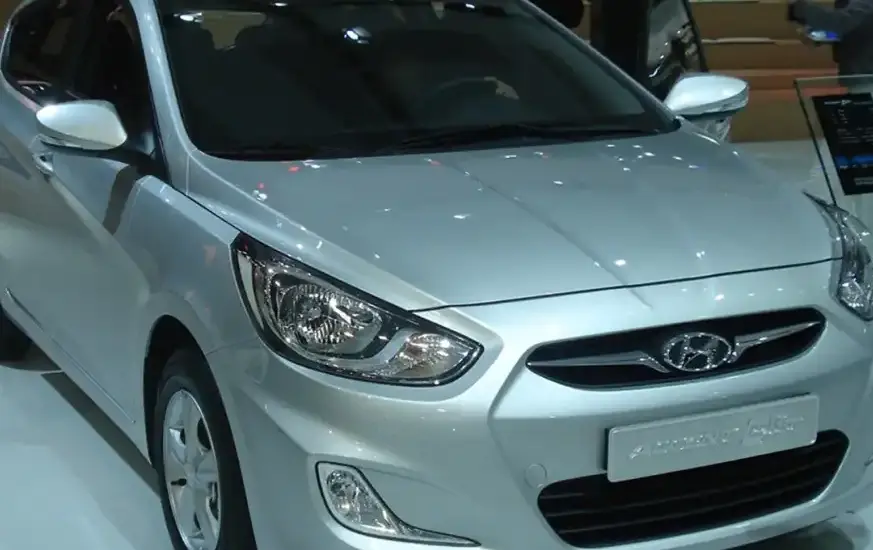
The Hyundai Solaris I Sedan (facelift 2014) 1.4 MPI with 107 horsepower and an automatic transmission represents a significant iteration of Hyundai’s entry-level compact sedan, primarily targeted at the Russian and Eastern European markets. Introduced as part of the Solaris’s first generation (launched in 2010), the 2014 facelift brought updated styling and minor mechanical refinements. This particular variant, combining a 1.4-liter engine with a four-speed automatic, was positioned as a comfortable and accessible option for buyers prioritizing ease of use over outright performance. Production of this specific configuration ran from 2014 to 2016, playing a key role in establishing Hyundai as a major player in the affordable sedan segment.
Technical Specifications
| Brand | Hyundai |
| Model | Solaris |
| Generation | Solaris I Sedan (facelift 2014) |
| Type (Engine) | 1.4 MPI (107 Hp) Automatic |
| Start of production | 2014 |
| End of production | 2016 |
| Powertrain Architecture | Internal Combustion engine |
| Body type | Sedan |
| Seats | 5 |
| Doors | 4 |
| Fuel consumption (urban) | 8.5 l/100 km (27.7 US mpg) |
| Fuel consumption (extra urban) | 5.2 l/100 km (45.2 US mpg) |
| Fuel consumption (combined) | 6.4 l/100 km (36.8 US mpg) |
| Fuel Type | Petrol (Gasoline) |
| Acceleration 0 – 100 km/h | 13.2 sec |
| Acceleration 0 – 62 mph | 13.2 sec |
| Acceleration 0 – 60 mph | 12.5 sec |
| Maximum speed | 170 km/h (105.63 mph) |
| Emission standard | Euro 4 |
| Weight-to-power ratio | 11.4 kg/Hp |
| Weight-to-torque ratio | 9 kg/Nm |
| Power | 107 Hp @ 6300 rpm |
| Torque | 135 Nm @ 5000 rpm (99.57 lb.-ft. @ 5000 rpm) |
| Engine layout | Front, Transverse |
| Engine displacement | 1396 cm3 (85.19 cu. in.) |
| Number of cylinders | 4 |
| Engine configuration | Inline |
| Number of valves per cylinder | 4 |
| Fuel injection system | Multi-port manifold injection |
| Engine aspiration | Naturally aspirated |
| Engine oil capacity | 3.6 l (3.8 US qt | 3.17 UK qt) |
| Coolant capacity | 6.8 l (7.19 US qt | 5.98 UK qt) |
| Kerb Weight | 1220 kg (2689.64 lbs.) |
| Max. weight | 1565 kg (3450.23 lbs.) |
| Max load | 345 kg (760.59 lbs.) |
| Trunk (boot) space | 470 l (16.6 cu. ft.) |
| Fuel tank capacity | 43 l (11.36 US gal | 9.46 UK gal) |
| Permitted trailer load (braked) | 800 kg (1763.7 lbs.) |
| Permitted trailer load (unbraked) | 450 kg (992.08 lbs.) |
| Length | 4375 mm (172.24 in.) |
| Width | 1700 mm (66.93 in.) |
| Height | 1470 mm (57.87 in.) |
| Wheelbase | 2570 mm (101.18 in.) |
| Front track | 1495 mm (58.86 in.) |
| Rear track | 1502 mm (59.13 in.) |
| Ride height | 160 mm (6.3 in.) |
| Turning circle | 10.4 m (34.12 ft.) |
| Drivetrain | Front wheel drive |
| Number of gears | 4 |
| Gearbox type | Automatic transmission |
| Front suspension | Independent, McPherson with coil spring and anti-roll bar |
| Rear suspension | Semi-independent, coil spring |
| Front brakes | Ventilated discs |
| Rear brakes | Disc |
| Assisting systems | ABS (Anti-lock braking system) |
| Steering type | Steering rack and pinion |
| Tire size | 185/65 R15; 195/55 R16 |
| Wheel rim size | 6.0J x 15; 6.0J x 16 |
Powertrain & Engine Architecture
The heart of this Solaris variant is the Hyundai G4FA 1.4-liter inline-four cylinder engine. This engine, a member of Hyundai’s Gamma family, utilizes a multi-point fuel injection system and a single overhead camshaft (SOHC) valvetrain with four valves per cylinder. The engine’s design prioritizes fuel efficiency and reliability over high-performance output. The 107 horsepower peak is achieved at 6300 rpm, while the 135 Nm (99.57 lb-ft) of torque is delivered at 5000 rpm. Paired with this engine is a four-speed automatic transmission. This transmission, while providing convenient shift operation, is a relatively older design compared to the continuously variable transmissions (CVTs) or six-speed automatics becoming common in newer vehicles. The four-speed unit’s gear ratios are tuned for fuel economy and smooth, if not particularly brisk, acceleration.
Driving Characteristics
The Solaris 1.4 Automatic delivers a comfortable, but uninspiring, driving experience. Acceleration is adequate for city driving and highway merging, but the 13.2-second 0-100 km/h (0-62 mph) time reflects its modest power output. The four-speed automatic transmission contributes to a noticeable lack of urgency during acceleration, with the engine often needing to downshift to maintain momentum. Compared to the available manual transmission or the more powerful 1.6-liter engine options, the 1.4 Automatic feels noticeably slower. However, the automatic transmission provides a smooth and effortless driving experience, making it well-suited for drivers prioritizing convenience over performance. The suspension is tuned for comfort, absorbing bumps and imperfections in the road reasonably well.
Equipment & Trim Levels
The 1.4 MPI Automatic Solaris typically came equipped with a base level of features, reflecting its position as an entry-level trim. Standard equipment generally included air conditioning, power windows, central locking, and a basic audio system with USB connectivity. Safety features such as ABS and dual front airbags were also standard. Higher trim levels offered upgrades like alloy wheels, a more sophisticated audio system, a trip computer, and fog lights. Interior upholstery was typically cloth, with a relatively simple dashboard layout. Optional extras included a rear parking sensor and a sunroof.
Chassis & Braking
The Solaris I Sedan utilizes a front-wheel-drive layout with an independent McPherson strut suspension in the front and a semi-independent coil spring suspension in the rear. The front suspension incorporates an anti-roll bar to reduce body roll during cornering. Braking duties are handled by ventilated discs in the front and solid discs in the rear. The braking system is assisted by ABS (Anti-lock Braking System), providing enhanced stopping power and stability during emergency braking. The chassis is designed to provide a balance between comfort and handling, prioritizing ride quality over sporty dynamics.
Market Reception & Comparison
The Hyundai Solaris, and specifically the 1.4 Automatic variant, was well-received in its target markets. Critics praised its affordability, fuel efficiency, and comfortable ride. However, the engine’s lack of power and the dated four-speed automatic transmission were common criticisms. Compared to the 1.6-liter engine options, the 1.4 Automatic offered lower running costs but significantly reduced performance. The 1.6L manual was often favored by drivers seeking a more engaging driving experience. In terms of reliability, the Solaris proved to be a generally dependable vehicle, with relatively few reported mechanical issues. Fuel economy figures of around 6.4 l/100 km (36.8 US mpg) were competitive for its class.
Legacy
The Hyundai Solaris I Sedan 1.4 MPI Automatic has established itself as a popular and affordable used car option. Its simple mechanical design and relatively robust engine contribute to its long-term reliability. While the four-speed automatic transmission may not be as refined as more modern units, it is generally dependable. Today, these vehicles can be found at very attractive price points, making them a practical choice for budget-conscious buyers. The Solaris played a crucial role in Hyundai’s success in the Russian and Eastern European markets, demonstrating the brand’s ability to deliver affordable and reliable transportation.