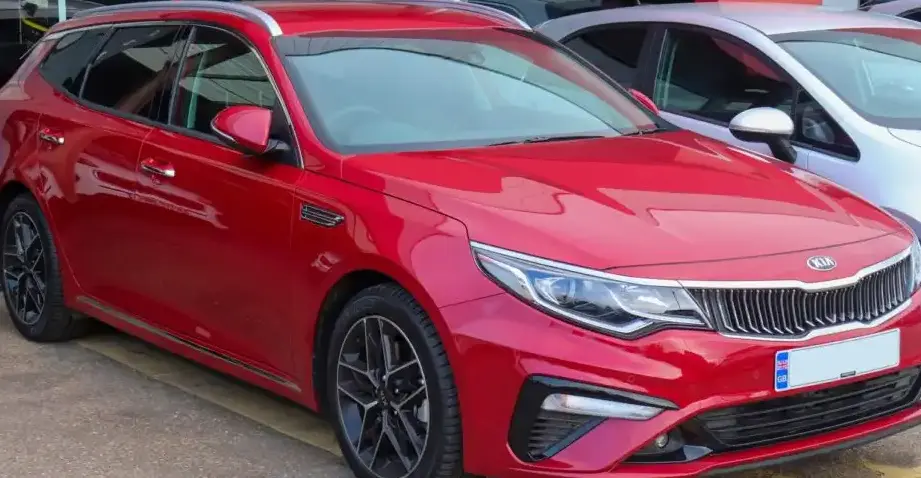
Technical Specifications
| Brand | Kia |
| Model | Optima |
| Generation | Optima IV Sportswagon (facelift 2018) |
| Type (Engine) | 1.6 CRDi (136 Hp) DCT |
| Start of production | 2018 |
| End of production | 2020 |
| Powertrain Architecture | Internal Combustion engine |
| Body type | Station wagon (estate) |
| Seats | 5 |
| Doors | 5 |
| Fuel consumption (urban) | 4.7-5.2 l/100 km (50 – 45.2 US mpg, 60.1 – 54.3 UK mpg, 21.3 – 19.2 km/l) |
| Fuel consumption (extra urban) | 4.0-4.4 l/100 km (58.8 – 53.5 US mpg, 70.6 – 64.2 UK mpg, 25 – 22.7 km/l) |
| Fuel consumption (combined) | 4.3-4.7 l/100 km (54.7 – 50 US mpg, 65.7 – 60.1 UK mpg, 23.3 – 21.3 km/l) |
| CO2 emissions | 112-123 g/km |
| Fuel Type | Diesel |
| Acceleration 0 – 100 km/h | 11.8 sec |
| Acceleration 0 – 62 mph | 11.8 sec |
| Acceleration 0 – 60 mph | 11.2 sec |
| Maximum speed | 193 km/h (119.92 mph) |
| Emission standard | Euro 6d – TEMP |
| Weight-to-power ratio | 11.5 kg/Hp, 87.2 Hp/tonne |
| Weight-to-torque ratio | 4.9 kg/Nm, 205.1 Nm/tonne |
| Power | 136 Hp @ 4000 rpm |
| Power per litre | 85.1 Hp/l |
| Torque | 320 Nm @ 2000-2250 rpm (236.02 lb.-ft. @ 2000-2250 rpm) |
| Engine layout | Front, Transverse |
| Engine Model/Code | D4FE |
| Engine displacement | 1598 cm3 (97.52 cu. in.) |
| Number of cylinders | 4 |
| Engine configuration | Inline |
| Cylinder Bore | 77 mm (3.03 in.) |
| Piston Stroke | 85.8 mm (3.38 in.) |
| Compression ratio | 15.9:1 |
| Number of valves per cylinder | 4 |
| Fuel injection system | Diesel Commonrail |
| Engine aspiration | Turbocharger, Intercooler |
| Engine oil capacity | 4.4 l (4.65 US qt | 3.87 UK qt) |
| Coolant capacity | 6.9 l (7.29 US qt | 6.07 UK qt) |
| Kerb Weight | 1560-1695 kg (3439.21 – 3736.84 lbs.) |
| Max. weight | 2150 kg (4739.94 lbs.) |
| Max load | 455-590 kg (1003.1 – 1300.73 lbs.) |
| Trunk (boot) space – minimum | 552 l (19.49 cu. ft.) |
| Trunk (boot) space – maximum | 1686 l (59.54 cu. ft.) |
| Fuel tank capacity | 70 l (18.49 US gal | 15.4 UK gal) |
| Max. roof load | 100 kg (220.46 lbs.) |
| Permitted trailer load with brakes (12%) | 1500 kg (3306.93 lbs.) |
| Permitted trailer load without brakes | 750 kg (1653.47 lbs.) |
| Permitted towbar download | 80 kg (176.37 lbs.) |
| Length | 4855 mm (191.14 in.) |
| Width | 1860 mm (73.23 in.) |
| Width including mirrors | 2120 mm (83.46 in.) |
| Height | 1470 mm (57.87 in.) |
| Wheelbase | 2805 mm (110.43 in.) |
| Front track | 1597-1607 mm (62.87 – 63.27 in.) |
| Rear (Back) track | 1604-1614 mm (63.15 – 63.54 in.) |
| Front overhang | 965 mm (37.99 in.) |
| Rear overhang | 1085 mm (42.72 in.) |
| Ride height (ground clearance) | 135 mm (5.31 in.) |
| Minimum turning circle (turning diameter) | 10.9 m (35.76 ft.) |
| Drivetrain Architecture | The Internal combustion engine (ICE) drives the front wheels of the vehicle. |
| Drive wheel | Front wheel drive |
| Number of gears and type of gearbox | 7 gears, automatic transmission DCT |
| Front suspension | Independent type McPherson |
| Rear suspension | Independent multi-link suspension |
| Front brakes | Ventilated discs |
| Rear brakes | Disc |
| Assisting systems | ABS (Anti-lock braking system) |
| Steering type | Steering rack and pinion |
| Power steering | Electric Steering |
| Tires size | 215/60 R16; 215/55 R17; 235/45 ZR18 |
| Wheel rims size | 6.5J x 16; 7.5J x 17; 7.5 x 18 |
The Kia Optima IV Sportswagon, particularly the 1.6 CRDi DCT variant, was designed to appeal to European buyers seeking a practical and fuel-efficient estate car. The facelifted model, launched in 2018, brought updated styling and minor mechanical revisions to the already well-received fourth-generation Optima. This specific engine and transmission combination was positioned as a strong all-rounder, offering a compromise between performance and economy. Built on the PF platform (also known as the 1HX0), the Sportswagon aimed to compete with established players like the Ford Mondeo Estate, Volkswagen Passat Variant, and Skoda Superb Estate.
Powertrain & Engine Architecture
At the heart of this Optima variant lies the Kia-developed 1.6-liter four-cylinder diesel engine, designated D4FE. This engine utilizes a common-rail direct injection system, delivering fuel at extremely high pressure for optimized combustion. The engine benefits from a turbocharger with an intercooler, boosting power output and improving torque delivery. The engine produces 136 horsepower at 4,000 rpm and a substantial 320 Nm (236 lb-ft) of torque between 2,000 and 2,250 rpm. The engine features a cast iron block and aluminum cylinder head, contributing to its durability. Paired with this engine is a 7-speed Dual Clutch Transmission (DCT). This DCT provides quick and smooth gear changes, enhancing both performance and fuel efficiency compared to a traditional automatic transmission. The DCT’s programming prioritizes fuel economy in normal driving conditions, but allows for quicker shifts in sport mode.
Driving Characteristics
The 1.6 CRDi DCT Optima Sportswagon delivers a comfortable and refined driving experience. While not overtly sporty, the engine provides adequate power for everyday driving and highway cruising. The DCT transmission contributes to responsive acceleration, although some drivers may notice a slight hesitation at low speeds. The 0-60 mph acceleration time of around 11.2 seconds is respectable for a diesel estate. The gear ratios are tuned for fuel efficiency, with higher gears engaged at lower speeds to minimize engine revs. Compared to the more powerful gasoline versions of the Optima, this diesel variant offers less outright performance, but significantly better fuel economy. Against other diesel Optima models, like the 1.7 CRDi, the 1.6 CRDi provides a noticeable increase in power and torque, resulting in a more relaxed driving experience, especially when fully loaded.
Equipment & Trim Levels
The 1.6 CRDi DCT Optima Sportswagon typically came well-equipped, even in base trim levels. Standard features often included air conditioning, a touchscreen infotainment system with Apple CarPlay and Android Auto compatibility, Bluetooth connectivity, and a suite of safety features such as ABS, ESC, and multiple airbags. Higher trim levels added features like leather upholstery, heated front seats, a panoramic sunroof, and advanced driver-assistance systems (ADAS) such as lane departure warning, automatic emergency braking, and adaptive cruise control. Interior upholstery was typically cloth on lower trims, with leather options available on higher-spec models. Dashboard configuration was consistent across the range, featuring a modern and user-friendly design.
Chassis & Braking
The Optima Sportswagon utilizes an independent McPherson strut suspension at the front and an independent multi-link suspension at the rear, providing a comfortable ride and good handling characteristics. Stabilizer bars are fitted to both axles to reduce body roll during cornering. Braking duties are handled by ventilated discs at the front and solid discs at the rear. ABS (Anti-lock Braking System) is standard, ensuring safe and controlled braking in emergency situations. The suspension setup is tuned to prioritize comfort, making it well-suited for long-distance journeys. The steering is electrically assisted, providing a light and precise feel.
Market Reception & Comparison
The Kia Optima IV Sportswagon 1.6 CRDi DCT was generally well-received by automotive critics. It was praised for its spacious interior, comfortable ride, and competitive fuel economy. Critics noted that while the engine wasn’t the most powerful in its class, it provided sufficient performance for most drivers. Compared to rivals like the Ford Mondeo Estate and Volkswagen Passat Variant, the Optima offered a strong value proposition, with a generous level of standard equipment and a competitive price point. The 1.6 CRDi engine offered a good balance between fuel efficiency and performance, making it a popular choice for those covering long distances. Reliability reports suggest that the D4FE engine and DCT transmission are generally reliable, although regular maintenance is crucial.
Legacy
The Kia Optima IV Sportswagon 1.6 CRDi DCT has established itself as a reliable and practical used car option. The D4FE engine, when properly maintained, is known for its longevity. The DCT transmission, while requiring occasional servicing, has proven to be durable. In the used car market, these Optima Sportswagons represent good value for money, offering a spacious interior, comfortable ride, and reasonable running costs. The combination of a diesel engine and estate body style continues to appeal to buyers seeking a versatile and fuel-efficient vehicle.