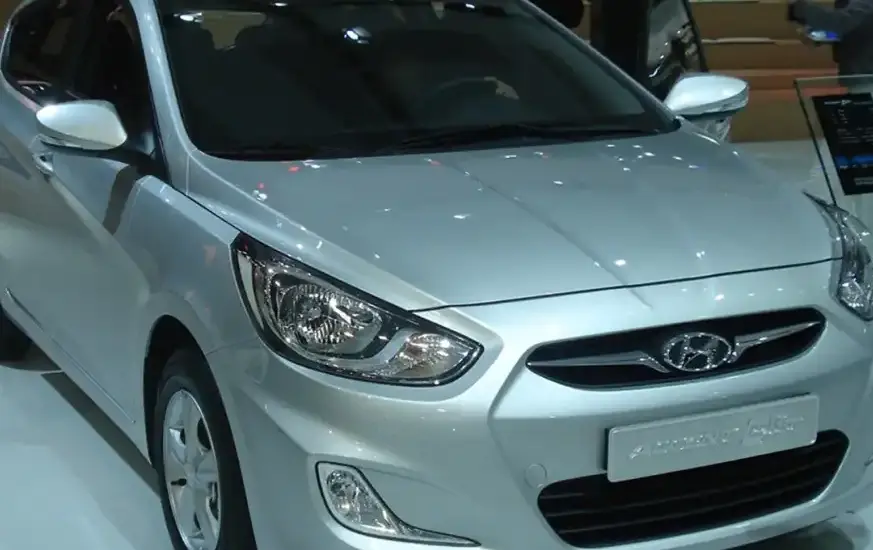
The Hyundai Solaris I Sedan (facelifted in 2014) with the 1.6-liter MPI engine producing 123 horsepower and paired with a six-speed automatic transmission represents a significant offering in the compact sedan segment, particularly within the Russian and Eastern European markets. Introduced as a replacement for the Accent in many regions, the Solaris was designed specifically to appeal to buyers seeking a reliable, affordable, and relatively modern vehicle. Production of this specific configuration ran from 2014 to 2016, falling within the broader Solaris I generation (2010-2017). This variant occupied a mid-range position within the Solaris lineup, offering a balance between fuel efficiency, ease of use, and a more comfortable driving experience compared to the base manual transmission models.
Technical Specifications
| Brand | Hyundai |
| Model | Solaris |
| Generation | Solaris I Sedan (facelift 2014) |
| Type (Engine) | 1.6 MPI (123 Hp) Automatic |
| Start of production | 2014 |
| End of production | 2016 |
| Powertrain Architecture | Internal Combustion engine |
| Body type | Sedan |
| Seats | 5 |
| Doors | 4 |
| Fuel consumption (urban) | 8.8 l/100 km (26.7 US mpg) |
| Fuel consumption (extra urban) | 5.2 l/100 km (45.2 US mpg) |
| Fuel consumption (combined) | 6.5 l/100 km (36.2 US mpg) |
| Fuel Type | Petrol (Gasoline) |
| Acceleration 0 – 100 km/h | 11.2 sec |
| Acceleration 0 – 62 mph | 11.2 sec |
| Acceleration 0 – 60 mph | 10.6 sec |
| Maximum speed | 185 km/h (114.95 mph) |
| Emission standard | Euro 4 |
| Weight-to-power ratio | 10 kg/Hp |
| Weight-to-torque ratio | 7.9 kg/Nm |
| Power | 123 Hp @ 6300 rpm |
| Torque | 155 Nm @ 4200 rpm (114.32 lb.-ft. @ 4200 rpm) |
| Engine layout | Front, Transverse |
| Engine displacement | 1591 cm3 (97.09 cu. in.) |
| Number of cylinders | 4 |
| Engine configuration | Inline |
| Number of valves per cylinder | 4 |
| Fuel injection system | Multi-port manifold injection |
| Engine aspiration | Naturally aspirated engine |
| Engine oil capacity | 3.6 l (3.8 US qt | 3.17 UK qt) |
| Coolant capacity | 7.3 l (7.71 US qt | 6.42 UK qt) |
| Kerb Weight | 1226 kg (2702.87 lbs.) |
| Max. weight | 1565 kg (3450.23 lbs.) |
| Max load | 339 kg (747.37 lbs.) |
| Trunk (boot) space – minimum | 470 l (16.6 cu. ft.) |
| Fuel tank capacity | 43 l (11.36 US gal | 9.46 UK gal) |
| Permitted trailer load with brakes (12%) | 800 kg (1763.7 lbs.) |
| Permitted trailer load without brakes | 450 kg (992.08 lbs.) |
| Length | 4375 mm (172.24 in.) |
| Width | 1700 mm (66.93 in.) |
| Height | 1470 mm (57.87 in.) |
| Wheelbase | 2570 mm (101.18 in.) |
| Front track | 1495 mm (58.86 in.) |
| Rear (Back) track | 1502 mm (59.13 in.) |
| Ride height (ground clearance) | 160 mm (6.3 in.) |
| Minimum turning circle (turning diameter) | 10.4 m (34.12 ft.) |
| Drivetrain Architecture | Front wheel drive |
| Number of gears and type of gearbox | 6 gears, automatic transmission |
| Front suspension | Independent, type McPherson with coil spring and anti-roll bar |
| Rear suspension | Semi-independent, coil spring |
| Front brakes | Ventilated discs |
| Rear brakes | Disc |
| Assisting systems | ABS (Anti-lock braking system) |
| Steering type | Steering rack and pinion |
| Tires size | 185/65 R15; 195/55 R16 |
| Wheel rims size | 6.0J x 15; 6.0J x 16 |
Powertrain & Engine Architecture
The heart of this Solaris variant is the Hyundai G4FG 1.6-liter inline-four cylinder engine. This engine utilizes a multi-point fuel injection system, a relatively simple and reliable setup for the time. The G4FG engine is a naturally aspirated design, meaning it doesn’t employ turbocharging or supercharging. Its aluminum cylinder head features dual overhead camshafts (DOHC) and four valves per cylinder, contributing to reasonable power output for its displacement. The engine’s 123 horsepower and 155 Nm (114 lb-ft) of torque are delivered at 6300 rpm and 4200 rpm respectively. Paired with this engine is a six-speed automatic transmission. This transmission, while offering convenience, wasn’t known for particularly rapid shifts or sporty performance. It prioritized smooth operation and fuel efficiency. The transmission’s gear ratios were tuned for everyday driving, emphasizing acceleration in the lower gears and comfortable cruising at highway speeds.
Driving Characteristics
The 1.6L automatic Solaris delivers a comfortable, if not particularly exhilarating, driving experience. Acceleration from 0-60 mph takes around 10.6 seconds, making it adequate for city driving and merging onto highways, but not a performance-oriented vehicle. The automatic transmission contributes to a smooth ride, but can feel somewhat sluggish when downshifting or attempting quick acceleration. Compared to the manual transmission versions of the Solaris, the automatic sacrifices some responsiveness. The higher-output 1.6L variants, though not significantly more powerful, felt more eager due to the direct connection of a manual gearbox. The suspension is tuned for comfort, absorbing bumps and imperfections in the road reasonably well. However, this comes at the expense of sharp handling; the Solaris isn’t a car designed for spirited cornering.
Equipment & Trim Levels
The 1.6 MPI Automatic Solaris typically came equipped with standard features such as air conditioning, power windows, power door locks, and a basic audio system with USB connectivity. Higher trim levels added features like alloy wheels, fog lights, a more advanced audio system, and sometimes a rear parking sensor. Interior upholstery was typically cloth, with options for upgraded materials on higher trims. The dashboard layout was functional and straightforward, prioritizing ease of use over aesthetic flair. Optional extras included a sunroof, leather upholstery, and a navigation system, depending on the specific market and trim level.
Chassis & Braking
The Solaris I Sedan utilizes a McPherson strut front suspension and a semi-independent coil spring rear suspension. This setup provides a good balance between ride comfort and handling. Front brakes are ventilated discs, offering adequate stopping power, while rear brakes are solid discs. ABS (Anti-lock Braking System) was standard equipment. The steering is a rack and pinion system, providing reasonable precision and feedback. The relatively lightweight construction of the Solaris (around 1226 kg or 2703 lbs) helps to offset the modest power output, contributing to acceptable performance.
Market Reception & Comparison
The Hyundai Solaris was generally well-received by critics and consumers alike, particularly in its target markets. It was praised for its affordability, reliability, and relatively modern features. The 1.6L automatic variant was seen as a good all-rounder, offering a comfortable and convenient driving experience. Fuel economy was a strong point, with combined fuel consumption figures around 6.5 l/100 km (36.2 US mpg). Compared to other trims, the automatic version was more expensive but offered greater convenience. The manual transmission versions were more fuel-efficient and slightly more engaging to drive, while higher-output engine options provided more performance but at a higher price point.
Legacy
The Hyundai Solaris I Sedan, particularly the 1.6 MPI Automatic variant, has proven to be a reliable and durable vehicle. Used examples are still relatively common on the market today, and are often sought after by buyers looking for an affordable and dependable compact sedan. The G4FG engine is known for its longevity, and the six-speed automatic transmission, while not the most sophisticated, has generally proven to be reliable with proper maintenance. The Solaris played a crucial role in establishing Hyundai as a major player in the compact car segment, and its success paved the way for subsequent generations of the model.