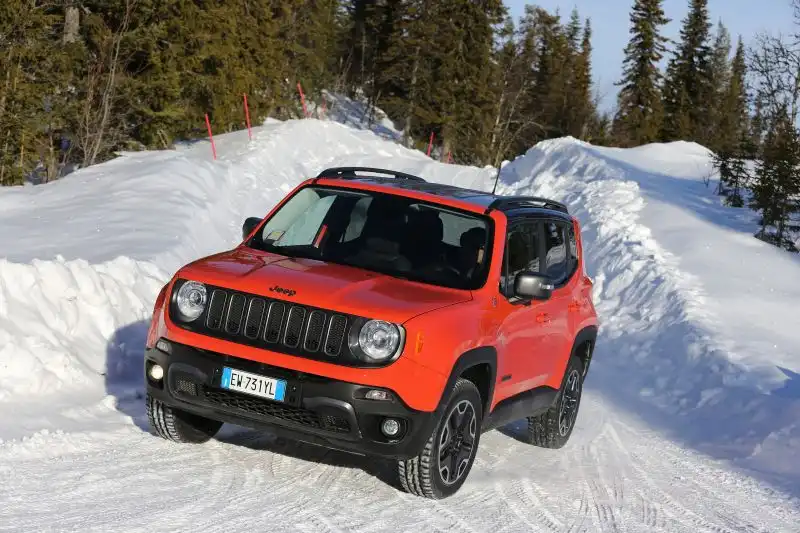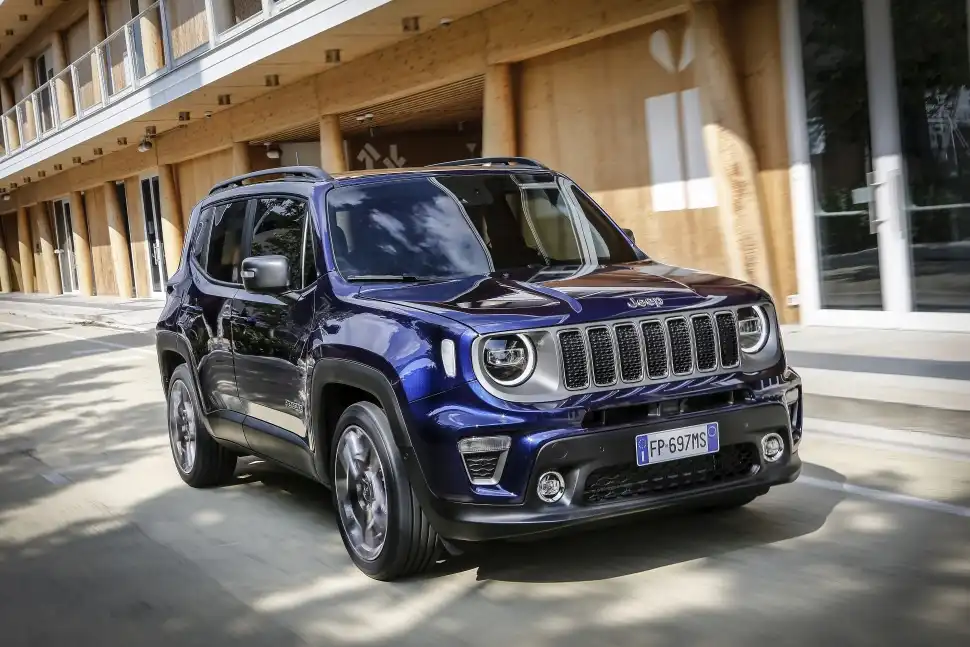
The Jeep Renegade, specifically the facelifted version introduced in August 2018, represented a significant step in Jeep’s expansion into the subcompact SUV segment. The 2.0 Multijet (140 hp) 4×4 Automatic variant, produced through July 2020, was positioned as a mid-range offering, balancing fuel efficiency, all-weather capability, and a more relaxed driving experience compared to its lower-powered or manual transmission siblings. This model played a key role in attracting European buyers seeking a stylish and capable small SUV with the added security of four-wheel drive.
Technical Specifications
| Brand | Jeep |
| Model | Renegade |
| Generation | Renegade (facelift 2018) |
| Type (Engine) | 2.0 Multijet (140 Hp) 4×4 Automatic |
| Start of production | August, 2018 |
| End of production | July, 2020 |
| Powertrain Architecture | Internal Combustion engine |
| Body type | SUV, Crossover |
| Seats | 5 |
| Doors | 5 |
| Fuel consumption (combined) | 6.2-6.4 l/100 km (37.9 – 36.8 US mpg, 45.6 – 44.1 UK mpg, 16.1 – 15.6 km/l) |
| CO2 emissions | 164-167 g/km |
| Fuel Type | Diesel |
| Acceleration 0 – 100 km/h | 10.2 sec |
| Acceleration 0 – 62 mph | 10.2 sec |
| Acceleration 0 – 60 mph | 9.7 sec |
| Maximum speed | 182 km/h (113.09 mph) |
| Emission standard | Euro 6 d |
| Weight-to-power ratio | 11 kg/Hp, 90.9 Hp/tonne |
| Weight-to-torque ratio | 4.4 kg/Nm, 227.3 Nm/tonne |
| Power | 140 Hp @ 3750 rpm |
| Power per litre | 71.6 Hp/l |
| Torque | 350 Nm @ 1750 rpm (258.15 lb.-ft. @ 1750 rpm) |
| Engine layout | Front, Transverse |
| Engine Model/Code | 55284064 |
| Engine displacement | 1956 cm3 (119.36 cu. in.) |
| Number of cylinders | 4 |
| Engine configuration | Inline |
| Cylinder Bore | 83 mm (3.27 in.) |
| Piston Stroke | 90.4 mm (3.56 in.) |
| Compression ratio | 16.5:1 |
| Number of valves per cylinder | 4 |
| Fuel injection system | Diesel Commonrail |
| Engine aspiration | Turbocharger, Intercooler |
| Engine oil capacity | 4.3 l (4.54 US qt | 3.78 UK qt) |
| Coolant | 6.5 l (6.87 US qt | 5.72 UK qt) |
| Kerb Weight | 1540 kg (3395.12 lbs.) |
| Trunk (boot) space – minimum | 351 l (12.4 cu. ft.) |
| Trunk (boot) space – maximum | 1297 l (45.8 cu. ft.) |
| Fuel tank capacity | 55 l (14.53 US gal | 12.1 UK gal) |
| Length | 4236 mm (166.77 in.) |
| Width | 1805 mm (71.06 in.) |
| Height | 1684 mm (66.3 in.) |
| Wheelbase | 2570 mm (101.18 in.) |
| Ride height (ground clearance) | 198 mm (7.8 in.) |
| Minimum turning circle | 11.0 m (36.09 ft.) |
| Drive wheel | All wheel drive (4×4) |
| Number of gears and type of gearbox | 9 gears, automatic transmission |
| Front brakes | Ventilated discs |
| Rear brakes | Ventilated discs |
INTRODUCTION
The 2018 facelift of the Jeep Renegade brought with it refinements to the exterior styling, interior materials, and available technology. The 2.0 Multijet 4×4 Automatic variant occupied a sweet spot in the lineup for buyers prioritizing fuel economy and all-weather capability. Built on the Small Wide architecture (shared with the Fiat 500X), the Renegade aimed to deliver Jeep’s renowned off-road DNA in a more accessible and urban-friendly package. This particular engine and transmission combination was primarily sold in the European market, where diesel engines and automatic transmissions were more popular than in the United States.
Powertrain & Engine Architecture
The heart of this Renegade variant is the 1.956-liter (119.36 cubic inches) four-cylinder diesel engine, designated with engine code 55284064. This engine belongs to the Multijet family, utilizing common-rail direct injection and a turbocharger with an intercooler to optimize power and efficiency. The Multijet technology allows for multiple injection events per combustion cycle, improving combustion efficiency and reducing noise. The engine produces 140 horsepower at 3750 rpm and a substantial 350 Nm (258 lb-ft) of torque at a low 1750 rpm. This torque output is a key characteristic of diesel engines, providing strong low-end pulling power. The engine features a compression ratio of 16.5:1 and 4 valves per cylinder. Paired with this engine is a ZF-sourced 9-speed automatic transmission. This transmission offers a wide range of gear ratios, contributing to both fuel efficiency and smooth acceleration. The 9-speed automatic was chosen for its ability to keep the engine operating in its optimal power band.
Driving Characteristics
The 2.0 Multijet Automatic Renegade delivers a comfortable and relaxed driving experience. While not a performance-oriented vehicle, the 350 Nm of torque provides ample power for everyday driving and highway merging. Acceleration from 0-60 mph takes approximately 9.7 seconds, and the top speed is 113 mph. The 9-speed automatic transmission shifts smoothly, although some drivers have noted occasional hesitation at lower speeds. The all-wheel-drive system provides enhanced traction in slippery conditions, making it a capable vehicle for inclement weather. Compared to the 1.6-liter gasoline versions, the 2.0 Multijet offers significantly more torque and better fuel economy. However, it lacks the responsiveness of the gasoline engines. Compared to the manual transmission versions of the 2.0 Multijet, the automatic offers greater convenience, especially in urban traffic, but may result in a slight decrease in fuel efficiency.
Equipment & Trim Levels
The 2.0 Multijet 4×4 Automatic Renegade typically came equipped with a reasonable level of standard features. These included air conditioning, power windows and locks, a touchscreen infotainment system with Bluetooth connectivity, and alloy wheels. Higher trim levels, such as the Limited or Trailhawk, added features like leather upholstery, heated seats, a navigation system, and advanced safety technologies like adaptive cruise control and lane departure warning. Optional extras included a panoramic sunroof, premium audio system, and various styling packages.
Chassis & Braking
The Renegade’s chassis features a MacPherson strut front suspension and a Chapman strut rear suspension. The suspension is tuned for comfort, providing a relatively smooth ride over uneven surfaces. The 4×4 system utilizes a rear axle disconnect, allowing the vehicle to operate in front-wheel drive mode when four-wheel drive is not needed, improving fuel efficiency. Braking duties are handled by ventilated discs on all four wheels, providing adequate stopping power. The Renegade is equipped with ABS (Anti-lock Braking System) and electronic stability control as standard safety features.
Market Reception & Comparison
The Jeep Renegade 2.0 Multijet 4×4 Automatic was generally well-received by automotive critics in Europe. It was praised for its stylish design, comfortable interior, and capable all-wheel-drive system. However, some critics noted that the engine could be somewhat noisy and that the automatic transmission occasionally felt hesitant. In terms of fuel economy, the 2.0 Multijet offered a significant advantage over the gasoline engines, achieving around 6.2-6.4 l/100 km (37.9-36.8 US mpg). Compared to other diesel-powered subcompact SUVs, such as the Nissan Juke dCi, the Renegade offered a more premium interior and a more refined driving experience.
Legacy
The 2.0 Multijet engine, in various iterations, has proven to be a reliable and durable powerplant. While diesel engines have faced increased scrutiny in recent years due to emissions concerns, the Renegade’s 2.0 Multijet engine, when properly maintained, is known for its longevity. On the used car market, these models hold their value reasonably well, particularly those with lower mileage and a full service history. The 9-speed automatic transmission has also proven to be generally reliable, although some owners have reported minor issues with software glitches. Overall, the Jeep Renegade 2.0 Multijet 4×4 Automatic remains a compelling option for buyers seeking a stylish, capable, and fuel-efficient subcompact SUV.