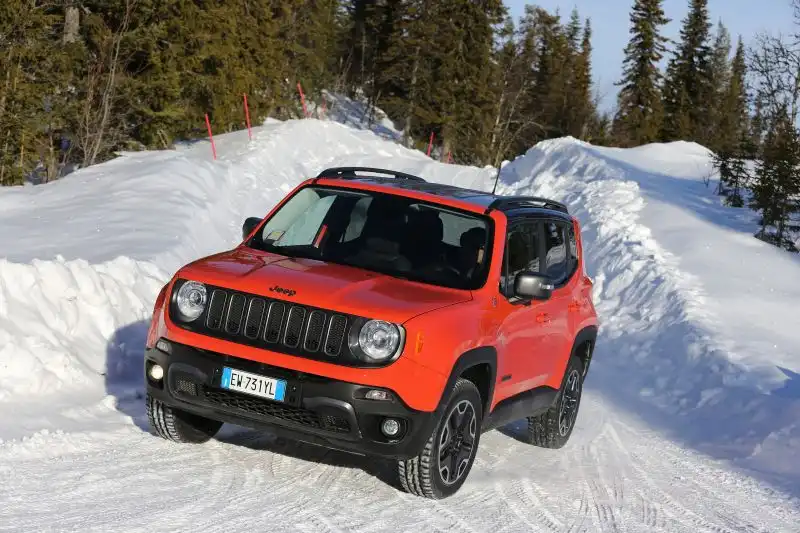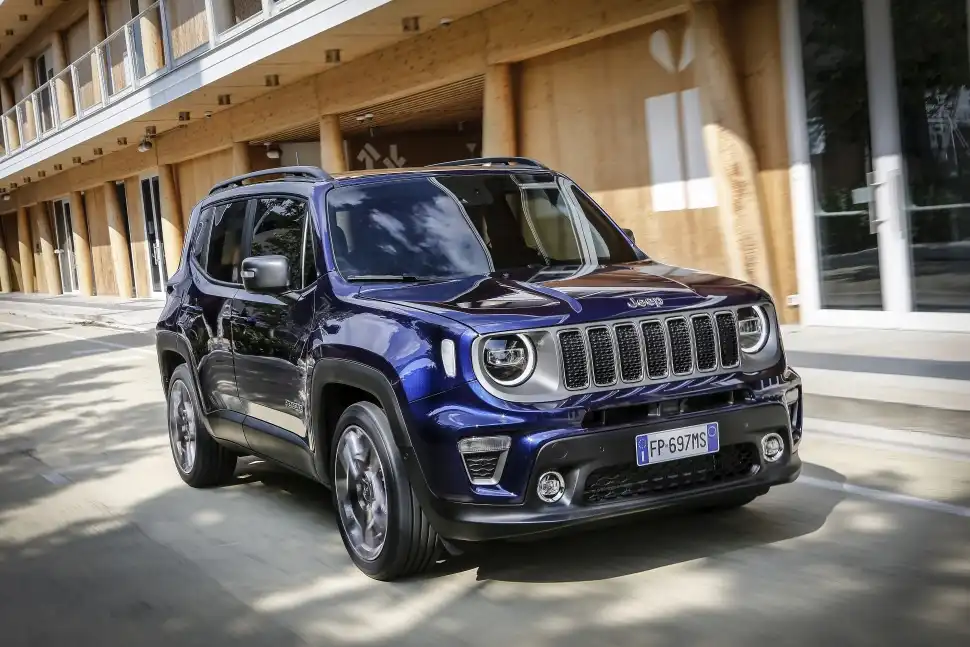
The Jeep Renegade, specifically the facelifted version introduced in August 2018, represented a significant step forward for the American brand in the highly competitive European subcompact SUV market. This variant, powered by a 2.0 Multijet diesel engine producing 170 horsepower and paired with a 9-speed automatic transmission and four-wheel drive, was offered through July 2020. It occupied a mid-to-upper position within the Renegade lineup, appealing to buyers seeking a blend of fuel efficiency, all-weather capability, and relative performance. The 2018 facelift brought styling updates, improved interior materials, and enhanced technology, solidifying the Renegade’s position as a distinctive offering in its segment.
Technical Specifications
| Brand | Jeep |
| Model | Renegade |
| Generation | Renegade (facelift 2018) |
| Type (Engine) | 2.0 Multijet (170 Hp) 4×4 Automatic |
| Start of production | August, 2018 |
| End of production | July, 2020 |
| Powertrain Architecture | Internal Combustion engine |
| Body type | SUV, Crossover |
| Seats | 5 |
| Doors | 5 |
| Fuel consumption (combined) | 6.6 l/100 km (35.6 US mpg, 42.8 UK mpg, 15.2 km/l) |
| CO2 emissions | 173 g/km |
| Fuel Type | Diesel |
| Acceleration 0 – 100 km/h | 8.9 sec |
| Acceleration 0 – 62 mph | 8.9 sec |
| Acceleration 0 – 60 mph | 8.5 sec |
| Maximum speed | 196 km/h (121.79 mph) |
| Emission standard | Euro 6 d |
| Weight-to-power ratio | 9.8 kg/Hp, 102.4 Hp/tonne |
| Weight-to-torque ratio | 4.7 kg/Nm, 210.8 Nm/tonne |
| Power | 170 Hp @ 3750 rpm |
| Power per litre | 86.9 Hp/l |
| Torque | 350 Nm @ 1750 rpm (258.15 lb.-ft. @ 1750 rpm) |
| Engine layout | Front, Transverse |
| Engine Model/Code | 55283099 |
| Engine displacement | 1956 cm3 (119.36 cu. in.) |
| Number of cylinders | 4 |
| Engine configuration | Inline |
| Cylinder Bore | 83 mm (3.27 in.) |
| Piston Stroke | 90.4 mm (3.56 in.) |
| Compression ratio | 16.5:1 |
| Number of valves per cylinder | 4 |
| Fuel injection system | Diesel Commonrail |
| Engine aspiration | Turbocharger, Intercooler |
| Engine oil capacity | 4.3 l (4.54 US qt | 3.78 UK qt) |
| Coolant | 6.5 l (6.87 US qt | 5.72 UK qt) |
| Kerb Weight | 1660 kg (3659.67 lbs.) |
| Trunk (boot) space – minimum | 351 l (12.4 cu. ft.) |
| Trunk (boot) space – maximum | 1297 l (45.8 cu. ft.) |
| Fuel tank capacity | 55 l (14.53 US gal | 12.1 UK gal) |
| Length | 4236 mm (166.77 in.) |
| Width | 1805 mm (71.06 in.) |
| Height | 1697 mm (66.81 in.) |
| Wheelbase | 2570 mm (101.18 in.) |
| Ride height (ground clearance) | 210 mm (8.27 in.) |
| Minimum turning circle | 11.0 m (36.09 ft.) |
| Drive wheel | All wheel drive (4×4) |
| Number of gears and type of gearbox | 9 gears, automatic transmission |
| Front brakes | Ventilated discs |
| Rear brakes | Ventilated discs |
Powertrain & Engine Architecture
The heart of this Renegade variant is the 2.0-liter Multijet diesel engine, identified by engine code 55283099. This engine is a four-cylinder, inline configuration, utilizing a common-rail direct injection system for optimized fuel delivery and combustion. A turbocharger with an intercooler is employed to boost power output and improve efficiency. The engine produces 170 horsepower at 3750 rpm and a substantial 350 Nm (258 lb-ft) of torque at a low 1750 rpm, providing ample pulling power for everyday driving and occasional off-road excursions. The 9-speed automatic transmission, sourced from ZF, is a key component of this powertrain. It offers a wide range of gear ratios designed to maximize fuel economy and provide smooth, responsive shifts. The transmission’s programming is tuned to work in harmony with the engine’s torque curve, ensuring optimal performance in various driving conditions.
Driving Characteristics
The 2.0 Multijet with the 9-speed automatic delivers a comfortable and capable driving experience. While not a performance-oriented setup, the engine’s torque provides brisk acceleration, achieving 0-60 mph in approximately 8.5 seconds. The automatic transmission generally shifts smoothly, although some drivers have noted occasional hesitancy at lower speeds. The 9-speed’s close ratios help keep the engine in its optimal power band, contributing to good in-gear acceleration. Compared to the lower-powered 1.6 Multijet versions, this 2.0L offers a noticeable improvement in performance, particularly when fully loaded or tackling inclines. It also feels more refined and less strained during highway cruising. Compared to the manual transmission options, the automatic sacrifices some driver engagement but provides greater convenience, especially in urban environments.
Equipment & Trim Levels
The 2.0 Multijet 4×4 Automatic Renegade typically came well-equipped, often positioned as a mid-range or upper-mid-range trim level. Standard features generally included air conditioning, a touchscreen infotainment system with Bluetooth connectivity, alloy wheels, and a suite of safety features such as ABS, electronic stability control, and multiple airbags. Higher trim levels added features like leather upholstery, heated front seats, a rearview camera, parking sensors, and advanced driver-assistance systems (ADAS) such as lane departure warning and automatic emergency braking. Optional extras included a panoramic sunroof, upgraded audio systems, and various cosmetic enhancements.
Chassis & Braking
The Renegade’s chassis is based on a modified version of the Fiat Small Wide architecture, shared with other compact Jeep and Fiat models. The suspension consists of MacPherson struts at the front and a multi-link setup at the rear, providing a comfortable ride quality. The four-wheel-drive system utilizes a rear axle disconnect, allowing the vehicle to operate in front-wheel drive under normal conditions to improve fuel efficiency. When traction is lost, the system automatically engages the rear axle. Braking duties are handled by ventilated discs on all four wheels, providing adequate stopping power. The steering is electrically assisted, offering a light and responsive feel.
Market Reception & Comparison
The 2.0 Multijet 4×4 Automatic Renegade received generally positive reviews from automotive critics. It was praised for its comfortable ride, capable four-wheel-drive system, and relatively fuel-efficient engine. However, some reviewers noted that the interior materials, while improved in the facelifted model, still didn’t quite match the quality of some competitors. Compared to other trims in the Renegade lineup, the 2.0L diesel offered a compelling balance of performance and economy. It was more expensive than the 1.6 Multijet versions but provided a significant power upgrade. Fuel economy was competitive with other diesel-powered subcompact SUVs, averaging around 35.6 US mpg in combined driving.
Legacy
The 2.0 Multijet engine, in various iterations, has proven to be a reliable and durable powerplant. The 9-speed automatic transmission, while occasionally exhibiting minor software glitches, has also demonstrated reasonable long-term reliability. On the used car market, the 2018-2020 Renegade 2.0 Multijet 4×4 Automatic holds its value reasonably well, particularly examples with low mileage and a full service history. Its combination of practicality, capability, and fuel efficiency continues to appeal to buyers seeking a versatile and affordable subcompact SUV. Regular maintenance, including timely oil changes and adherence to the manufacturer’s recommended service intervals, is crucial for ensuring the longevity of this powertrain.